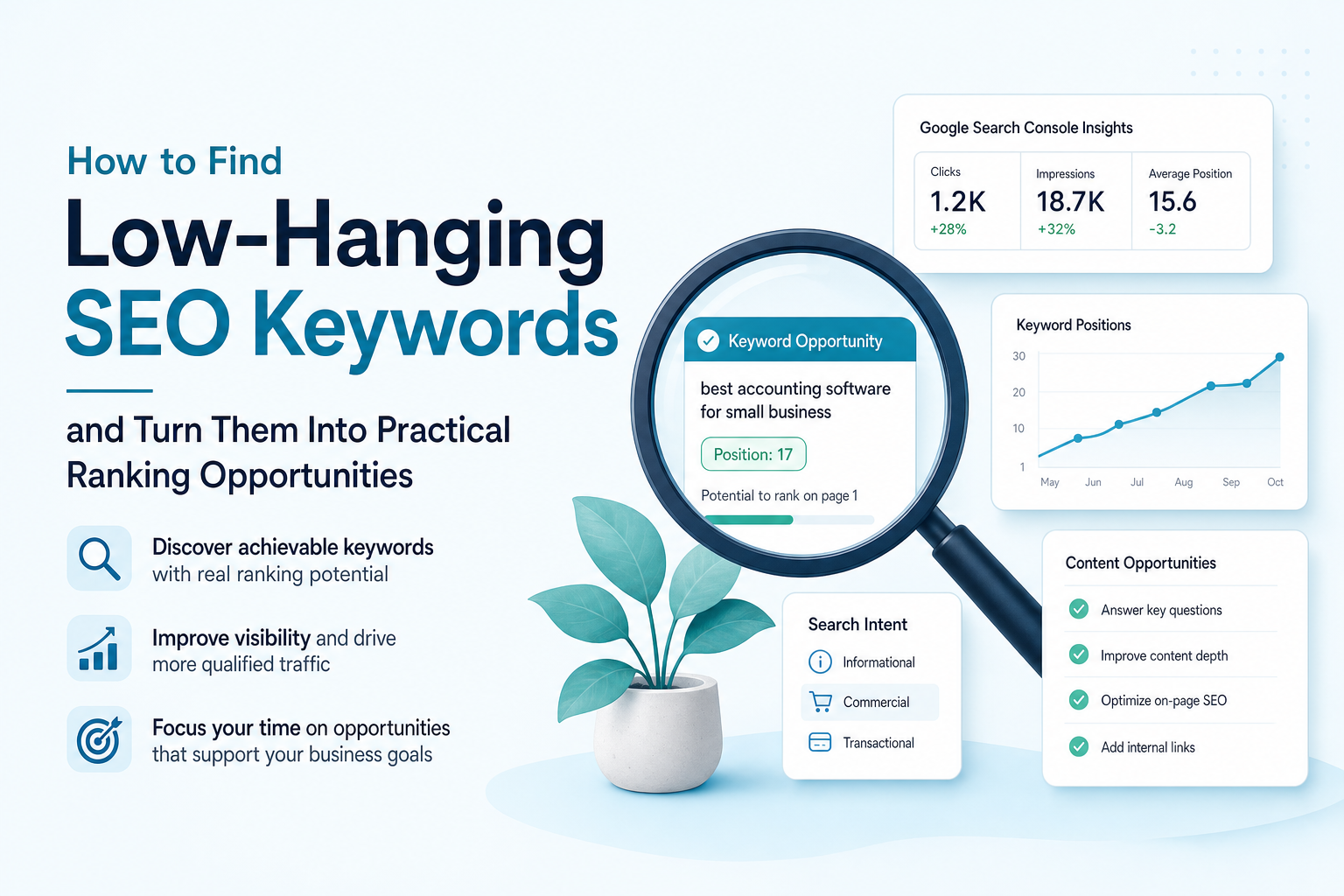
 You may already have valuable pages on your website, yet still feel unsure what to publish next. Broad terms such as “SEO,” “accounting software” or “web design” can attract large audiences, but they are often difficult for a small business to rank for. Meanwhile, your website may already be appearing for more specific searches that are much closer to page one.These overlooked opportunities are often called low-hanging SEO keywords. They are relevant search terms where your website has a realistic chance of improving its visibility without starting from zero. Learning how to find low hanging SEO keywords can help you focus limited time and budget on work that supports your services, customers and commercial goals.This guide explains what low-hanging SEO keywords are, why they matter, where to find them and how to decide which opportunities deserve attention first. It also shows how Google Search Console data, competitor research, search intent and semantic keyword mapping can work together to create a more useful SEO content plan.
What Are Low-Hanging SEO Keywords?
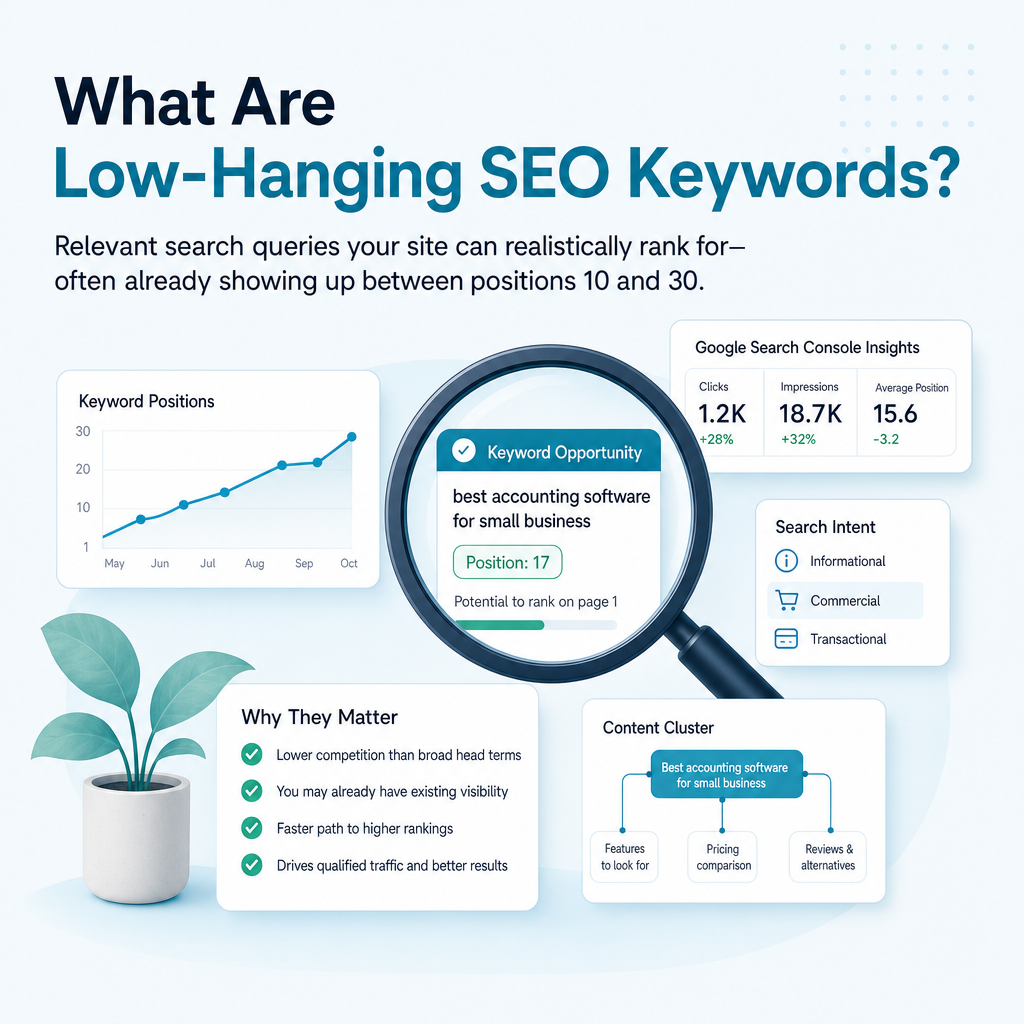
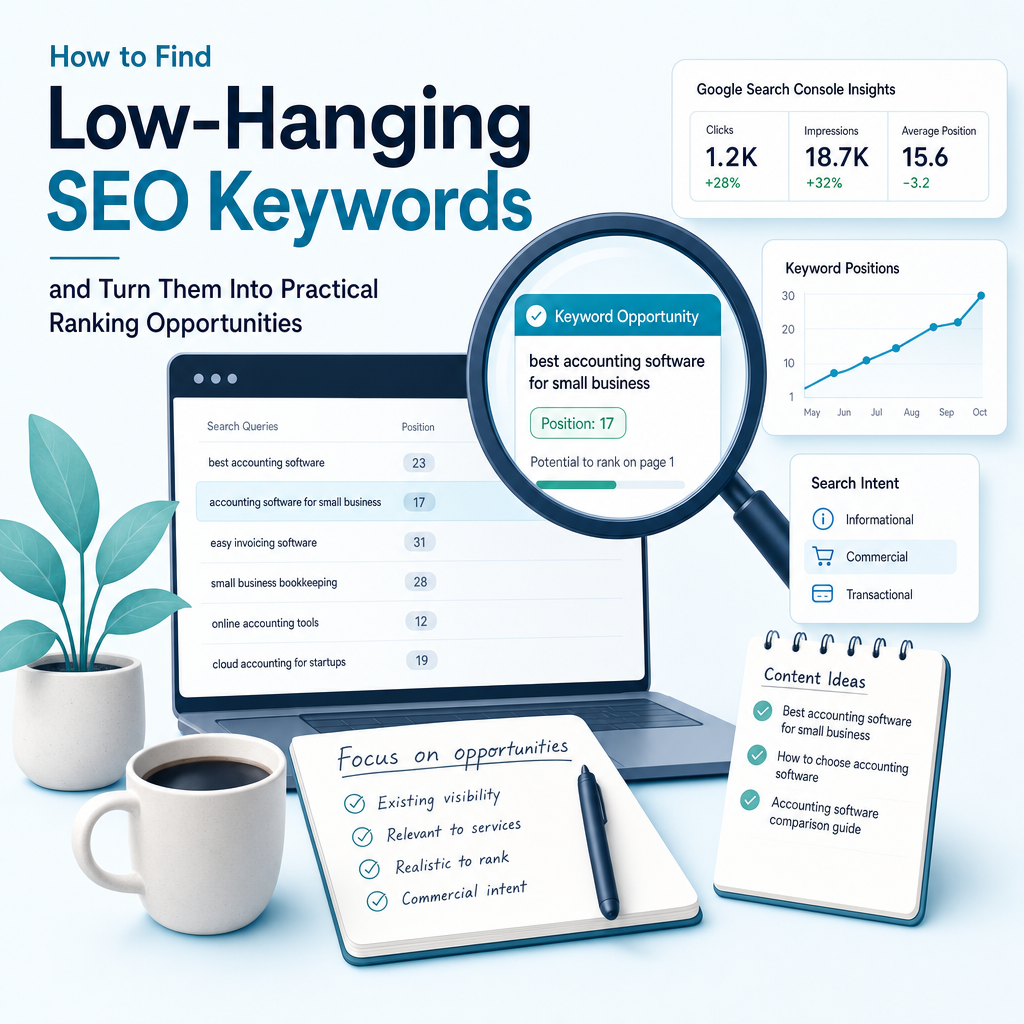
Low-hanging SEO keywords are relevant search queries that are comparatively attainable for your website. They may have lower competition than broad head terms, or your website may already have some visibility for them. In many cases, the page ranks somewhere between positions 10 and 30, meaning a focused improvement could move it closer to the first page.
The phrase does not mean that ranking is automatic. Search results depend on the quality and relevance of the content, the strength of competing pages, the authority of the website, technical performance and the searcher’s location. A low-hanging opportunity is a promising starting point, not a guaranteed outcome.
For example, a small UK-based accounting practice may find it difficult to rank for “accountant.” A more specific phrase such as “cloud accounting support for small businesses in Manchester” may be more relevant to its services, clearer in intent and less competitive. The narrower query may also attract visitors who are more likely to make an enquiry.
Typical Characteristics
- Existing visibility: Your website already receives impressions or ranks for the query.
- Relevant intent: The search relates directly to a product, service, audience or problem you address.
- Manageable competition: The current results include pages that a well-researched, useful page could compete with.
- Specific wording: Long-tail, local, question-based and use-case searches often provide clearer opportunities.
- Commercial value: The query can support awareness, consideration, enquiries, sign-ups or sales.
Why Low-Hanging Keywords Matter for Small Businesses
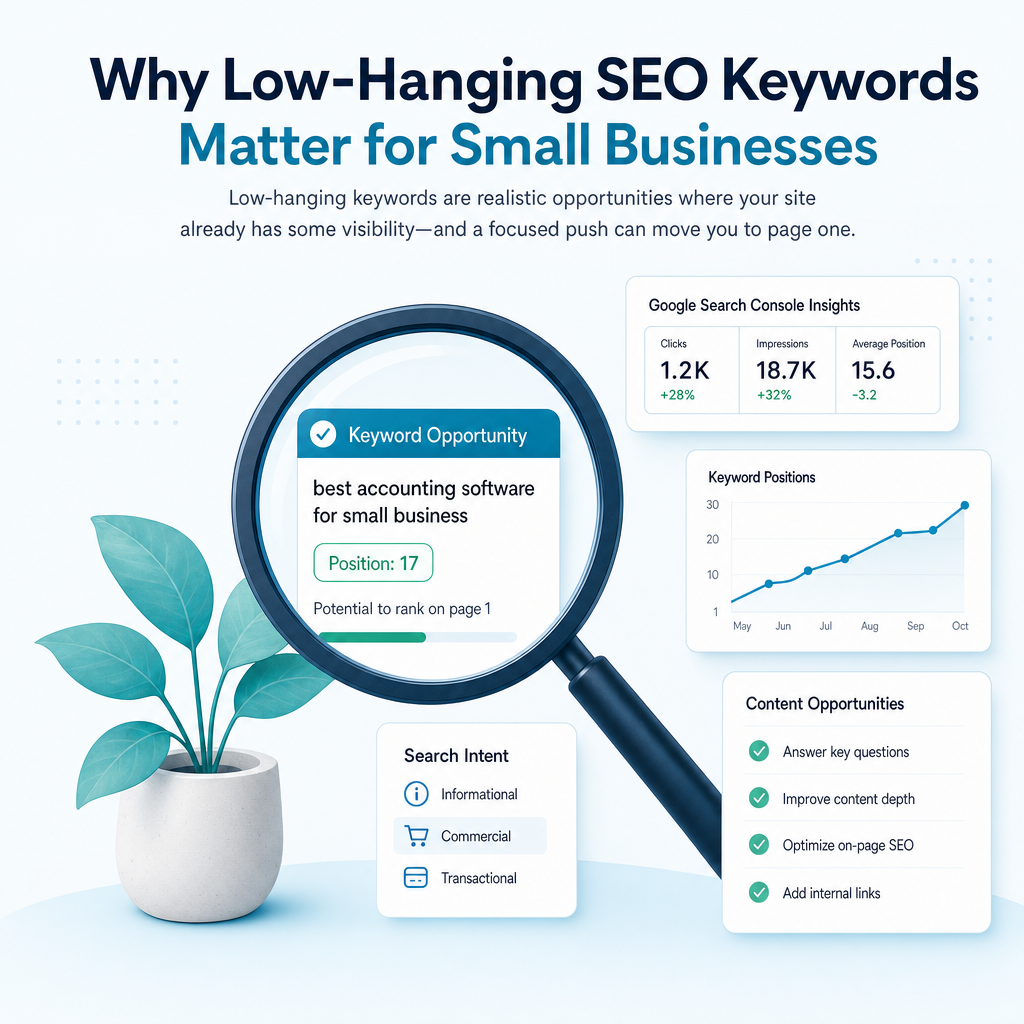
Small businesses rarely have unlimited resources for SEO. A founder, marketing manager or small internal team may be responsible for research, writing, website updates and reporting alongside many other tasks. Spending months pursuing a highly competitive keyword without checking whether easier opportunities exist can lead to slow progress and inconsistent publishing.
Low-hanging SEO keywords provide a more practical route into organic search. They help you improve pages that already have some relevance, answer specific customer questions and develop a stronger connection between your content and your services. This approach is useful for service businesses, B2B software companies, e-commerce brands, healthcare practices, education providers and property businesses across the UK and English-speaking international markets.
Early improvements can also make SEO easier to manage internally. When your team can see which pages and queries are gaining visibility, it becomes easier to decide what to refresh, what to create and what to leave for later.
Benefits of Targeting Attainable Opportunities
- More efficient use of resources: You focus writing and optimisation time on realistic opportunities rather than guessing.
- Closer alignment with customer needs: Specific queries often reveal the exact problem a visitor wants to solve.
- Improved conversion potential: A detailed search can indicate a more defined need than a broad term.
- Stronger topical coverage: Related pages can build depth around an important service or subject.
- Better content decisions: Search data helps you improve existing assets before producing more content.
Existing Visibility vs New Keyword Ideas
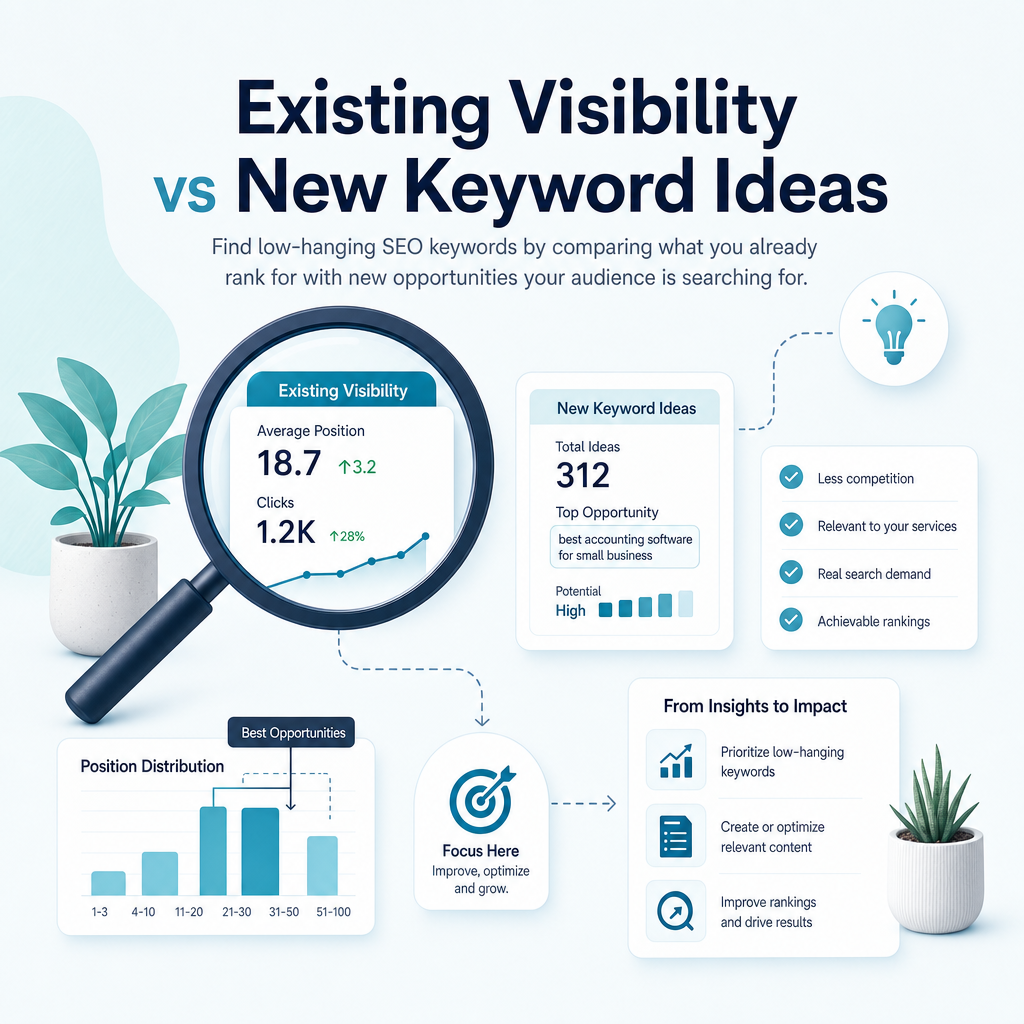
There are two broad ways to find low-hanging SEO keywords. The first is to examine searches where your website already appears. The second is to discover new terms through keyword research, competitor analysis & content gaps, customer questions and search-result features.
Existing visibility is often the fastest place to begin because Google already has evidence that your page is relevant to the query. New keyword research remains valuable, particularly when your website has limited historical data or when you need to expand into a new service area.
| Keyword source | Best use | What to look for |
|---|---|---|
| Google Search Console | Improve existing pages | Impressions, clicks and positions around pages two and three |
| Competitor research | Find content gaps | Relevant queries competitors cover poorly or your site does not address |
| Keyword research tools | Expand topic ideas | Specific phrases with suitable intent and manageable competition |
| Customer conversations | Reflect real language | Questions, objections and service descriptions customers use |
| Google search features | Find supporting topics | Autocomplete suggestions, related searches and People Also Ask questions |
How to Find Low Hanging SEO Keywords in Google Search Console
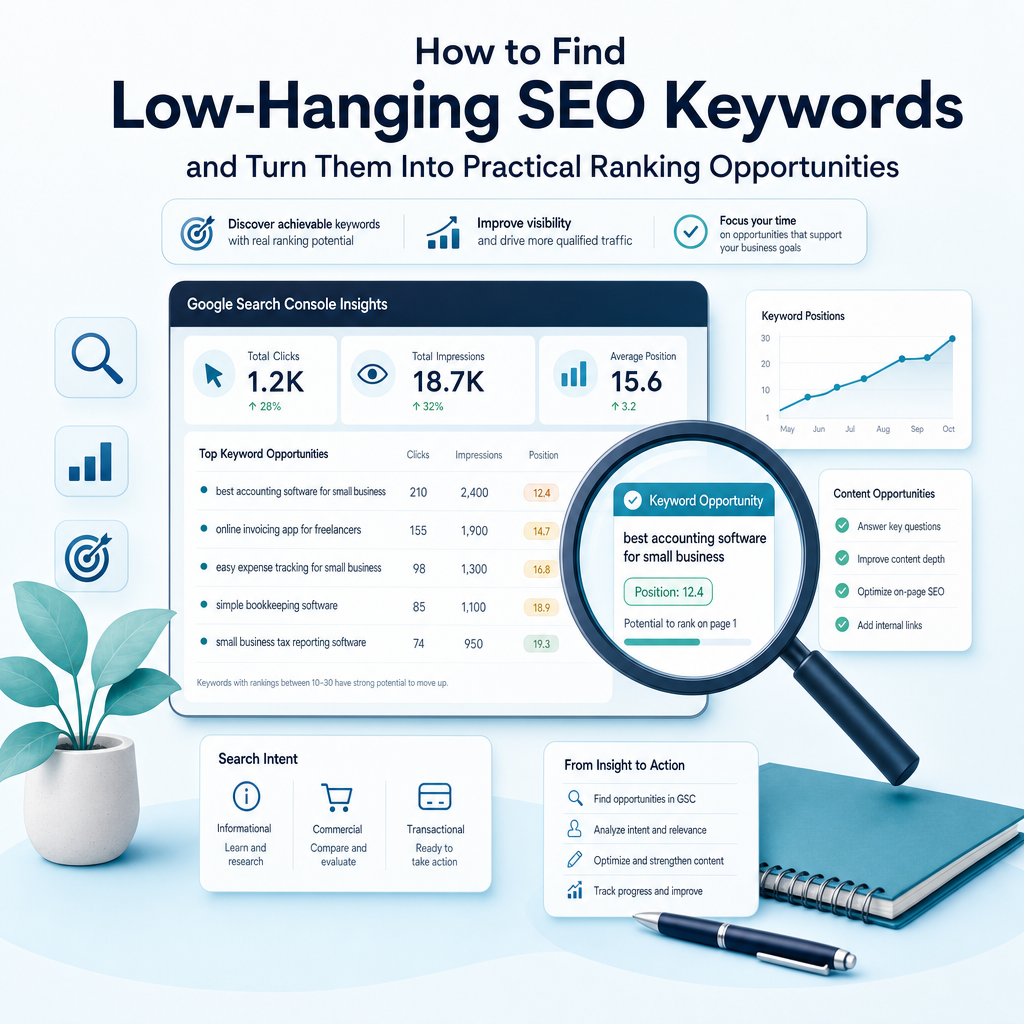
Google Search Console is one of the most useful sources for finding realistic SEO opportunities because it shows how your site performs in Google Search. It can reveal queries that third-party tools may not identify, including unusual wording, local variations and longer searches with limited recorded volume.
For the full Search Console filter, scoring and editing process, see our guide to striking distance keywords.
You need verified access to a website property. Search Console data is based on your site’s actual performance, so it should be treated as a starting point for decisions rather than a complete measure of every search your audience makes.
Step 1: Open the Search Results Report
Sign in to Google Search Console and select the relevant website property. Open Performance, then choose Search results. Set a date range long enough to provide useful data, such as three months or six months, depending on the size and activity of your website.
Display clicks, impressions, average click-through rate and average position. You can also review the Pages, Queries, Countries and Devices tabs to understand where the opportunity appears and which page is receiving visibility.
Step 2: Review Queries Around Positions 10 to 30
Filter or sort the query report by average position. Focus on relevant keywords where your website appears between positions 10 and 30. These searches often represent pages that are close to stronger visibility, although the exact opportunity depends on the search results and the quality of the page.
Do not treat the position range as a strict rule. A query in position 35 can still be useful if it has strong relevance and impressions, while a query in position 12 may not deserve attention if it has no connection to your business.
Step 3: Compare Impressions, Clicks and Intent
High impressions with few clicks may indicate an opportunity, but several explanations are possible. The page may rank lower than the average position suggests for some users, the title may not match the query well, search features may reduce clicks, or the content may not fully satisfy the intent.
Review the query alongside the page that receives impressions. Ask whether the page is the best destination, whether the title and description accurately describe its value and whether the opening section answers the searcher’s main question quickly.
Step 4: Group Similar Queries
Search Console may show many variations of one underlying topic. Group similar queries into clusters (otherwise known as semantic keywords) rather than creating a separate page for every wording variation. A single well-structured page may serve several closely related searches when they share the same intent.
For example, “local SEO content ideas,” “content for local SEO” and “local SEO blog topics” may belong to one cluster. A different page may be needed for “local SEO content creation service” because the intent is more commercial.
Step 5: Check Which Page Is Ranking
Use the Pages tab to identify the URL associated with each opportunity. If several pages appear for very similar queries, review whether they overlap too heavily. Unclear page targeting can make it harder for search engines to identify the strongest result on your site.
Where one page is clearly the best fit, improve that page rather than publishing another article that repeats the same subject.
How to Find New Low-Hanging SEO Keywords
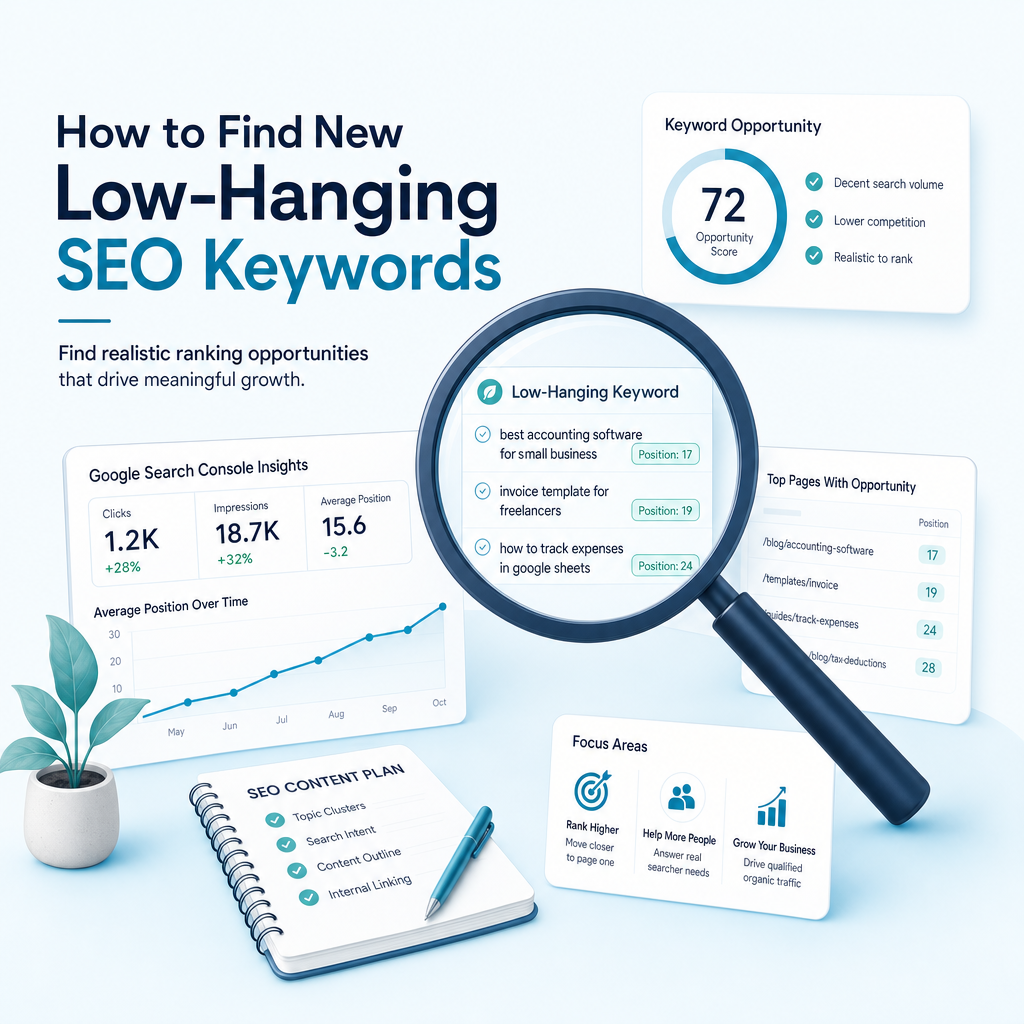
Search Console is powerful for established websites, but it is not the only source. New keyword opportunities can come from structured research, competitor content-gap analysis and the language customers use when describing their problems.
The objective is not to collect the largest possible list. It is to build a shortlist of terms that are relevant, realistic and connected to a useful page or business outcome.
Use Keyword Research Tools Carefully
Keyword research platforms can provide search-volume estimates, related phrases, competition indicators and competitor rankings. These metrics are useful for comparing opportunities, but they are not official Google measurements and should not replace manual review.
Begin with a service or customer problem, then expand into specific variations. Look for phrases that describe a clear audience, use case, location, comparison or desired outcome. A term with modest volume can be more valuable than a broad term if it attracts a visitor who is ready to take a relevant next step.
Study Search Intent Before Difficulty Scores
Search intent is the reason behind a query. A keyword can have a low difficulty score and still be a poor target if the searcher wants something your business does not offer. Intent should be checked before deciding that a keyword is an opportunity.
- Informational: The searcher wants an explanation, process or answer.
- Commercial research: The searcher is comparing options, providers or approaches.
- Transactional: The searcher is ready to enquire, buy, book or start a trial.
- Local: The searcher wants a service or provider in a particular place.
Review the current Google results for the phrase. If the results are mostly guides, a service page may not satisfy the intent. If the results are provider pages, a general educational article may be less suitable.
Look for Long-Tail and Question-Based Searches
Long-tail keywords contain more detail and often reveal a specific need. Examples include “how to create an SEO content calendar for a small business,” “Google Search Console content strategy for a local service company” and “AI SEO content platform for growing businesses.”
Question-based searches can help you plan educational content for early-stage readers. Use Google Autocomplete, People Also Ask, related searches, customer emails and sales-call notes to identify the language people actually use.
Analyse Competitor Content Gaps
Competitor research is most useful when it identifies weaknesses in the current results rather than simply copying another website’s keyword list. Review pages that rank for services or topics relevant to your business. Note which questions they answer, which audiences they overlook and whether their information is current and practical.
A content gap may exist when competitors rank for a useful query but provide a shallow answer, fail to cover a specific audience or do not connect the topic to a clear next step. Your opportunity is to create a more relevant and helpful resource, not to reproduce the same page with minor wording changes.
Mine Customer Questions and Online Discussions
Customer conversations can reveal valuable keyword ideas that standard tools miss. Look at support messages, enquiry forms, sales conversations, reviews and questions asked by prospects. Online communities and question platforms can also expose recurring problems and natural phrasing.
Use these sources for insight, not as a substitute for original expertise. If a question appears repeatedly, it may deserve a dedicated article, service-page section or FAQ. The final content should answer the problem clearly and reflect your business’s actual capabilities.
How to Decide Which Keywords to Target First
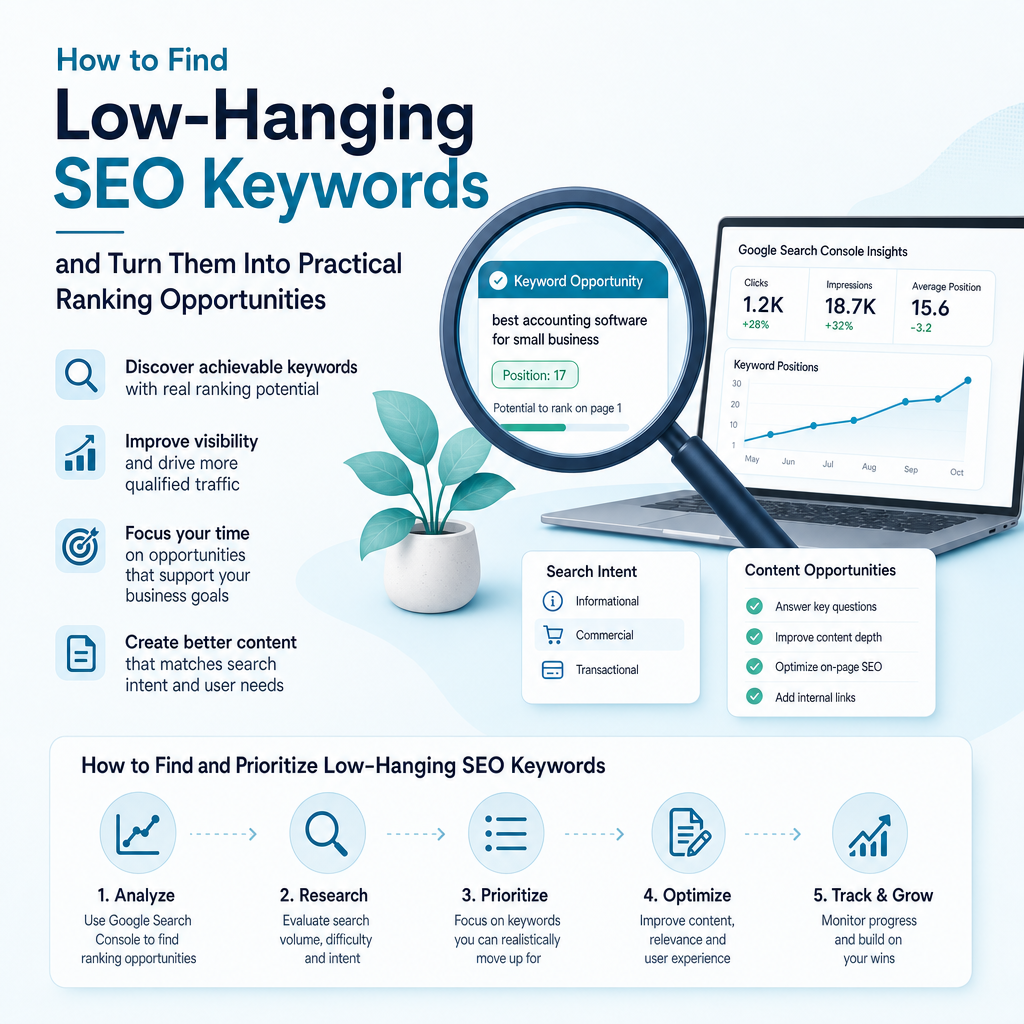
Once you have a list of possible keywords, rank them by business value and practical feasibility. The best opportunity is rarely the keyword with the highest estimated volume. It is usually the term where relevance, intent, competition and your ability to produce a strong result overlap.
Create a simple scoring system using factors such as current position, impressions, relevance, intent, competition, content quality and conversion potential. Keep the scoring consistent so that decisions are easier to explain and revisit.
A Practical Prioritisation Checklist
- Does the keyword describe a problem your business solves?
- Is the search intent clear?
- Does your website already have a relevant page?
- Is the page visible in Search Console?
- Are the current results weak, outdated or poorly matched?
- Could one page serve a meaningful cluster of related queries?
- Would a visitor have a sensible next step after reading?
- Can your team create or improve the page to a high standard?
What to Do After Finding a Low-Hanging Keyword
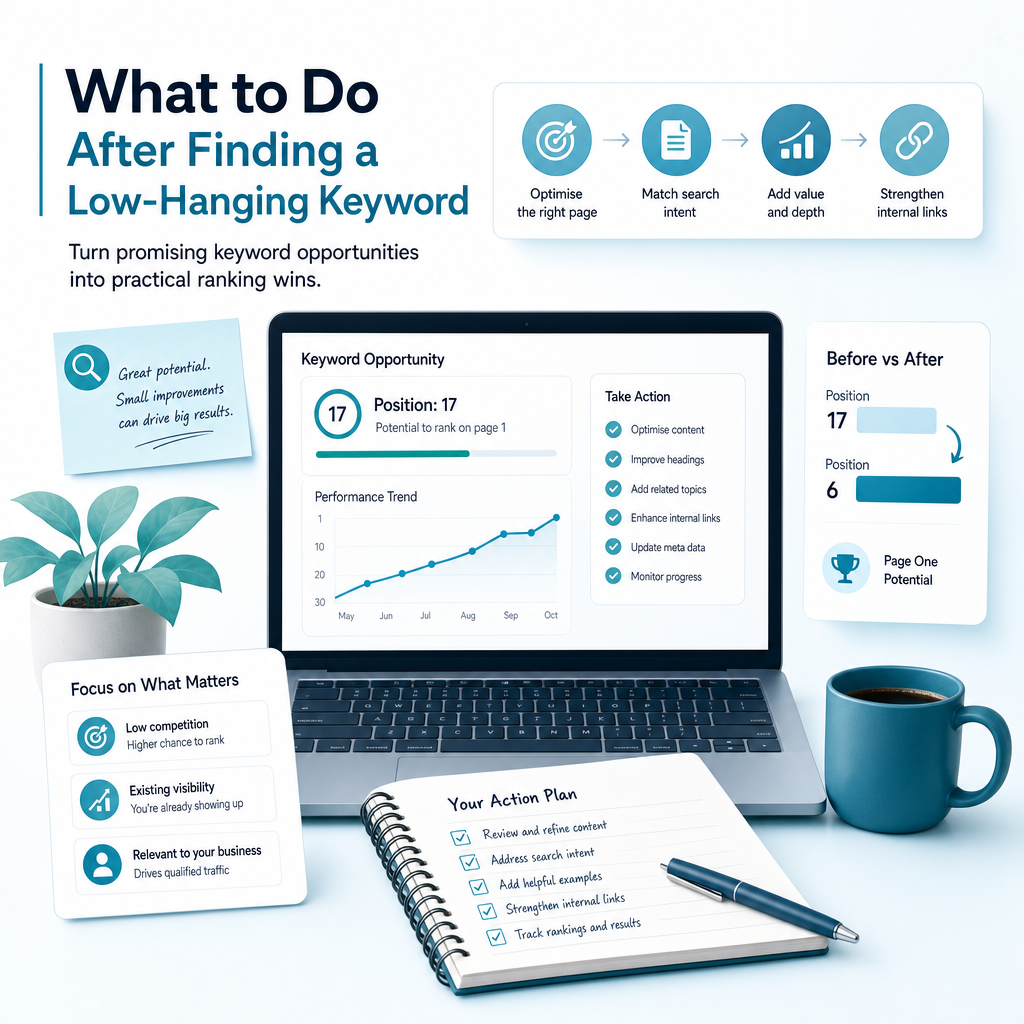
Finding an opportunity is only the beginning. The next action depends on whether an existing page already addresses the topic and how closely it matches the search intent.
Improve an Existing Page
Refresh the page when it is relevant but incomplete or poorly aligned with the query. Improve the introduction, page structure, headings, examples, supporting evidence and internal links. Add the target phrase naturally where it helps the reader, but do not force exact-match wording throughout the page.
Review the title and meta description for clarity and accuracy. A stronger page experience may also involve improving navigation, readability, mobile usability and page speed. These changes should support the visitor rather than being made only for a ranking signal.
Create a New Page
Publish a new page when no existing URL matches the intent or when the subject deserves its own resource. Give the page one clear purpose and cover the topic thoroughly enough to answer the main question. Add related concepts through semantic keyword mapping so the content has useful depth without repeating the same phrase.
Link the new page from relevant existing content. Internal links help readers discover related information and help search engines understand how the pages fit together.
Build a Topic Cluster
A single keyword can lead to a wider group of related needs. For example, a small business exploring AI SEO tools may also search for Google Search Console content strategy, semantic keyword mapping, content gap analysis and SEO reporting. These subjects can form a connected content plan around a broader service or problem.
Use one central page to explain the main subject, then create supporting pages for distinct questions and use cases. Each page should add something new and link naturally to the others.
Common Mistakes to Avoid
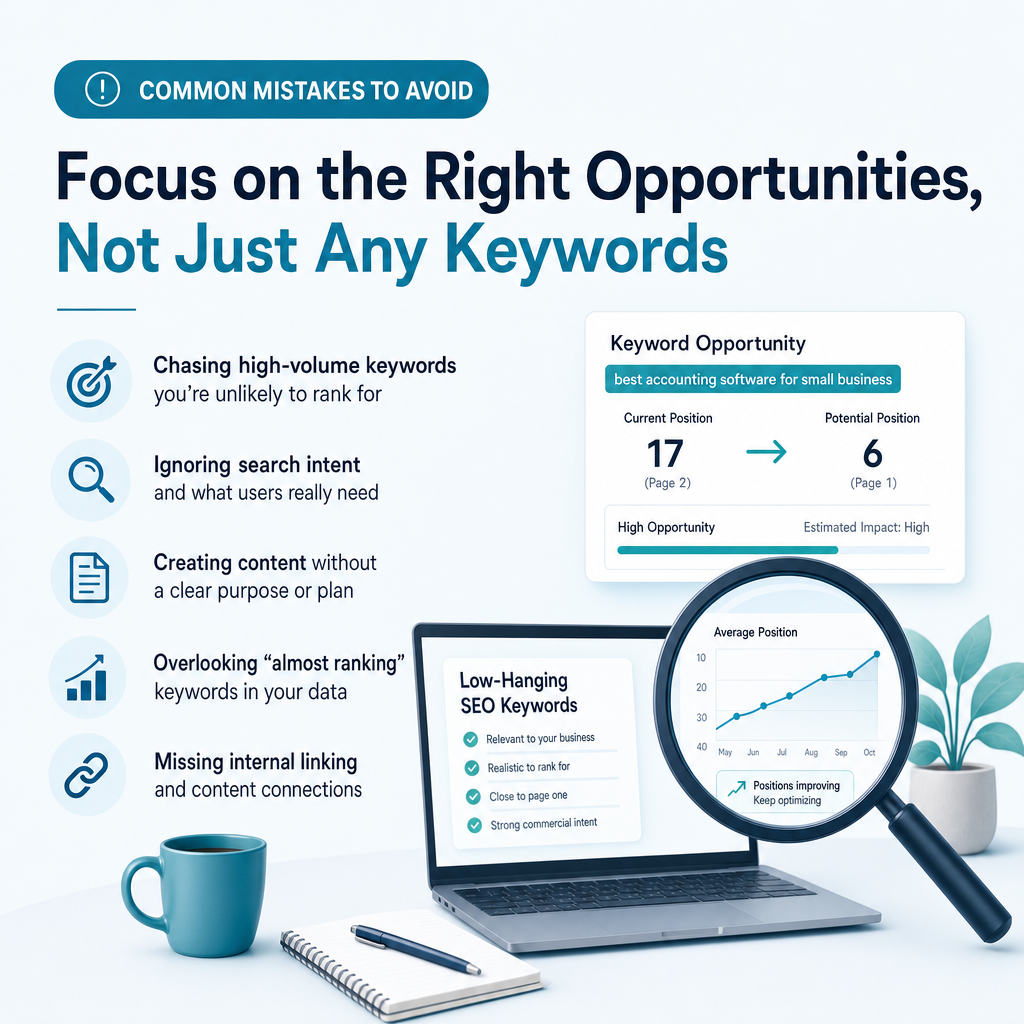
Low-hanging SEO keywords are useful because they encourage focused work, but they can still be misused. A list of low-difficulty phrases will not create a strong SEO strategy if the terms are unrelated, repetitive or disconnected from customer needs.
Small teams should also avoid treating SEO as a one-time update. Search results change, competitors publish new content and customer language evolves. Review performance regularly and use the data to refine your content plan.
- Chasing volume alone: High volume does not guarantee useful traffic or enquiries.
- Trusting tool scores blindly: Difficulty metrics vary by provider and are estimates.
- Creating too many similar pages: Overlapping content can make page selection unclear.
- Ignoring local intent: UK service businesses should review relevant towns, regions and service areas where appropriate.
- Updating only the keyword: A page must satisfy the underlying question, not just mention the phrase.
- Publishing without internal links: New content needs a clear place within the wider website.
- Expecting immediate results: Rankings can take time to reflect changes and can fluctuate.
When Should You Use an SEO Content Platform?
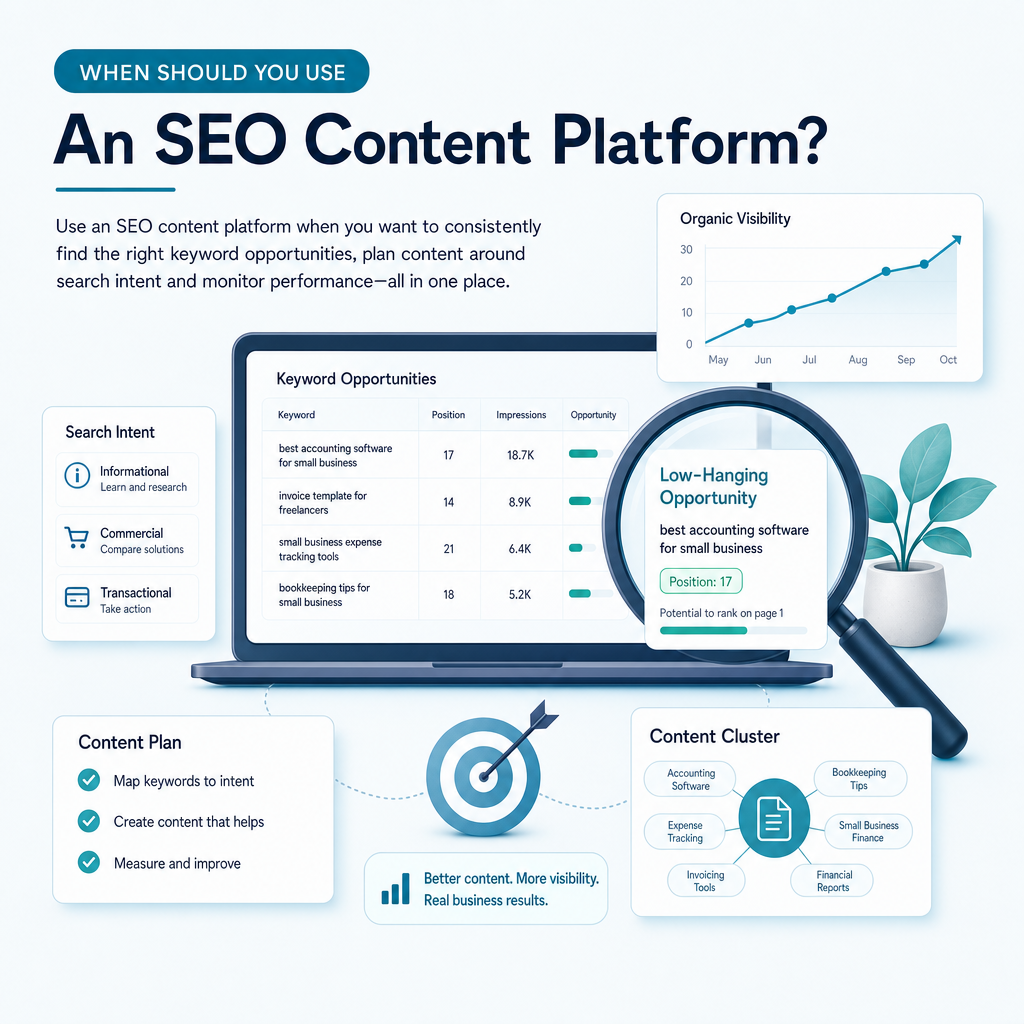
Manual research can work when you have a small website and a short list of pages. It becomes harder when you need to combine Search Console data, Analytics data, competitor research, intent analysis and content planning across many services or locations.
An AI SEO content platform can help organise these inputs into a more practical workflow. The technology should support judgement rather than replace it. You still need to confirm that an opportunity matches your business, your audience and the page you can credibly create.
Ammpli combines Google Search Console and Analytics data with competitor research, search-intent analysis and semantic keyword mapping. It helps small and growing businesses identify realistic ranking opportunities, plan relevant content and create search-optimised articles without the cost or complexity often associated with a traditional SEO agency.
What Ammpli Can Help You Manage
- SEO opportunity analysis based on your existing search performance.
- Google Search Console data analysis for pages and queries already gaining visibility.
- AI-powered SEO content creation grounded in your business and topic plan.
- Keyword and search-intent research.
- Competitor content-gap analysis.
- Semantic keyword mapping and topical authority planning.
- SEO content calendars and local SEO content creation.
- Blog and brand analysis, direct CMS publishing and SEO performance reporting.
This approach is different from using a generic AI writing tool that produces text without understanding your existing performance. It also gives small businesses an alternative to commissioning every research and writing task from an external agency. Ammpli is designed for owners, founders and marketing managers who need a practical way to turn real search data into consistent content.
A Simple Workflow for Finding Low-Hanging SEO Keywords
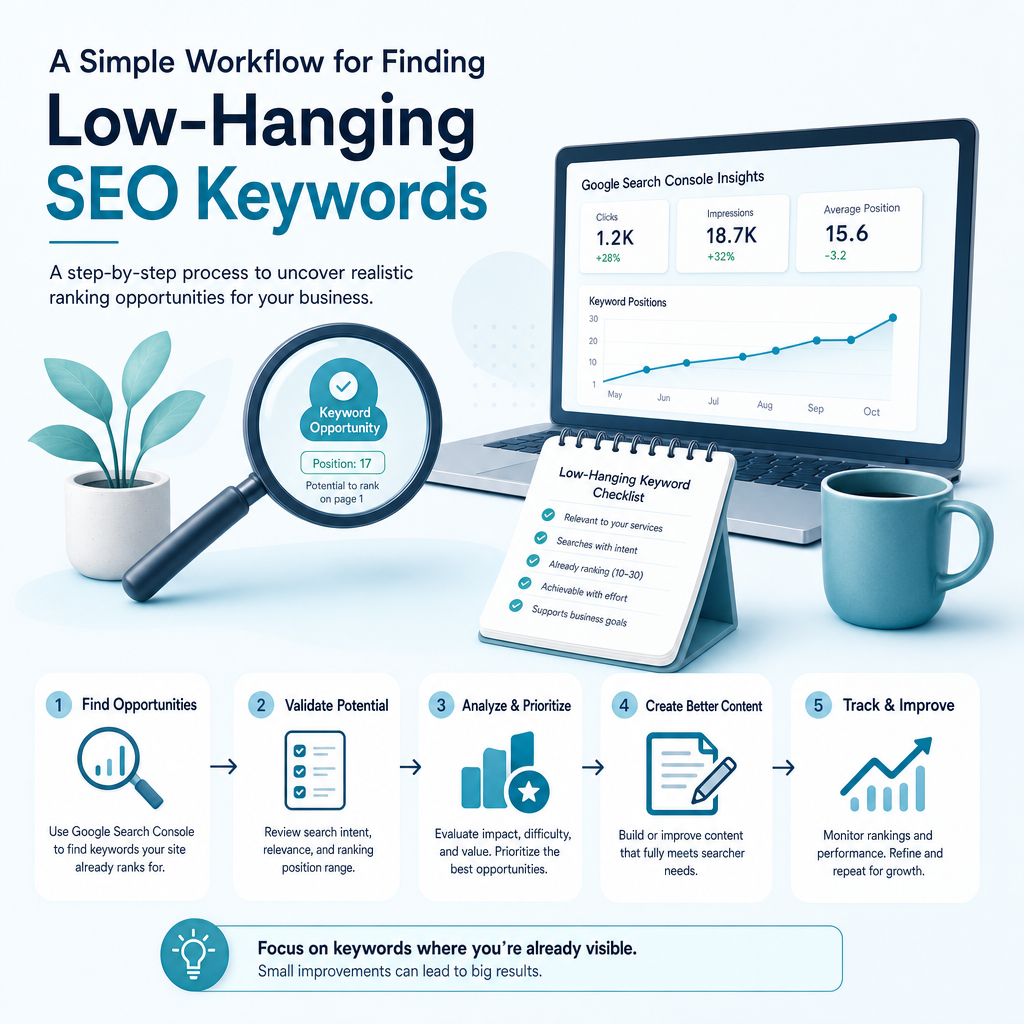
You can use the following workflow as a repeatable monthly process. Start with data you already have, validate each opportunity against customer intent and then assign a clear action to every shortlisted keyword.
- Export or review Search Console queries: Look for relevant searches where pages rank around positions 10 to 30.
- Check the destination page: Confirm which URL ranks and whether it satisfies the query.
- Group related phrases: Build sensible clusters around shared intent.
- Review the search results: Compare page quality, content depth, freshness and relevance.
- Choose an action: Refresh an existing page, create a new page or defer the term.
- Strengthen the content: Improve structure, answer the main question and add useful internal links.
- Track performance: Monitor impressions, clicks, average position and meaningful business actions.
Repeat this process with a clear connection to your commercial priorities. A service business may prioritise local and enquiry-focused searches, while a B2B software company may focus on comparison, implementation and problem-solving content.
Frequently Asked Questions
What are low-hanging SEO keywords?
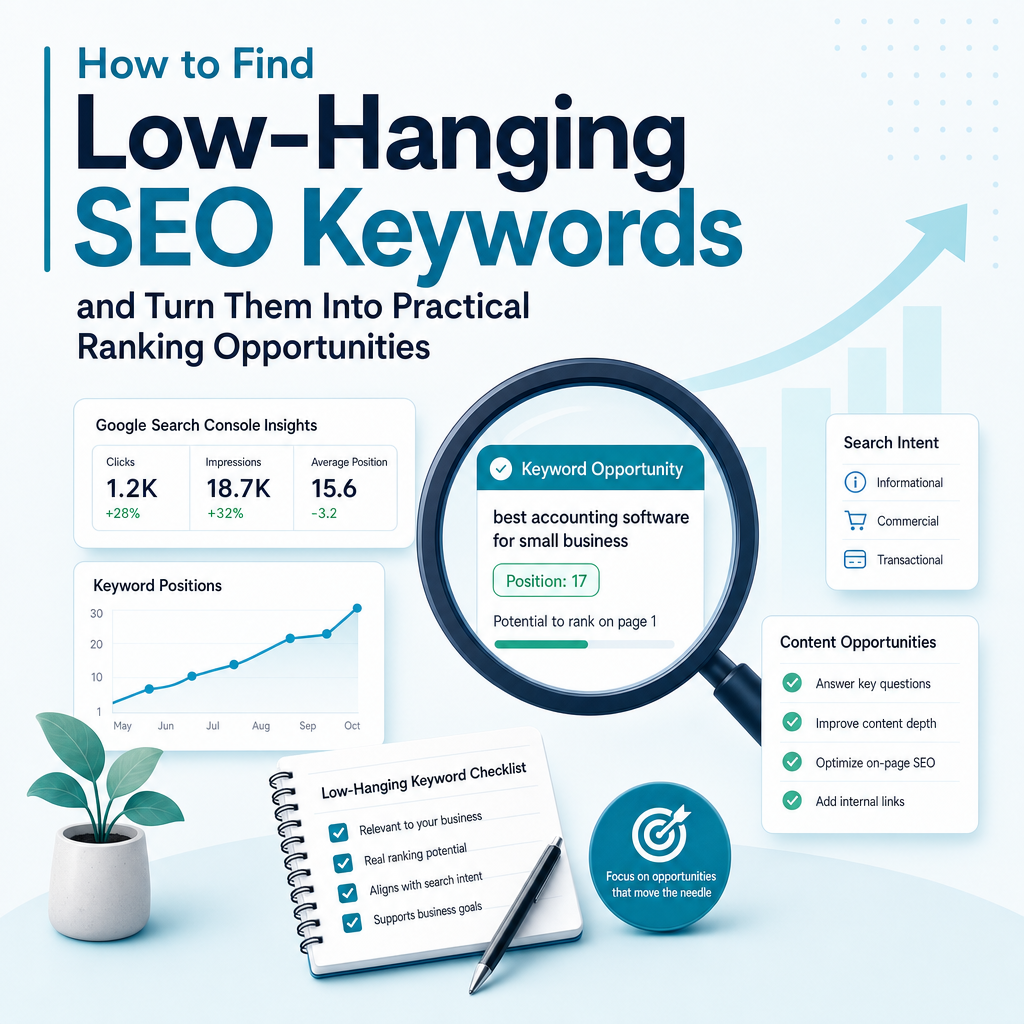
Low-hanging SEO keywords are relevant search terms with a realistic chance of improvement. They may have manageable competition, specific intent or existing visibility for your website, often around positions 10 to 30 in Google Search.
How do I find low hanging SEO keywords for free?
Start with Google Search Console to identify queries where your pages already receive impressions. You can also use Google Autocomplete, People Also Ask, related searches, customer questions and competitor page reviews to find additional ideas without relying on a paid platform.
Are low-hanging keywords always low-volume?
No. Some have modest search demand because they are specific, while others can attract substantial interest. Search volume should be considered alongside relevance, intent, competition and the value of the visitor.
Should I create a new page for every keyword?
No. Closely related keywords with the same intent can often be served by one well-structured page. Create separate pages when the audience, purpose or expected answer is meaningfully different.
How long does it take to see results from a keyword update?
There is no fixed timeframe. Google may take time to recrawl and reassess a page, and rankings can change because of competition, location, device and search-result features. Track trends over an appropriate period instead of judging an update after only a few days.
Can Ammpli help me find low-hanging SEO keywords?
Yes. Ammpli uses Google Search Console and Analytics data alongside competitor research, search-intent analysis and semantic keyword mapping to identify realistic opportunities. It can then help turn those opportunities into a content plan and search-optimised articles.
Find Your Next Ranking Opportunity
Learning how to find low hanging SEO keywords gives small businesses a more focused way to improve organic visibility. Instead of competing immediately for every broad industry term, you can identify searches where your website already has relevance or where a specific, useful page could meet an underserved need.
Start with Google Search Console, validate intent, review the current results and choose between refreshing an existing page or creating a new one. Then connect each opportunity to a wider content plan so individual improvements contribute to stronger topical authority.
Ammpli helps you turn search data into better content with less manual research and guesswork. Start your 14-day free trial and find your next ranking opportunity. No credit card required.