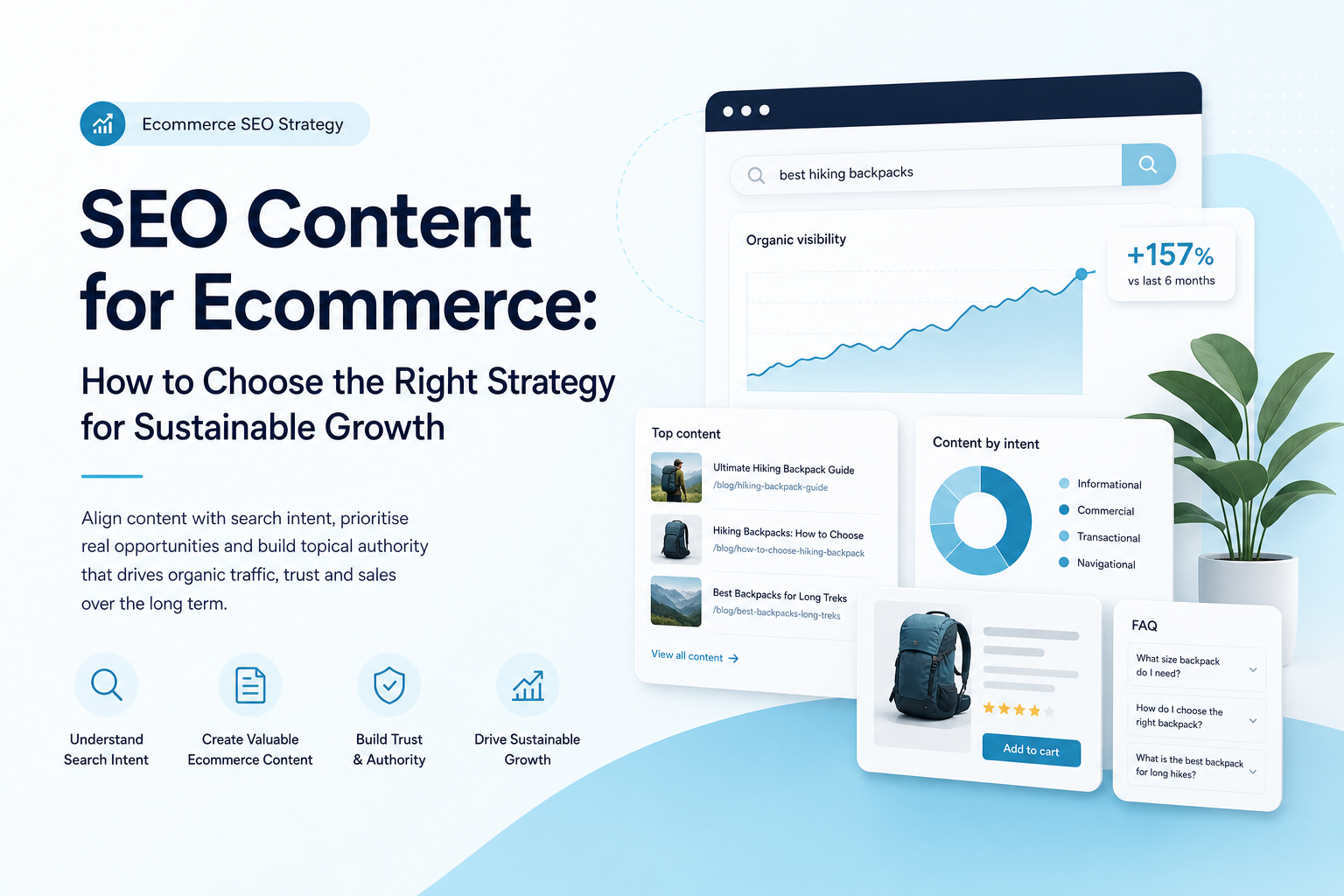
Your ecommerce store may have strong products, attractive photography and a reliable checkout, yet still struggle to attract customers from Google. The problem is often not a lack of content. It is a lack of direction: unclear search intent, product pages that repeat supplier descriptions, category pages with little useful information and blog posts aimed at keywords your business has little chance of ranking for.
SEO content for ecommerce should connect what shoppers search for with what your store genuinely offers. That means improving product and category pages, answering questions before purchase, building trust through useful information and prioritising realistic opportunities rather than publishing at random.
This guide explains how to compare the main approaches to ecommerce SEO content, what a practical process looks like and how a small or growing business can use search data to make better decisions. It also explains where an AI SEO content platform such as Ammpli fits alongside internal marketing, freelance writers, specialist providers and traditional agencies.
What is SEO content for ecommerce?
SEO content for ecommerce is content created and structured to help an online store appear for relevant searches and guide visitors towards a purchase. It includes more than blog articles. Product descriptions, category introductions, buying guides, comparison pages, FAQs, local landing pages and customer reviews can all contribute to organic visibility.
The strongest ecommerce content satisfies both the shopper and the search engine. It helps a customer choose the right product, understand specifications, compare alternatives or resolve an objection. At the same time, it gives Google clear information about the page, its subject, its relevance and its relationship with other pages on the site.
Why ecommerce content needs a different approach
Ecommerce websites have several page types, each with a different role. A product page usually targets a specific item or model, while a category page targets a broader product group. An article may answer an informational question, and a buying guide can support shoppers who are comparing options.
These pages should work together rather than compete with each other. For example, a store selling home office equipment could create a category page for ergonomic office chairs, product pages for individual chairs and a guide explaining how to choose a chair for long working days. Each page serves a different search need and links naturally to the others.
- Product pages: Support specific product, brand, model and specification searches.
- Category pages: Target broader commercial searches and organise the product catalogue.
- Buying guides: Help shoppers compare features, use cases, sizes, materials and price points.
- Blog content: Answer informational questions and introduce customers to relevant products.
- Reviews and questions: Add first-hand language, trust and useful detail to product pages.
The options for creating ecommerce SEO content
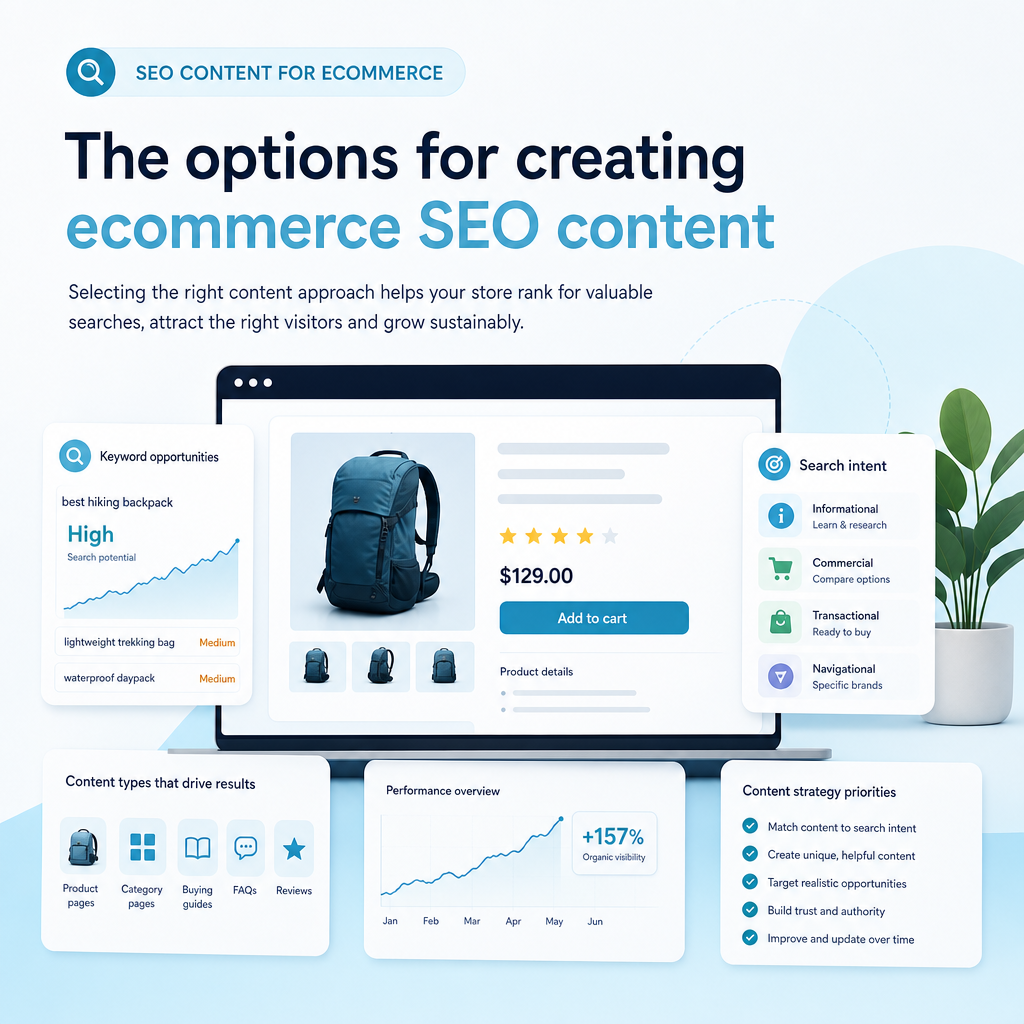
Small businesses normally choose between several content models. You can write content internally, hire freelancers, use generic AI writing tools, work with an agency or use an AI SEO content platform. None is suitable for every business, so the right choice depends on your catalogue size, internal expertise, budget, publishing goals and need for strategic guidance.
The main difference between these options is not simply writing speed. It is the quality of the research, the accuracy of the recommendations, the amount of human review and the connection between content production and business results.
| Option | Best fit | Strengths | Limitations |
|---|---|---|---|
| Internal content creation | Businesses with available marketing expertise | Strong brand knowledge and direct product access | Research and production can take substantial time |
| Freelance SEO writer | Businesses needing specialist writing support | Flexible capacity and human judgement | Research quality and strategic consistency vary |
| Generic AI writing tool | Early drafts, ideas and simple content tasks | Fast and accessible | May not understand search performance, competition or the catalogue |
| Content or SEO agency | Businesses needing broad strategic support | Access to specialists and established processes | Higher ongoing cost and less direct control |
| AI SEO content platform | Small teams wanting data-led planning and scalable production | Connects opportunity research, planning and content creation | Still requires business knowledge, review and quality control |
DIY content creation
Writing content yourself can work well when you have a small catalogue, strong product knowledge and enough time to research each topic. Internal teams often understand customer objections, product differences and brand language better than an external provider.
The challenge is consistency. Keyword research, competitor analysis, content briefs, writing, editing, publishing and performance reporting can quickly become a large workload. DIY content can also become reactive, with the team publishing topics that sound useful without checking whether they match search demand or support a commercial goal.
Freelance writers and content specialists
A freelance writer can add valuable capacity without the commitment of a full agency relationship. This option is useful when you already have a content strategy and need someone to turn clear briefs into well-written pages.
The quality of the result depends heavily on the brief and the writer’s ecommerce experience. A writer may produce polished copy but still miss technical requirements, search intent, internal linking opportunities or gaps in the competitor landscape. You may also need to manage research, editing and publishing internally.
Generic AI writing tools
Generic AI writing tools such as ChatGPT can help with brainstorming, outlines, rewrites and first drafts. They can reduce the time needed to create basic copy, but they do not automatically know which searches your website is already appearing for, which competitors are strongest or which topics are realistic for your domain.
That distinction matters. Content can be grammatically correct and still be commercially weak. A generic tool may produce a broad article targeting a competitive term while overlooking a smaller search opportunity where your store already has impressions. AI-generated text also needs fact-checking, product review and brand editing before publication.
Traditional agencies and content marketing providers
An agency can provide strategic advice, technical SEO, content production, outreach and reporting under one relationship. This can be a good fit for larger catalogues, complex migrations or businesses that need broad marketing support.
For a small ecommerce brand, the cost and process may be more than necessary. Some agencies also work from standard packages that prioritise a fixed number of articles or keywords instead of the opportunities visible in your own search data. Ask how the provider chooses topics, how success is reported and who owns the content and strategy.
AI SEO content platforms
An AI SEO content platform is designed to bring research, planning and production into one workflow. Ammpli combines Google Search Console and Analytics data with competitor research, search-intent analysis and semantic keyword mapping to identify opportunities that are relevant to a specific website.
This approach is different from asking an AI tool to write an article from a single keyword. The aim is to understand where the site has existing visibility, what content competitors cover, which related terms belong together and what type of page best matches the search. Ammpli then turns those insights into a practical content plan and search-optimised articles.
How to build a practical ecommerce SEO content strategy
A useful strategy starts with the customer and the catalogue, not with a list of random keywords. Begin by identifying the products, categories, margins, seasonal priorities and questions that influence buying decisions. Then connect those business priorities with real search behaviour.
The process should be repeatable enough for a small team to manage, but flexible enough to respond to stock changes, new products and seasonal demand. A content calendar is useful, but only when each planned page has a clear purpose.
1. Map the buying journey
Shoppers use different searches at different stages. Someone looking for general advice may not be ready to buy, while someone searching for a specific product, size or feature may have strong purchase intent.
- Informational: “How do I choose a standing desk?”
- Commercial research: “Best standing desk for a small office”
- Comparison: “Electric standing desk versus manual desk”
- Transactional: “Buy white electric standing desk”
- Local: “Office furniture shop in Manchester”
Match informational searches with guides and helpful articles, commercial searches with comparison content and category pages, and transactional searches with product and collection pages. A mismatch between the keyword and page type often leads to weak engagement, even if the page attracts impressions.
2. Use Google Search Console as a source of opportunity
Google Search Console shows the queries, pages, impressions, clicks, click-through rates and average positions associated with your website. This makes it especially useful for finding content opportunities that generic keyword tools may not reveal.
Look for relevant queries where your website receives impressions but has not yet achieved strong visibility. These searches can indicate that Google already associates your site with the topic. A new guide, improved category page or clearer product content may be more realistic than starting with an unrelated high-volume keyword.
Analytics data adds another layer. It can show which landing pages lead to engagement, product views, enquiries or sales. Together, Search Console and Analytics help you prioritise topics based on visibility and business relevance.
3. Analyse competitor content gaps
Competitor research should identify more than the keywords other stores rank for. Review the page types appearing in search results, the questions they answer, the product attributes they explain and the internal links they use.
A content gap may be a missing buying guide, an underdeveloped category page or a product comparison that customers need before making a decision. It may also reveal that competitors have created pages for searches your catalogue cannot satisfy. Do not copy their structure automatically. Use the research to identify a useful angle your business can support with accurate information.
4. Build semantic topic groups
Search engines understand relationships between words and concepts, not just exact keyword matches. Semantic keyword mapping groups related terms around a subject so that one page can address the topic naturally without repeating the same phrase.
For example, a page about waterproof hiking boots may need to cover grip, ankle support, walking conditions, materials, sizing, waterproof membranes and care. These related concepts help the page answer the underlying need behind the search.
Semantic mapping also reduces the risk of creating several thin pages that target nearly identical terms. Where one strong page can satisfy the intent, consolidate the information. Where the intent differs, create separate pages and link them clearly.
What high-quality ecommerce SEO content should include
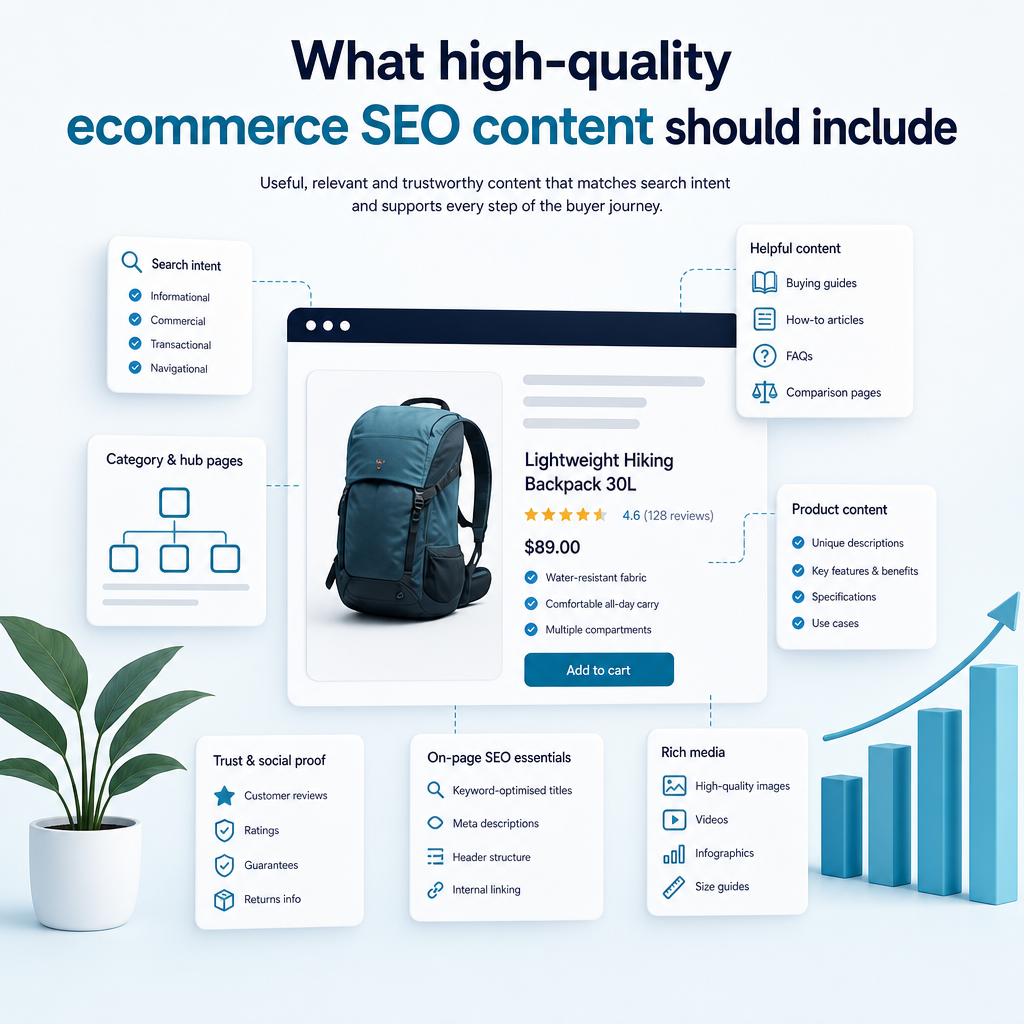
Good SEO content for ecommerce is useful before it is persuasive. The reader should be able to understand the product, compare options and decide what to do next without searching elsewhere for basic information.
Quality varies by page type, but the same principles apply: accuracy, originality, clarity, relevance and a visible connection to customer needs.
Product pages
Product pages should describe more than what the manufacturer supplied. Explain the benefits of important features, who the product suits, how it compares with alternatives and what the customer needs to know about size, compatibility, delivery, returns and care.
- Use a clear, unique product title and H1.
- Write original descriptions based on customer needs.
- Include specifications in an easy-to-scan format.
- Use descriptive image file names and relevant alt text.
- Add genuine reviews and customer questions where available.
- Link to related products, categories and buying guides.
- Keep price, availability and delivery information accurate.
Category pages
Category pages are often the most valuable commercial pages on an ecommerce site. They should help shoppers understand the range, choose a suitable product and reach relevant product pages quickly.
A useful category page may include a concise introduction, buying advice, filters that reflect genuine product attributes, frequently asked questions and links to related categories. Avoid adding large blocks of generic copy simply to increase word count. The content should support the shopping task.
Buying guides and comparison content
Buying guides are valuable for middle-of-funnel shoppers who know the problem they want to solve but need help selecting a product. A strong guide explains the differences between options, identifies important features, sets realistic expectations and links to suitable products.
Comparison tables can make this information easier to use. Keep the claims accurate and explain which product is suitable for which use case rather than declaring one universal winner. This creates a better experience and gives the reader a clear route to purchase.
Reviews and user-generated content
Customer reviews add first-hand language that businesses may not think to include themselves. They can answer questions about fit, setup, durability, delivery and everyday use. Reviews also support trust, particularly when shoppers cannot see or test a product in person.
Request reviews after customers have had enough time to use the product. Encourage specific feedback, but do not attempt to control the sentiment. Authentic negative reviews can help shoppers make an informed decision and show that feedback is genuine.
Technical foundations that support content
Content cannot perform well if search engines cannot crawl, understand or index the pages. Ecommerce stores often have technical complications caused by filters, product variants, temporary stock changes, duplicate URLs and large image files.
A technical review should sit alongside content planning. You do not need to fix every issue at once, but you should know which problems affect priority pages and customer experience.
- Site architecture: Keep the path from the homepage to important categories and products clear.
- Internal links: Connect guides, categories and products with descriptive links.
- Canonicalisation: Manage duplicate or near-duplicate URLs created by filters and sorting.
- Indexing: Decide which pages provide enough value to appear in search.
- XML sitemaps: Keep important product, category and editorial URLs discoverable.
- Mobile experience: Check navigation, text, filters, images and checkout on smaller screens.
- Performance: Monitor loading speed and Core Web Vitals across key templates.
- Structured data: Use accurate product, offer, review, breadcrumb and article markup where appropriate.
- Security: Use HTTPS and maintain a trustworthy shopping experience.
Google’s ecommerce guidance highlights product data, structured data, URL design, site structure and crawlable pagination as areas that store owners should manage carefully. Technical implementation does not replace useful content, but it helps search engines interpret and surface it.
How to measure the value of ecommerce SEO content
Traffic alone does not show whether your content is helping the business. A page can attract many visitors who have no interest in buying, while a smaller page may influence valuable purchases or repeat visits.
Choose measures that reflect the purpose of each page. Informational articles may be judged by relevant impressions, clicks, engagement and assisted product views. Product and category pages should be connected to organic revenue, add-to-cart activity and conversion behaviour where tracking is available.
- Impressions and clicks in Google Search Console
- Click-through rate for important queries
- Average position by page and search intent
- Organic sessions by product, category and article page
- Product views and add-to-cart actions
- Revenue or enquiries attributed to organic search
- Conversion rate and average order value from organic visitors
- Pages gaining or losing visibility over time
- Queries that reveal new content opportunities
Review performance regularly, but avoid reacting to daily fluctuations. Use the data to improve titles, update outdated information, strengthen internal links, merge competing pages and create content where demand is clear.
Common mistakes when choosing an ecommerce content solution
Many small businesses choose a provider based on volume alone: how many articles are included, how quickly they can be produced or how low the monthly price appears. Those details matter, but they do not tell you whether the content will support your catalogue or attract the right shoppers.
Ask practical questions before committing to a solution. The answers will reveal whether the provider has a repeatable process or simply produces text.
- Does the provider use your Google Search Console data?
- How are search intent and page type determined?
- Will competitor content gaps be reviewed?
- How are semantic topics mapped?
- Who checks product facts and brand accuracy?
- How will internal links and content updates be managed?
- Can the process support seasonal products and changing stock?
- What reporting will show business relevance, not only publishing volume?
- Can your team review, edit and approve content before publication?
- Who owns the content, data and strategy if you change provider?
When should you use an AI SEO content platform?
An AI SEO content platform may suit your business if you already have an established website, receive Google impressions or rankings and need a more consistent way to identify and publish opportunities. It can be particularly useful when a small team cannot dedicate hours to manual research each week.
It is less suitable as a substitute for product expertise, editorial judgement or technical support. The best process combines automation for research and production with human review for accuracy, brand fit and customer usefulness.
How Ammpli supports SEO content for ecommerce
Ammpli is an AI-powered SEO content platform for small and growing businesses in the United Kingdom and English-speaking international markets. It is designed for teams that need practical SEO support without the cost, complexity or time commitment associated with a traditional agency relationship.
Ammpli combines Google Search Console and Analytics data with competitor research, search-intent analysis and semantic keyword mapping. This helps identify relevant opportunities, including searches where a website already receives visibility but has not yet reached its strongest positions.
From there, Ammpli supports SEO opportunity analysis, content gap analysis, topical authority planning, SEO content calendars and AI-powered SEO content creation. Businesses can also use features such as local SEO content creation, blog and brand analysis, direct CMS publishing and SEO performance reporting.
The result is a more connected workflow: find a realistic opportunity, understand the intent, map the topic, create the content, publish it and monitor what happens. This approach gives a small team more structure without removing the business knowledge needed to produce trustworthy ecommerce content.
A practical starting plan for a small ecommerce team
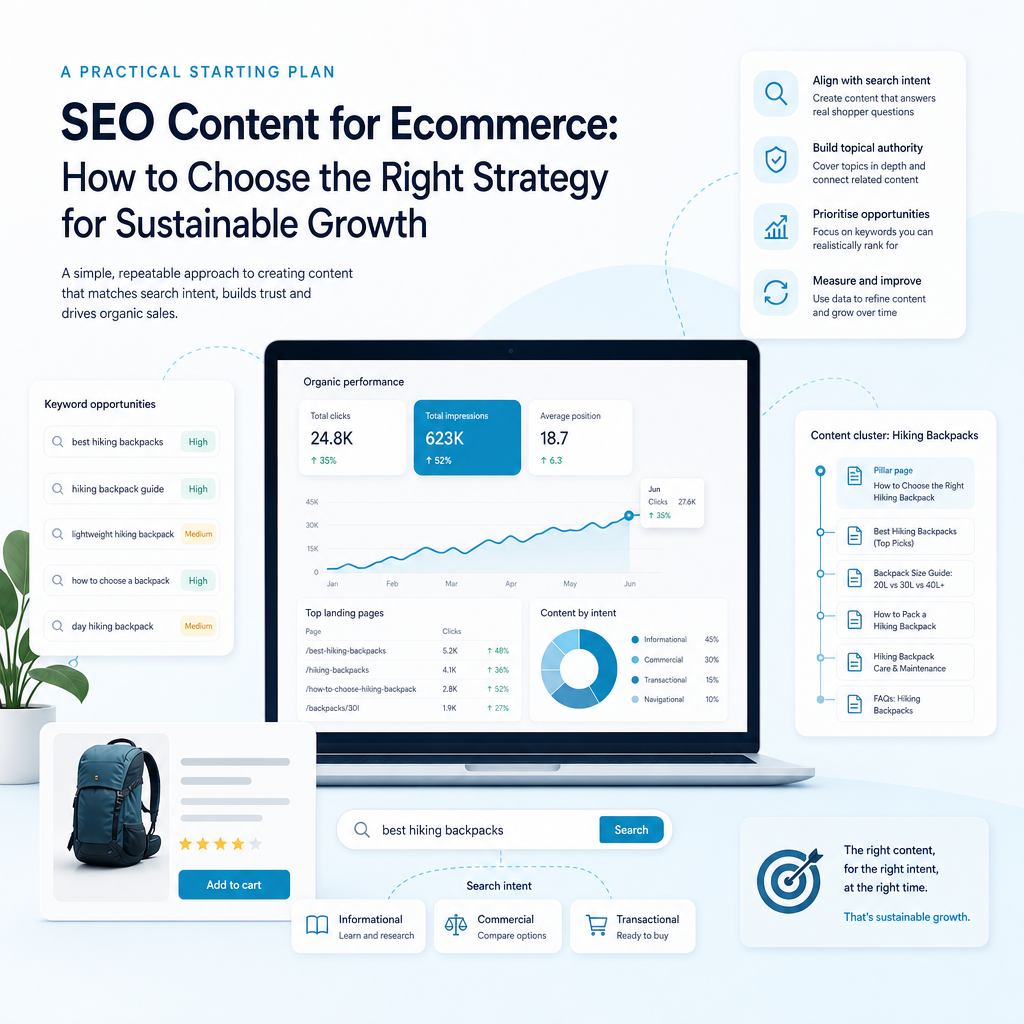
You do not need to optimise every product and category page at once. A focused first phase can reveal which type of content is most likely to support your commercial priorities and where the biggest weaknesses sit.
Start with pages that combine business value and existing search potential. This may be a category with healthy margins, a product range with clear demand or a guide that answers a question customers regularly ask before buying.
- Connect and review Google Search Console and Analytics data.
- List priority products, categories, seasonal ranges and customer questions.
- Find relevant queries where the site already receives impressions.
- Review competing pages and identify missing or weak information.
- Map related terms and assign each topic to the correct page type.
- Improve one or two priority category or product pages.
- Create a buying guide that supports a clear commercial category.
- Strengthen internal links between guides, categories and products.
- Check technical basics, structured data, mobile usability and page speed.
- Report on visibility, engagement and commercial actions before expanding.
Frequently Asked Questions
What is the best type of SEO content for an ecommerce website?
The best type depends on the search intent and the role of the page. Product pages support specific purchase searches, category pages target broader commercial demand, and buying guides help shoppers compare options. A balanced strategy connects all three rather than relying only on blog articles.
Can AI create effective SEO content for ecommerce?
AI can support research, outlines, drafting and content production, but effective ecommerce content needs accurate product knowledge, search-intent analysis and human review. A platform connected to Search Console and Analytics can provide more relevant direction than a generic writing tool because it considers the website’s existing visibility and opportunities.
How do I choose between an agency, freelancer and AI SEO content platform?
Choose based on the support you need. A freelancer may suit a business with an existing strategy that needs writing capacity. An agency may suit a larger or technically complex project. An AI SEO content platform may suit a small team that needs data-led opportunity research, content planning and scalable production with internal review.
Should ecommerce businesses create separate pages for every keyword?
No. Creating a separate page for every close variation can lead to thin content and competing pages. Group related terms when they share the same intent, then create separate pages only when the search need, product group or audience is genuinely different.
How does Google Search Console help with ecommerce content planning?
Search Console shows the queries and pages already generating impressions and clicks. This can reveal realistic opportunities where your website has relevance but needs stronger content or a better page type. Combining this data with Analytics helps you prioritise topics that also support engagement, product discovery and commercial actions.
Is SEO content worth investing in for a small ecommerce business?
SEO content can be worthwhile when it targets relevant searches, improves the shopping experience and is measured against business goals. Small businesses should avoid publishing large volumes without a plan. A focused programme based on existing search data, product priorities and content gaps is usually a more practical starting point.
Take the next step with Ammpli
SEO content for ecommerce works best when every page has a clear purpose and every topic is connected to real customer demand. If your team is unsure what to write, which keywords are within reach or how to publish consistently, Ammpli can help turn your search data into a practical content plan.
Start your 14-day free trial with Ammpli and find your next ranking opportunity. No credit card required.