SEO for Small Business Owners: A Practical Guide to Getting Found Online
For many small businesses, the hardest part of marketing is not delivering the service well. It is getting found by the right people at the right time. A plumbing company in South London, a family-run dental practice in Croydon, a bookkeeping firm in Manchester, or a local dog groomer in Leeds may all offer excellent service, yet still struggle to appear when potential customers search online. That is where seo for small business owners becomes useful.
SEO, or search engine optimisation, is the work of improving your website and wider online presence so search engines are more likely to show your business for relevant searches. Unlike paid ads, SEO focuses on organic visibility. That means showing up because your content, website, business profile, and reputation appear relevant and helpful, rather than because you paid for a click.
For small service-based businesses in the UK, SEO can be one of the most practical long-term marketing channels available. It can help you show up in Google Search, Google Maps, AI-generated search summaries, and local results when people are asking early-stage questions such as how much a service costs, whether they need it, what affects the price, or which option suits their situation. If you are a business owner trying to make sense of where to start, this guide explains the essentials in plain English.
What SEO Means for Small Business Owners
SEO is often described as a way to rank higher on Google, but that only tells part of the story. In practice, seo for small business owners means making it easier for customers to discover your business when they search for problems you solve, services you offer, and questions related to buying. This includes your website pages, blog articles, service descriptions, local listings, reviews, images, and even brand mentions across the web.
For a small team, SEO should not be treated as a technical hobby or a trick to game search engines. It is a method for matching your online presence to what real customers are already searching for. A person in London might search for “emergency electrician near me,” while another might search “why does my fuse board keep tripping” or “how much does rewiring cost in London.” All three searches signal possible demand, but each reflects a different stage of buying intent.
This is why good SEO is not only about broad keywords. It is about understanding customer language, local demand, service areas, and the practical questions people ask before they are ready to contact a provider. When your website answers those questions clearly, your business becomes easier to trust and easier to find.
Why SEO Matters for Small Service Businesses in the UK
Small business owners often compare SEO with paid search, social media, referrals, or directory listings. Each channel has value, but SEO stands out because it can keep producing leads after the initial work has been done. Paid advertising can create traffic quickly, but the moment you stop funding campaigns, that visibility drops. SEO usually takes longer to build, but it can keep working over time.
This matters even more for smaller firms with tight budgets. Many independent businesses in the UK do not have the resources to outspend national competitors in Google Ads. A local cleaning company in North London may not win by bidding on the broadest terms every day. It can, however, create useful pages and articles around specific local needs, such as end of tenancy cleaning in Camden, office cleaning for small businesses in Islington, or what affects the cost of deep cleaning in London flats.
SEO also supports trust. Users often see strong organic rankings and well-maintained local profiles as signs that a business is established and credible. That does not mean every top-ranking site is the best provider, but consistent visibility usually helps your brand feel familiar before someone even gets in touch.
How Search Engines Decide What to Show
Search engines use automated systems to find, index, and rank pages across the web. They scan websites, look at page structure, review content, assess links, and measure signals related to usability, speed, and relevance. The goal is to serve results that best answer the user’s query.
For seo for small business owners, this means your pages need to make sense both to real people and to search engines. A service page should explain what you do, who it is for, where you work, and what someone can expect. A blog article should answer a specific question properly, not just mention a keyword repeatedly. Your contact details should be easy to find. Your site should work well on mobile. Your local profile should match the information on your website.
Google and Bing also look beyond the page itself. Reviews, links from other reputable websites, accurate directory listings, brand mentions, and local relevance can all play a part. In many cases, search engines are trying to work out not just whether your page exists, but whether your business appears dependable, useful, and relevant to the searcher’s location and intent.
What Small Business SEO Usually Includes
SEO is made up of several connected areas. You do not need to master all of them at once, but it helps to know what they are. Many small businesses improve their results by handling the basics well before getting distracted by advanced tactics. If your site is slow, your service pages are thin, and your Google Business Profile is incomplete, those basics will often matter more than chasing obscure technical tweaks.
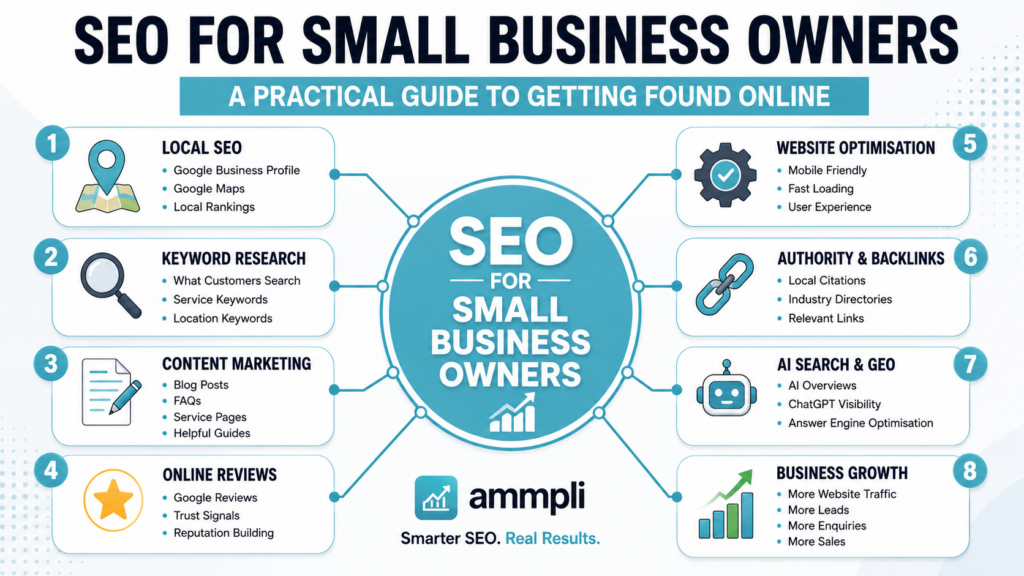
The main parts of seo for small business owners usually include on-page SEO, technical SEO, content creation, local SEO, internal linking, and link earning from other trusted websites. These areas work together. Strong content without a usable site can underperform. A fast site with weak content can also struggle. A local business with a great website but no reviews may miss out on map visibility.
- Keyword research: finding the words and questions your customers actually use
- On-page SEO: improving titles, headings, meta descriptions, URLs, and page copy
- Technical SEO: helping search engines crawl your site and improving speed, mobile use, and security
- Local SEO: strengthening your visibility in map results and location-based searches
- Content marketing: publishing useful pages and articles that answer customer questions
- Internal linking: connecting related pages so users and search engines can move through your site easily
- Authority signals: building reviews, mentions, and backlinks from credible sources
Keyword Research: Starting with Customer Language
Keyword research is often the first step because it helps you understand what people are searching for and how they describe their needs. This is especially helpful for service businesses because business owners often use industry language while customers use plain, everyday language. A roofing contractor might talk about pitched roof membrane systems, while the customer searches “roof leak repair after heavy rain.”
The best keyword targets are not always the biggest ones. Broad terms may have high search volume, but they can also be vague, highly competitive, or poor at showing buying intent. Smaller firms often do better by targeting more specific phrases, including local and long-tail searches. A solicitor in London may have a better chance of winning traffic for “how much does probate cost in London” than simply trying to rank for “solicitor.”
Good keyword research also helps shape your website structure. It can show you which services need their own pages, which questions deserve blog posts, and how people compare options before hiring. If customers regularly search for pricing, timelines, risks, alternatives, or whether a service is necessary, those topics should appear on your site.
Writing Content That Helps Before It Sells
For top-of-funnel traffic, content matters because many users are not ready to contact a business straight away. They are researching a problem, checking whether they need help, comparing providers, or trying to understand cost. If your site only says “contact us today” without answering basic questions, you may miss those early-stage visits.
Helpful content builds visibility and confidence. A physiotherapy clinic could publish articles on whether back pain needs treatment, how many sessions people usually need, and what happens at a first appointment. A pest control company could explain common signs of a rat problem in London terraces and what affects treatment pricing. A cleaning company could compare one-off deep cleans with regular domestic cleaning.
This kind of content supports SEO because it gives search engines more context about your expertise and service areas. It also supports enquiries because people often return to the businesses that taught them something useful. The content should be written for humans first. Clear answers, simple formatting, and realistic examples usually outperform pages stuffed with awkward keywords.
On-Page SEO: The Basics That Still Matter
On-page SEO refers to the elements on your website pages that help users and search engines understand the topic. This includes the page title, headings, URL, meta description, image alt text, and the visible body content. For small businesses, these basics are often missed or duplicated across pages, which makes it harder for search engines to work out what each page is about.
A good service page should have one clear focus. If you offer boiler servicing and boiler repair, those may need separate pages if customers search for them differently. Your page title should describe the service naturally. Your main heading should match the topic. The body copy should explain the service, common use cases, service areas, what affects cost, and how to get help.
Meta descriptions do not directly push rankings upward, but they can improve click-through rates by making your result more appealing in search. Internal links also matter. If you publish a blog post about common causes of blocked drains, link it to your drain unblocking service page. That helps users move forward and helps search engines understand page relationships.
Technical SEO Without the Jargon
Technical SEO can sound intimidating, but the basics are straightforward. Your website should load quickly, work properly on phones, use secure HTTPS, avoid broken links, and make it easy for search engines to crawl your pages. If the site is hard to use or pages fail to load, rankings and conversions can both suffer.
This is especially relevant for local service businesses because many searches happen on mobile devices. Someone with a burst pipe in London is unlikely to tolerate a slow, confusing site. If your contact details are buried, your buttons do not work on mobile, or your map and service area are unclear, users may leave before making an enquiry.
Regular technical checks can reveal problems such as missing page titles, duplicate content, redirect issues, orphan pages, or slow image-heavy layouts. Tools like Google Search Console and PageSpeed Insights can help highlight issues. You do not need a huge website to benefit from technical SEO. In fact, smaller sites often see noticeable gains when the main issues are fixed.
Local SEO for Small Business Owners
Local SEO is one of the most useful parts of seo for small business owners when the business serves a defined area. This includes trades, clinics, salons, accountants, solicitors, removals firms, and many other services that depend on local demand. Local SEO helps your business appear in map listings, “near me” searches, and location-based results such as “electrician in Wimbledon” or “family dentist in East London.”
Your Google Business Profile is central to this. A complete and accurate profile gives search engines clear information about your business name, address, phone number, opening hours, categories, photos, and services. It also gives customers confidence. Reviews matter here too. Businesses with strong review profiles often stand out in local packs, especially where several providers appear similar at first glance.
Consistency matters across the web. Your name, address, and phone number should match on your website, Google Business Profile, and local directories. If you serve multiple locations, you may benefit from dedicated location pages, but they should be useful and unique, not thin copies of one another with town names swapped out.
Local SEO Examples in a London Context
A London-based business often faces heavier competition than a smaller town business, so relevance becomes even more important. A generic page about “plumbing services” may struggle in Greater London. A more focused page such as “emergency plumber in Clapham” or “boiler repair for flats in North London” can be more useful if that reflects genuine demand and actual service coverage.
Customers in London also search with transport, borough, and neighbourhood language. Some will search by borough, some by district, and some by “near me.” If you work across several parts of the city, your content and business profile should reflect that clearly. Service area clarity can help both rankings and enquiry quality.
EEAT and Why Trust Signals Matter
Search engines want to rank content that appears reliable. This idea is often discussed through the term EEAT: experience, expertise, authoritativeness, and trustworthiness. While many small business owners never use that phrase, they already understand the principle. People want to hire providers who look experienced, informed, and genuine.
For a service business, trust signals can appear in many forms. These include well-written service pages, staff bios, years in business, qualifications, trade memberships, case studies, customer reviews, and clear contact information. If your business works in a sensitive area such as financial advice, legal services, or healthcare, trust signals become even more valuable.
Freshness can help too. A website that has not been updated in years may feel abandoned. That does not mean you need to post constantly, but your site should show signs of care. Updated service pages, current photos, recent reviews, and accurate opening times all support trust.
SEO vs Paid Search: Which Is Better?
Many small business owners ask whether they should invest in SEO or PPC. The honest answer is that it depends on timing, budget, and competition. Paid search can drive visibility quickly, which is useful if you need enquiries now or want to test demand for certain services. SEO tends to take longer, but it can create more durable visibility.
Think of paid search like renting attention and SEO like building an asset. If you stop paying for ads, your traffic from that source often stops. If you stop publishing content for a while, your organic visibility does not vanish overnight. That is why many businesses use a mix. PPC can help during the early months while SEO groundwork is being built.
For smaller firms with limited budgets, SEO often becomes attractive because it can keep producing value without a permanent ad cost attached to every click. Still, competitive industries in major cities such as London may need a blended approach, especially if you need leads quickly while organic work gains traction.
How Much Does SEO Cost for a Small Business?
SEO costs vary widely because the work involved depends on your site, competition, location, and goals. A small local business with a simple website and one core service will usually need a different level of support from a multi-location firm with dozens of pages. Cost can also depend on whether you handle some work in-house or use a specialist.
Some businesses start by improving their existing site, setting up tracking, fixing local listings, and rewriting key service pages. Others need a full strategy, technical clean-up, ongoing content, and link outreach. There is no single price that fits every business. In the UK, monthly SEO support for a small service business can range from modest freelancer rates to agency retainers running well into four figures.
The key question is not only what SEO costs, but what kind of return it can produce. If one additional recurring client or a few qualified leads per month covers the investment, the maths can work well. That said, SEO is not instant. Businesses should expect a longer-term view, especially in competitive local markets.
Typical Factors That Affect SEO Pricing
| Pricing Factor | How It Affects Cost |
|---|---|
| Website size | More pages usually mean more optimisation, auditing, and content work |
| Competition level | Highly competitive sectors and places like London often need more work |
| Local vs national focus | National campaigns usually require broader strategy and content depth |
| Current website condition | Poor technical setup or thin content increases the amount of work needed |
| Content creation needs | New articles, service pages, and location pages add to monthly workload |
| Link and authority building | Digital PR, outreach, and local citation work require time and expertise |
| Reporting and strategy support | More frequent analysis and planning usually raise the monthly fee |
Common SEO Misunderstandings Small Business Owners Have
One common misunderstanding is that SEO is only about ranking number one. In reality, SEO should support useful business outcomes such as better-qualified traffic, more calls, more form enquiries, and stronger local visibility. A page can rank well for the wrong searches and bring very little value. Another page can rank in position three for a highly relevant local phrase and generate steady leads.
Another misunderstanding is that SEO is a one-off project. Some setup tasks are one-time improvements, but search behaviour, competitors, algorithms, and customer expectations keep shifting. Your service pages need refreshing. Your profile needs reviews. Your content should expand as new questions appear in the market.
Many owners also assume SEO is purely technical. Technical work matters, but a large part of SEO is really about communication. Are you clearly explaining what you do, who you help, where you work, what it costs, and why someone should trust you? If the answer is no, rankings and conversions both suffer.
How AI Is Changing SEO for Small Businesses
Search has changed. Users now see AI summaries, featured answers, map packs, videos, and “people also ask” boxes before they reach standard results. This means visibility is no longer only about ten blue links. Your content may be cited, summarised, or overlooked depending on how clearly it answers questions.
For seo for small business owners, the practical lesson is simple: write clearly, answer real questions directly, and back up your content with experience and specificity. AI-generated answers often pull from content that is easy to interpret, well-structured, and genuinely useful. Businesses that rely on vague pages full of marketing language may find it harder to stand out.
This does not mean SEO is disappearing. It means helpfulness, originality, and local relevance matter even more. A London roofing company that publishes clear guidance on flat roof repair costs, storm damage, and common issues in Victorian terraces may become more visible across both traditional search and AI-assisted search experiences.
What to Prioritise If You Are Just Getting Started
Small business owners often feel pulled in too many directions. The simplest way to start is to focus on the actions most likely to improve visibility and user experience without making the process overly complicated. You do not need to publish fifty blog posts in the first month. You do need a usable site, clear service pages, and accurate local information.
Start by reviewing what your customers ask before they call or email. Those questions can shape your service pages and blog content. Then look at your website on a phone. Can someone quickly understand what you do, where you work, and how to contact you? If not, fix that before chasing advanced tactics.
- Claim and complete your Google Business Profile
- Make sure your name, address, and phone number are consistent everywhere
- Improve your core service pages with clearer copy and local relevance
- Research customer questions and build content around them
- Fix obvious technical issues such as slow pages, broken links, or missing titles
- Ask customers for honest reviews on Google and relevant platforms
- Track enquiries so you know whether SEO is helping the business
How to Measure Whether SEO Is Working
SEO should be measured by both visibility and business outcomes. Rankings can be useful, but they are only part of the picture. Traffic growth matters, but traffic without enquiries is not enough. For small service businesses, the aim is usually qualified leads, not empty website visits.
Google Search Console can show how often your pages appear in search, which queries bring impressions, and how many clicks you receive. Analytics tools can show how users behave once they arrive. Call tracking, form submissions, booked appointments, and quote requests can help you connect search visibility to real business activity.
It also helps to measure locally. If you are targeting London or a specific borough, check whether your map visibility, service page traffic, and location-based enquiries are improving. SEO progress is often uneven. Some pages move quickly, others take months. Looking only at week-to-week changes can lead to poor decisions. A steadier month-by-month view is usually more useful.
When It Makes Sense to Speak to an SEO Professional
Some small business owners can make a strong start on their own, especially with local profile setup, service page improvements, and basic content writing. But there comes a point where outside help can save time and prevent costly mistakes. If your market is competitive, your site has technical problems, or your team cannot keep up with content and tracking, specialist support may be worthwhile.
Speaking to a professional also makes sense if you are not sure why your site is underperforming. Sometimes the issue is content. Sometimes it is poor structure, weak local signals, duplicate pages, or mismatched search intent. An experienced provider should be able to explain priorities clearly rather than burying you in jargon.
If you are comparing SEO providers, ask how they approach keyword research, local SEO, content planning, reporting, and link building. Ask what they would prioritise in the first three months. Ask how success will be measured. Clear answers are usually a good sign.
Frequently Asked Questions
How long does SEO take to work for a small business?
SEO usually takes time. Some improvements, such as fixing titles, local listings, or service page content, may help within weeks, but stronger movement often takes several months. In competitive areas like London, it can take longer. The timeline depends on your starting point, competition, website quality, and how consistently the work is done.
Is local SEO different from normal SEO?
Yes. Local SEO focuses on visibility in a specific area, such as appearing in Google Maps, local packs, and searches with town, city, or “near me” intent. General SEO may target broader searches across larger regions. Many small businesses need both, but local SEO is often the most practical starting point for service providers.
Can I do SEO myself as a small business owner?
You can handle some parts yourself, especially the basics. Many owners can improve service pages, answer common customer questions, complete their Google Business Profile, and ask for reviews. Where businesses often need help is technical SEO, strategy, tracking, and more competitive markets.
What is the biggest SEO mistake small businesses make?
One of the biggest mistakes is creating a website that talks about the business but does not answer customer questions. Another common mistake is ignoring local SEO, especially inaccurate or incomplete Google Business information. Thin service pages, slow mobile performance, and no review strategy are also common problems.
Should I focus on blog posts or service pages first?
Service pages usually come first because they are closer to the enquiry stage and explain what you actually offer. Blog posts are useful for attracting early-stage traffic and answering broader questions, but they work best when the core service pages are already strong. A balanced strategy often starts with service pages, then expands into blog content.
Does SEO still matter now that AI answers questions in search?
Yes. AI is changing how people discover information, but it still relies on useful source material. Clear, trustworthy, well-structured content remains valuable. Businesses that publish original, relevant, experience-based content can still benefit from organic search, local search, and AI-assisted visibility.