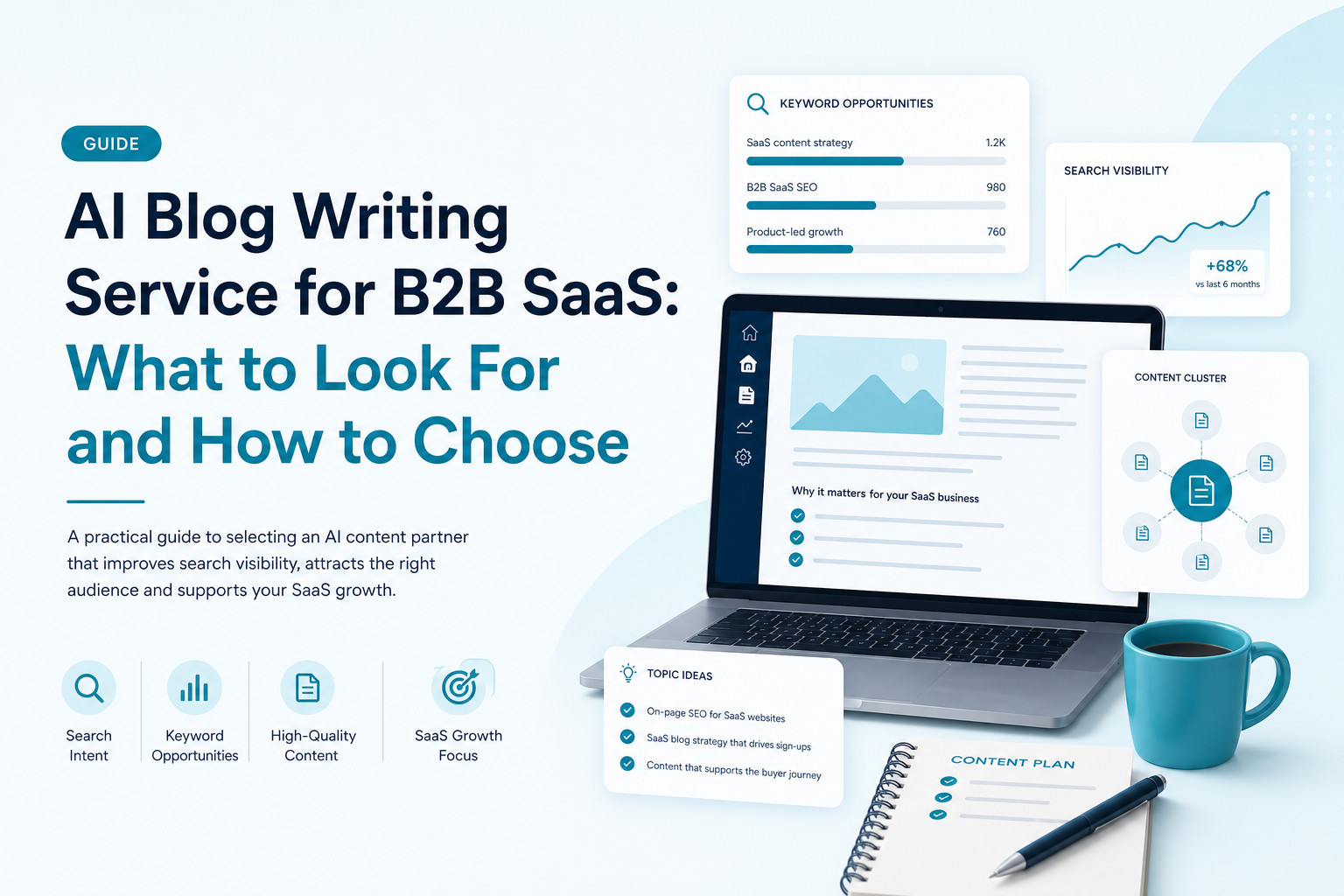
Choosing an AI blog writing service for B2B SaaS is not simply a matter of finding a tool that produces readable articles. Your content needs to support a clear search strategy, reflect your product accurately, match the intent behind relevant queries and give potential buyers useful reasons to trust your business.
For a small B2B SaaS company, the right service can reduce research time and create a more consistent publishing process. The wrong one may produce generic articles that sound polished but fail to attract qualified visitors or support your wider SEO goals. This guide explains what a suitable provider should include, how the process works, what affects pricing and how to compare AI SEO content platforms with other options.
What an AI blog writing service for B2B SaaS should include
A useful service combines content creation with research and strategic direction. It should not treat every topic as an isolated writing task. Instead, it should connect each article to your website, existing search visibility, competitors, customer questions and commercial priorities.
For B2B SaaS businesses, practical support often includes:
- Keyword and search-intent research based on realistic opportunities.
- Analysis of existing Google Search Console and Analytics data.
- Competitor content-gap analysis.
- Semantic keyword mapping and related-topic planning.
- SEO briefs, content calendars and article production.
- Review of brand positioning, product language and audience needs.
- Local SEO content creation where the business serves defined locations.
- Direct CMS publishing and SEO performance reporting where available.
The provider should also explain what human input is needed. AI can accelerate research, outlining and drafting, but product expertise, editorial judgement and fact checking remain important for credible B2B content.
Why generic AI writing tools are often not enough
General tools can produce a draft from a prompt, but they may not know which topics your website can realistically compete for. They can also miss the difference between an informational query, a comparison search and a buyer who is ready to request a demonstration.
A generic article may mention common industry terms without building a meaningful relationship between your product, audience and search intent. It may also repeat information already available across competing pages. This creates activity, but not necessarily a useful content asset.
A specialist AI SEO content platform takes a different approach. It uses evidence from your website and search performance to identify opportunities, then applies those insights to planning and writing. Ammpli combines Google Search Console and Analytics data with competitor research, search-intent analysis and semantic keyword mapping alongside our proprietary formula , helping small businesses turn existing visibility into a more focused content plan.
How the process works

A reliable AI blog writing service should make its process clear before you commit. You should know how topics are selected, how drafts are reviewed and how performance is measured after publication.
1. Analyse your current search performance
The process begins with your website rather than a blank document. Google Search Console can show the queries that already generate impressions, the pages receiving visibility and opportunities where your site appears without attracting enough clicks.
Google Analytics data adds context about what visitors do after arriving. Together, these sources help identify subjects connected to your existing audience and commercial goals.
2. Find realistic keyword opportunities
Keyword research should go beyond search volume. A relevant query with moderate demand may be more valuable than a broad term dominated by large publishers. A keyword opportunity finder can help identify searches where your website has a credible basis for gaining visibility.
The best opportunities usually sit close to your expertise, product category or customer problems. They may include comparison topics, implementation questions, integration searches, workflow problems or industry-specific use cases.
3. Map search intent and semantic topics
Search intent explains what a person expects to find when they search. A page aimed at “how to rank higher on Google” will need a different structure from a page aimed at comparing SEO content software.
Semantic keyword mapping connects the main topic with related concepts, questions and terminology. This supports clearer coverage without forcing repeated phrases into the copy. It can also help build topical authority by planning a group of connected pages rather than publishing disconnected posts.
4. Review competitor content gaps
Competitor research should identify useful gaps, not encourage imitation. A content gap analysis tool can reveal questions competitors answer poorly, topics they have missed and areas where their pages lack practical detail.
For a B2B SaaS company, this may lead to content about implementation, security processes, workflows, team adoption, reporting or sector-specific applications. The final topic should still reflect your own experience and offer a clear reason for the reader to continue with your business.
5. Create, review and publish the article
The writing stage should produce an article with a clear purpose, useful structure and accurate product references. A suitable workflow includes editorial review, brand checks, internal linking and a final review of titles, headings, metadata and calls to action.
Some SEO content software can publish directly to a CMS. This can reduce manual work, although your team should retain approval over important product claims, regulated subjects and pages aimed at high-value prospects.
6. Measure performance and improve the plan
Publishing is not the end of the process. Search impressions, clicks, rankings, engagement and conversions can show which topics deserve further work.
Performance reporting should inform future content planning rather than focus on a single metric. A page may first build visibility for several related searches before generating qualified enquiries. Regular review helps your team decide whether to update, expand, link to or replace an article.
What outcomes can you reasonably expect?
An AI blog writing service for B2B SaaS should help you create a more consistent and evidence-led publishing system. The immediate outcome is usually a clearer list of topics, briefs and articles connected to your audience and website data.
Over time, useful content can support:
- More relevant organic visibility.
- Stronger coverage of customer questions.
- Better internal linking between related pages.
- More consistent communication of your product’s value.
- A clearer route from informational content to commercial pages.
- Less manual research for your marketing team.
No provider can responsibly promise a fixed ranking position or a set level of traffic. Results depend on competition, site quality, technical factors, content usefulness, authority and ongoing publishing. A trustworthy provider explains these variables instead of presenting guaranteed outcomes.
Pricing factors for B2B SaaS AI content services
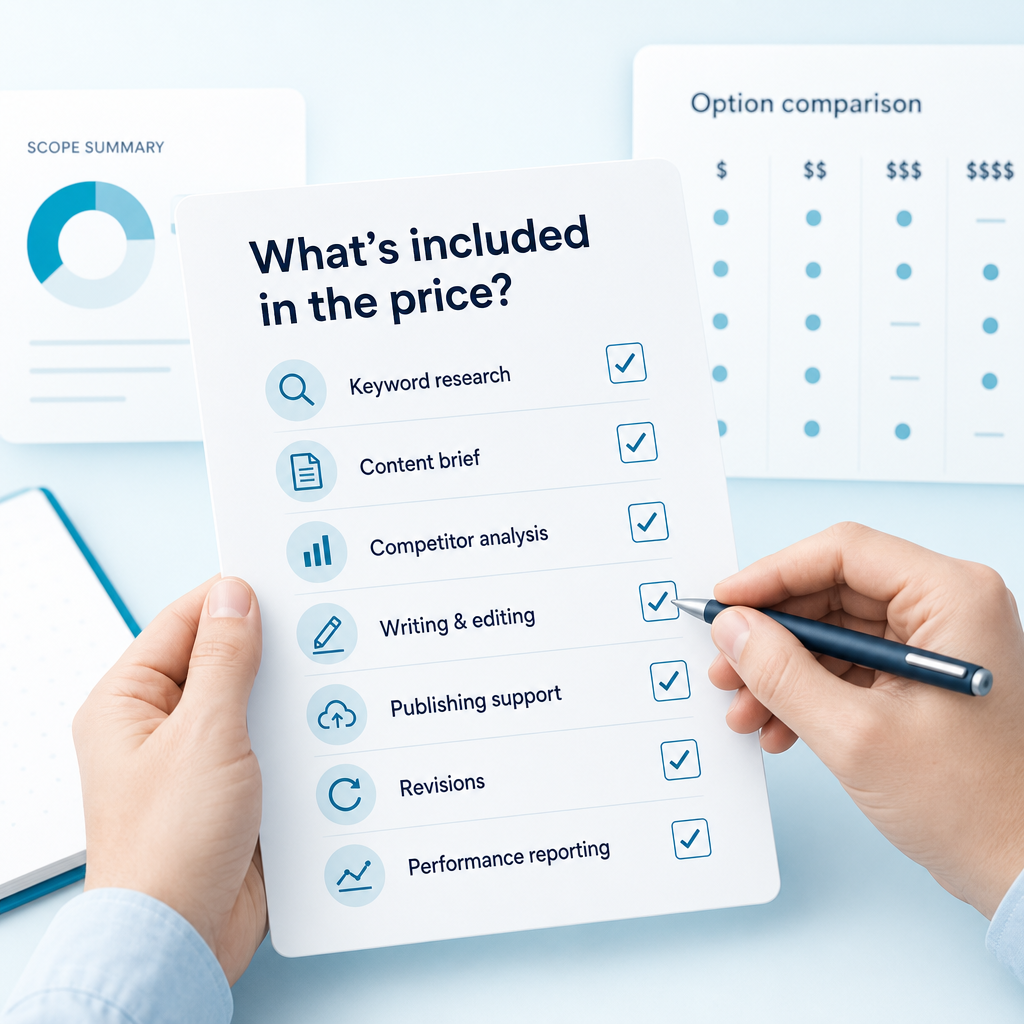
Pricing varies because providers offer different levels of research, editorial support and publishing assistance. A low-cost writing tool may produce drafts, while a specialist service may include opportunity analysis, content planning, semantic mapping, review and reporting.
Before comparing quotes, check what is included in the monthly or project fee. The table below highlights common differences between approaches.
| Option | Typical focus | Best suited to |
|---|---|---|
| Generic AI writing tool | Prompt-based drafts with limited website context | Teams with their own SEO strategy and editorial resources |
| Freelance SEO writer | Human-led research and article production | Businesses needing specialist writing for selected topics |
| Content marketing agency | Strategy, production and account support | Companies with a larger budget and wider marketing requirements |
| AI SEO content platform | Data-led opportunity research, planning, writing and reporting | Small teams seeking repeatable SEO content production |
Ask whether the price includes keyword research, content briefs, competitor analysis, editing, publishing, revisions and performance reporting. Also check whether you can approve topics before articles are created. Clear scope reduces surprises and helps you compare providers fairly.
How to evaluate a provider before choosing
The strongest provider is not necessarily the one that produces the highest number of articles. It is the one that can show how each article relates to your audience, search data and business objectives.
Look for a provider that:
- Explains its research and review process clearly.
- Uses your actual website data rather than relying only on generic keyword lists.
- Separates content creation from unsupported performance promises.
- Allows you to review topics and product claims.
- Creates content for people as well as search engines.
- Can support content planning, internal linking and future updates.
- Provides understandable reporting.
- Has experience working with limited internal marketing resources.
Ask for examples that demonstrate quality and relevance, while checking whether the examples reflect your market. Reviews can help, but they should be read alongside the provider’s process, scope and communication standards.
Why Ammpli may suit a small B2B SaaS team

Ammpli is an AI SEO content platform designed for small and growing businesses that need practical SEO support without the cost or complexity of a traditional SEO agency. It combines SEO opportunity analysis, Google Search Console data analysis, AI-powered SEO content creation and competitor content-gap analysis in one workflow.
The platform can help your team identify relevant searches where your website already has visibility but has not yet reached its strongest positions. It then supports search-intent research, semantic keyword mapping, topical authority planning and SEO content calendars, so your publishing decisions are based on evidence rather than guesswork.
Ammpli also supports local SEO content creation, blog and brand analysis, direct CMS publishing and SEO performance reporting. This makes it relevant to B2B SaaS teams in the United Kingdom and English-speaking international markets that want a repeatable approach without hiring a large external team.
When should you start?
It may be time to choose an AI blog writing service when your website receives impressions but your team does not have a clear plan for turning them into useful content. It may also be suitable when publishing has become irregular, articles are not connected to commercial goals or marketing staff spend too much time on manual research.
Start with a focused review of your existing website, search data and priority audiences. A good provider should help you identify a practical first set of opportunities rather than pushing an unnecessarily large content programme.
For many small teams, the best next step is to test the workflow on a limited set of topics. This lets you judge the quality of the research, writing, review process and reporting before making broader plans.
Frequently Asked Questions
What is an AI blog writing service for B2B SaaS?
It is a service or platform that uses AI to support research, planning and production of search-optimised blog content for business software companies. A strong service also considers website data, search intent, competitors, semantic topics and the product’s audience rather than producing generic drafts.
Can AI-written B2B SaaS content rank on Google?
AI-assisted content can perform well when it is accurate, useful, original and aligned with search intent. Rankings depend on many factors, including competition, site quality, technical performance, authority and the value the page provides. No responsible provider should guarantee a particular position.
How much does an AI SEO content platform cost?
Cost depends on the level of research, number of articles, editorial review, publishing support, reporting and other services included. Compare the full scope rather than the headline price, and check whether opportunity analysis and content planning are part of the package.
Is an AI SEO content platform suitable for a small B2B SaaS company?
It can be suitable when the company has an established website, some Google visibility and limited time or internal SEO expertise. The platform should make it easier to find realistic opportunities, plan connected content and publish consistently while keeping the team involved in approval and product accuracy.
What should I check before choosing a provider?
Review the provider’s research process, data sources, editorial controls, pricing scope, publishing options and reporting. Confirm that the service supports your audience and business model, explains limitations clearly and does not rely on unsupported ranking promises.
Can Ammpli help create a B2B SaaS SEO content plan?
Yes. Ammpli uses search-performance data, competitor research, search-intent analysis and semantic keyword mapping to identify content opportunities. It can then support SEO content planning, AI-powered article creation and performance reporting through a practical workflow for small and growing businesses.
Choose a more practical way to create SEO content
The right AI blog writing service for B2B SaaS should give you more than a collection of drafted articles. It should help you decide what to publish, why the topic matters, how it connects to your website and what to review after publication.
Ammpli brings those tasks together through an AI SEO content platform built around real search-performance data. If you are ready to turn your search data into better content, start your 14-day free trial. No credit card is required.