How to Create Local SEO Content for Your Services
If your service business is not appearing when nearby customers search for help, the problem may not be your service or your website. You may simply be creating content without a clear local SEO strategy behind it.
Learning how to create local SEO content for my services starts with understanding what your customers search for, where they are located, what they want to do next and which pages already perform well. The goal is not to add a town name to every heading. It is to create useful pages that match local search intent and give potential customers enough confidence to enquire.
This guide explains how small-business owners, founders and marketing managers can plan and create local SEO content for service areas across the United Kingdom and English-speaking international markets. It also explains how Ammpli uses Google Search Console and Analytics data, competitor research and semantic keyword mapping to help identify realistic content opportunities.
What is local SEO content?
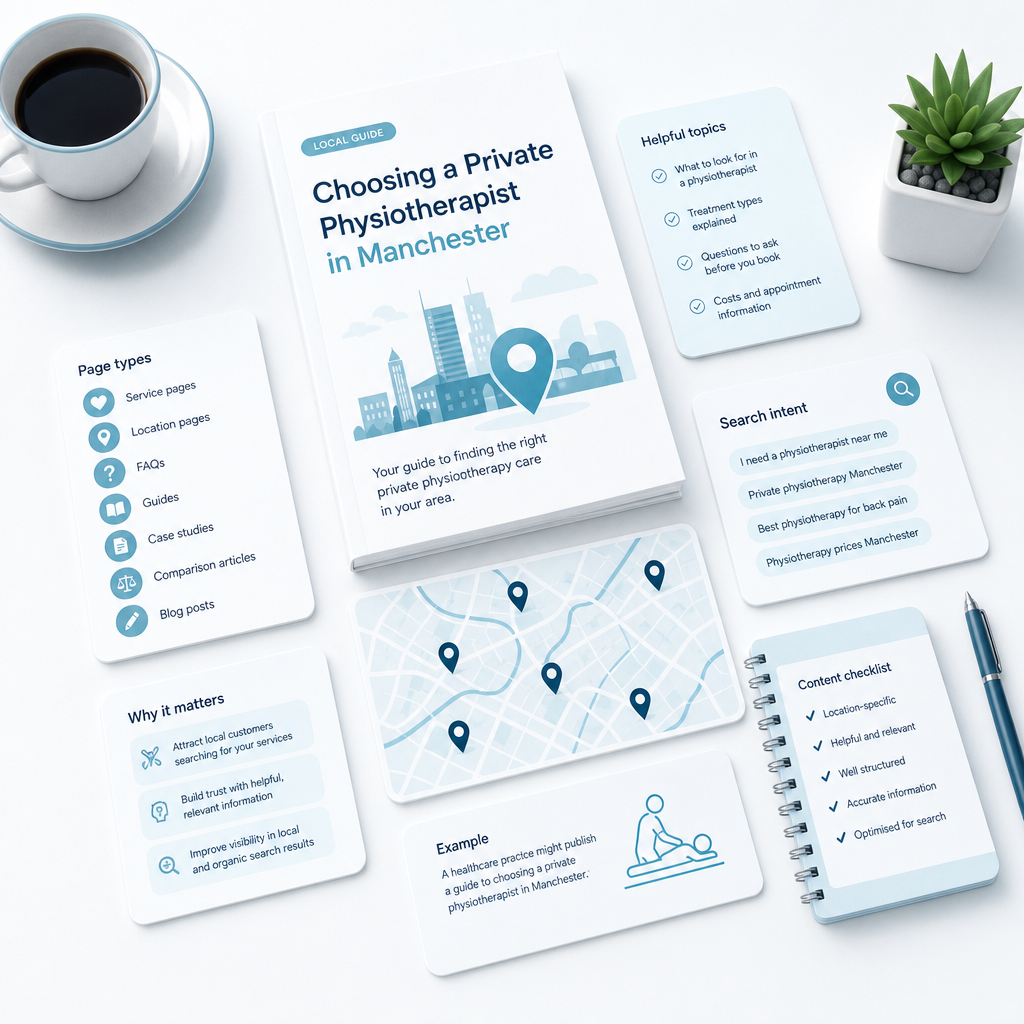
Local SEO content is website content created to attract people searching for a service in a particular geographic area. It can include service pages, location pages, FAQs, guides, case studies, comparison articles and blog posts that answer questions relevant to a local audience.
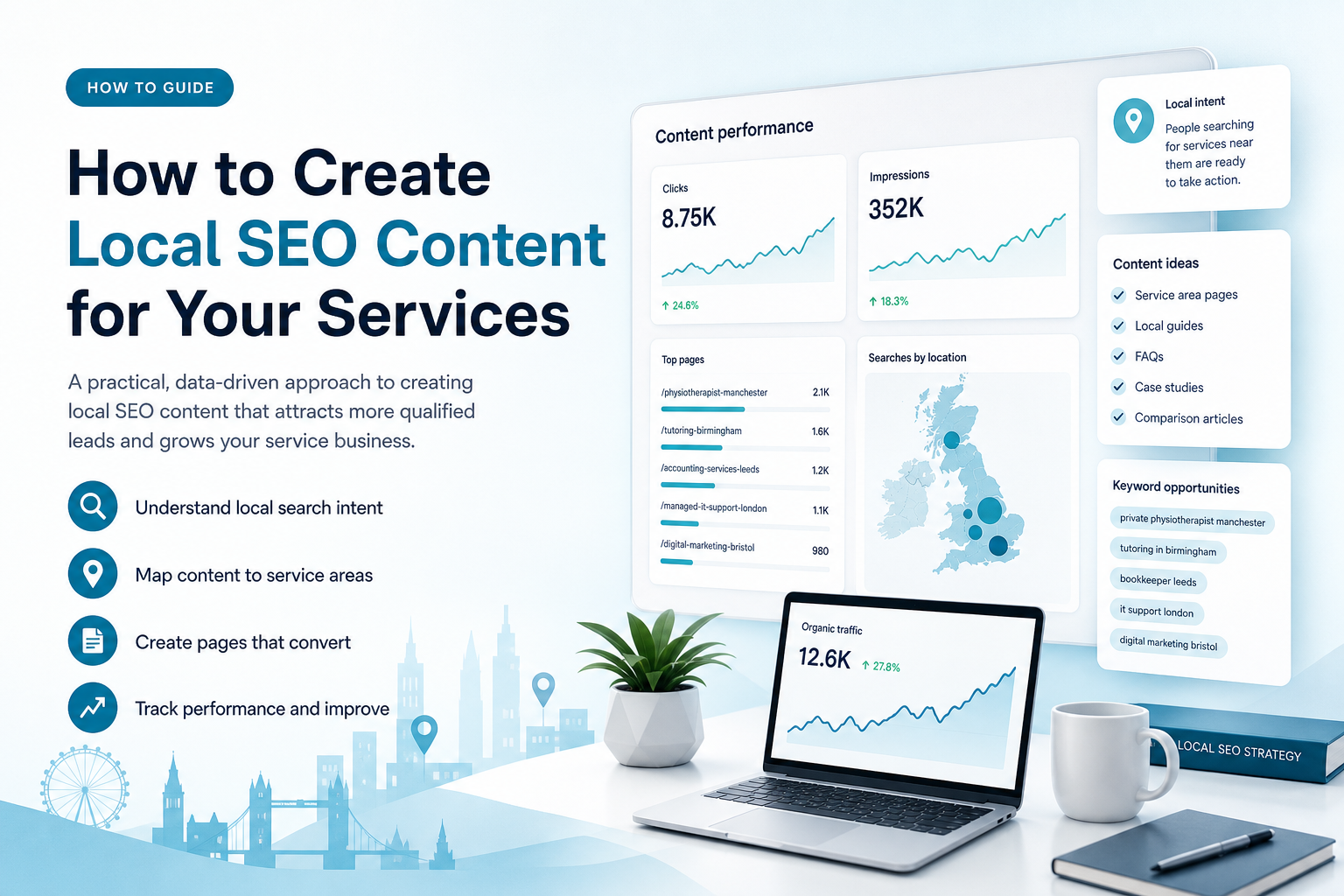
For example, a healthcare practice might publish a guide to choosing a private physiotherapist in Manchester. An education provider might create a page about tutoring options in Birmingham. A B2B SaaS company serving UK businesses could publish content about software requirements for small companies in London and surrounding areas.
Local SEO content supports two related search experiences. The first is the local pack and map results, which rely heavily on accurate business information, relevance and reputation. The second is the standard organic results, where helpful, well-structured service content can attract visitors before they are ready to contact you.
Why local SEO content matters for service businesses
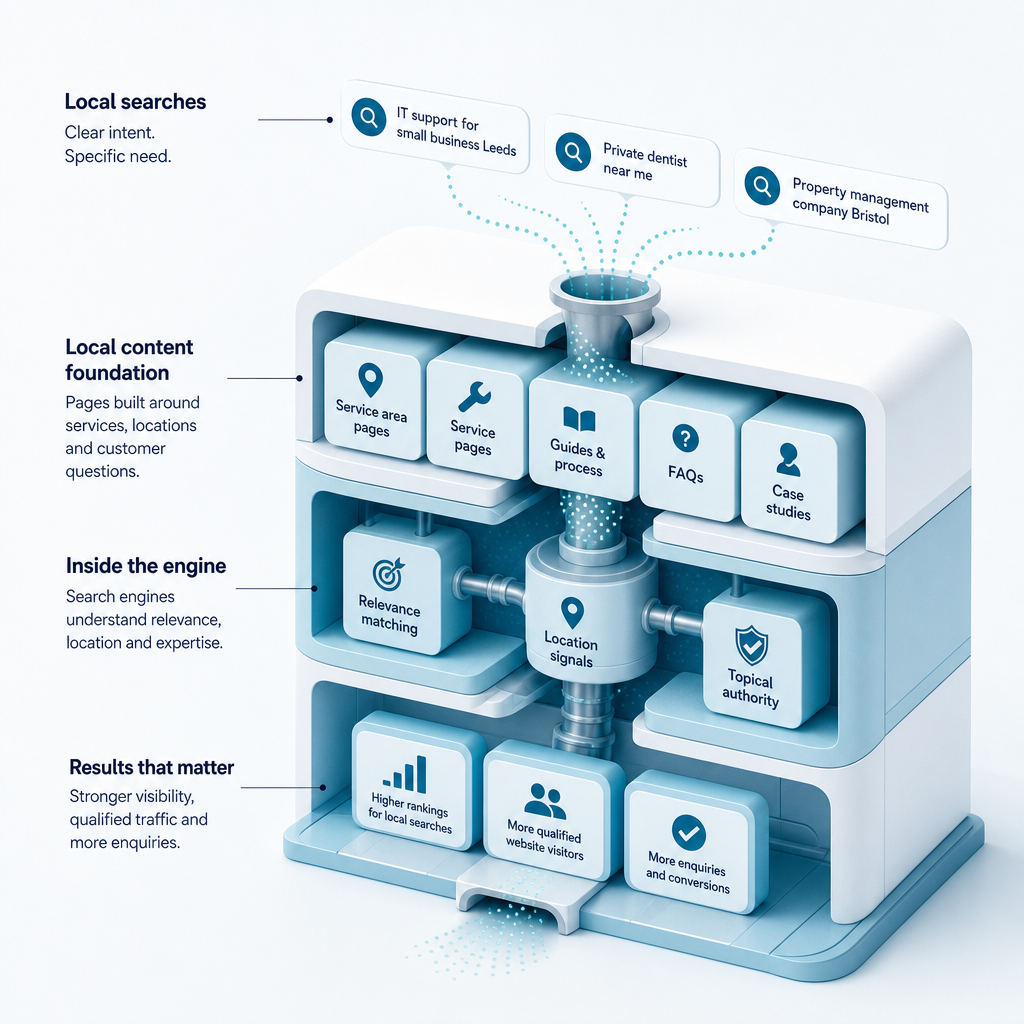
People searching for a service in a particular location often have a clear problem to solve. A query such as “IT support for small business Leeds”, “private dentist near me” or “property management company Bristol” reveals more intent than a broad search for “IT support”, “dentist” or “property management”.
Local content helps your business appear for these more specific searches. It also allows you to explain your process, service area, expertise, pricing factors and next steps before a prospect makes contact.
For small businesses, this matters because local SEO can create a more focused route to qualified enquiries. You do not need to compete for every broad industry term. You can build visibility around the services, locations and customer questions that are commercially relevant to your business.
Local content can support several business goals
- Attract customers searching for a specific service in a defined area.
- Explain what your service includes and who it is suitable for.
- Answer common questions before a sales conversation.
- Build topical authority around your services and industry.
- Support Google Business Profile visibility with relevant website content.
- Help potential customers compare providers with greater confidence.
How to create local SEO content for my services step by step
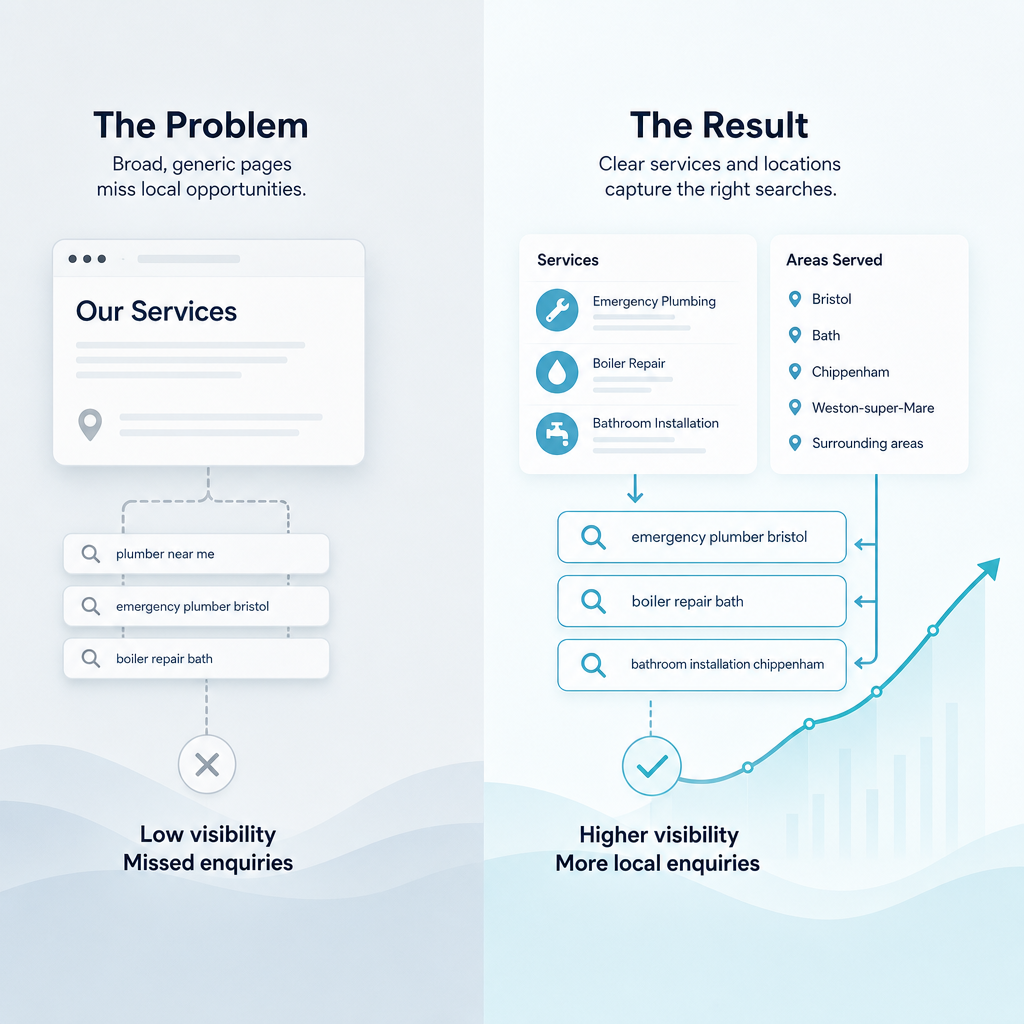
A reliable local content process begins with evidence rather than assumptions. Instead of publishing a large number of generic articles, identify the searches your audience makes, map them to the right pages and measure what happens after publication.
The steps below provide a practical framework for service businesses with limited time and marketing resources. You can use the process manually, or use an AI SEO content platform such as Ammpli to reduce research and planning work.
1. Define your services and service areas
Start with a clear list of the services you actually provide. Avoid grouping everything into one broad page if customers search for distinct services with different needs. A business offering web development, technical support and cybersecurity services may need separate service pages for each area.
Then list the locations you serve. This may include one town, several cities, a region, the whole of the United Kingdom or international English-speaking markets. Separate physical locations from service areas. A business can serve customers across a region without having an office in every town.
Your initial planning document should include:
- Core services and specialist services.
- Primary customer types.
- Physical locations, if applicable.
- Areas served remotely or through on-site visits.
- Industries or customer segments served.
- Commercial priorities, such as services with the strongest margins or capacity.
2. Research local keywords and search intent
Keyword research is not just about finding phrases with high search volume. It is about understanding the language customers use when they need your service and identifying which searches have local intent.
Begin with service-led phrases. A cleaning company might research “end of tenancy cleaning”, “commercial cleaning” and “deep cleaning”. A marketing provider might research “SEO content for small business”, “local SEO content creation” and “SEO content software”. Add locations only where they make sense, such as “commercial cleaning Birmingham” or “local SEO content creation for UK service businesses”.
Search intent describes what the person wants to accomplish. Common local service intents include:
- Service intent: the searcher wants to hire a provider.
- Location intent: the searcher wants a provider in a specific area.
- Problem intent: the searcher wants help with a problem.
- Comparison intent: the searcher is comparing services, providers or approaches.
- Information intent: the searcher wants to understand a service before taking action.
Google Search Console is particularly useful because it shows the queries for which your website already receives impressions and clicks. Some of these searches may sit just outside the strongest positions. Improving or expanding the relevant page may be more realistic than starting with an entirely new topic.
3. Find realistic ranking opportunities
Small businesses often waste resources targeting broad terms dominated by established brands. A better approach is to find relevant searches where your website has existing visibility, where competitors have content gaps or where the search intent closely matches a service you want to sell.
Review queries that receive impressions but few clicks. Check the current ranking page and ask whether it answers the searcher’s question fully. You may find that a service page needs clearer local information, a blog post needs stronger internal links or a new page is needed for a distinct service and location combination.
A keyword opportunity finder can help group opportunities by service, location, search intent and business value. Ammpli uses Google Search Console and Analytics data alongside competitor research to identify relevant opportunities rather than producing content from generic keyword lists.
4. Analyse competitors and content gaps
Search for your priority service and location combinations. Review the businesses appearing in the local pack and the organic results. Look at the pages they use, the questions they answer, their service descriptions, trust signals and calls to action.
Competitor research should not mean copying another business. It should help you identify what customers expect to see and where the current results leave unanswered questions.
Look for gaps such as:
- A service page that does not explain the process.
- Missing information about service areas or response times.
- Weak answers to pricing and availability questions.
- Limited evidence of experience or relevant expertise.
- No content for a specific customer type or use case.
- Outdated information or pages that are difficult to use on mobile devices.
A content gap analysis tool can speed up this review by comparing topics, subtopics and semantic terms across competing pages. The output should be a practical brief, not a list of phrases to insert mechanically.
5. Map keywords and topics to the right page
Each important search theme should have a clear destination. A homepage may target the business category and primary service area. Individual service pages should target distinct services. Location pages should explain what is available in that location and include genuinely useful local information.
Do not create near-identical pages for every town simply by replacing the place name. Thin or repetitive pages provide little value to users. Each location page should explain the service, the customers served, relevant local context, availability and the reasons someone in that area may choose your business.
Semantic keyword mapping helps connect the main topic with related concepts. For a page about boiler repair in London, related topics might include boiler types, emergency appointments, service coverage, engineer qualifications and maintenance. The exact subjects depend on the service and what customers need to decide.
6. Build a local SEO content brief
A content brief gives the writer or AI SEO content generator a clear purpose. It should define the audience, primary topic, location, search intent, page type, recommended structure and conversion goal.
A useful brief can include:
- Primary service and location.
- Target customer and their problem.
- Primary keyword and related search themes.
- Questions the page should answer.
- Competitor gaps to address.
- Evidence, credentials or trust information to include.
- Relevant internal links.
- Call to action, such as requesting a quote or booking a consultation.
Data-driven SEO content is easier to review because the team can judge it against a defined purpose. It also reduces the risk of producing polished copy that attracts the wrong audience.
7. Write for local customers, not search engines
Good local content should sound like a knowledgeable service provider speaking to a real customer. Explain what happens, what the service includes, who it suits and what the next step involves.
Use local terms naturally, but do not repeat a town or city in every paragraph. Mention relevant areas when explaining service coverage, travel arrangements, local regulations, customer needs or nearby business conditions. If a detail does not help the reader, it does not need to appear.
Strong service content usually includes:
- A clear explanation of the service.
- The problem or outcome it addresses.
- Who the service is for.
- What the process involves.
- Factors that influence pricing.
- Expected deliverables or outcomes.
- Answers to common concerns.
- A direct, relevant enquiry route.
8. Add local trust signals and practical details
Search visibility is only useful when the page gives people a reason to contact you. Include accurate business information and details that reduce uncertainty.
Depending on the business, useful trust signals may include service areas, opening hours, qualifications, professional memberships, relevant experience, customer feedback, photographs, examples of work and clear contact details. Do not add claims that cannot be supported.
Keep your business name, address and phone number consistent across your website, Google Business Profile and relevant directories. If you operate as a service-area business, explain where you work and whether customers visit you, you visit them or the service is delivered remotely.
9. Optimise the page technically
Local content needs a sound on-page foundation. Use a descriptive title, a clear H1, helpful subheadings and a readable URL. Write a meta description that explains the page’s value rather than repeating a keyword.
Check that the page works well on mobile devices, loads efficiently and links to related services or helpful guides. Add relevant image descriptions and structured data where appropriate. LocalBusiness schema can help describe the business, while Service and FAQ structured data may be relevant when the page genuinely contains those elements.
Technical improvements support user experience, but they cannot replace useful content. A perfectly formatted page will not compensate for vague service information or a mismatch with search intent.
10. Connect local content with your wider website
Internal links help users move from educational content to relevant service pages. They also help search engines understand the relationship between your topics.
For example, a guide about choosing a local IT support provider could link to managed IT support, cybersecurity services and an enquiry page. A location page could link to the services available in that area and a related guide explaining the process.
Use descriptive anchor text that tells the reader what they will find. Avoid linking every mention of a location or forcing links where they do not help.
11. Publish consistently with a realistic calendar
Consistency matters more than publishing a large number of pages at once. A small business may benefit from one strong service page improvement and one useful supporting article each month rather than several rushed posts.
Prioritise content using three factors: business value, likelihood of attracting relevant searchers and the effort required. A practical calendar may include service pages, location pages, customer questions, comparison guides, process explanations and updates to existing content.
An SEO content planning tool can turn opportunities into a calendar with assigned topics, target pages and publication priorities. Ammpli combines opportunity analysis, search-intent research, semantic mapping and AI-powered SEO content creation to help small teams maintain this process without the cost of a traditional SEO agency.
What local SEO content should a service business create?
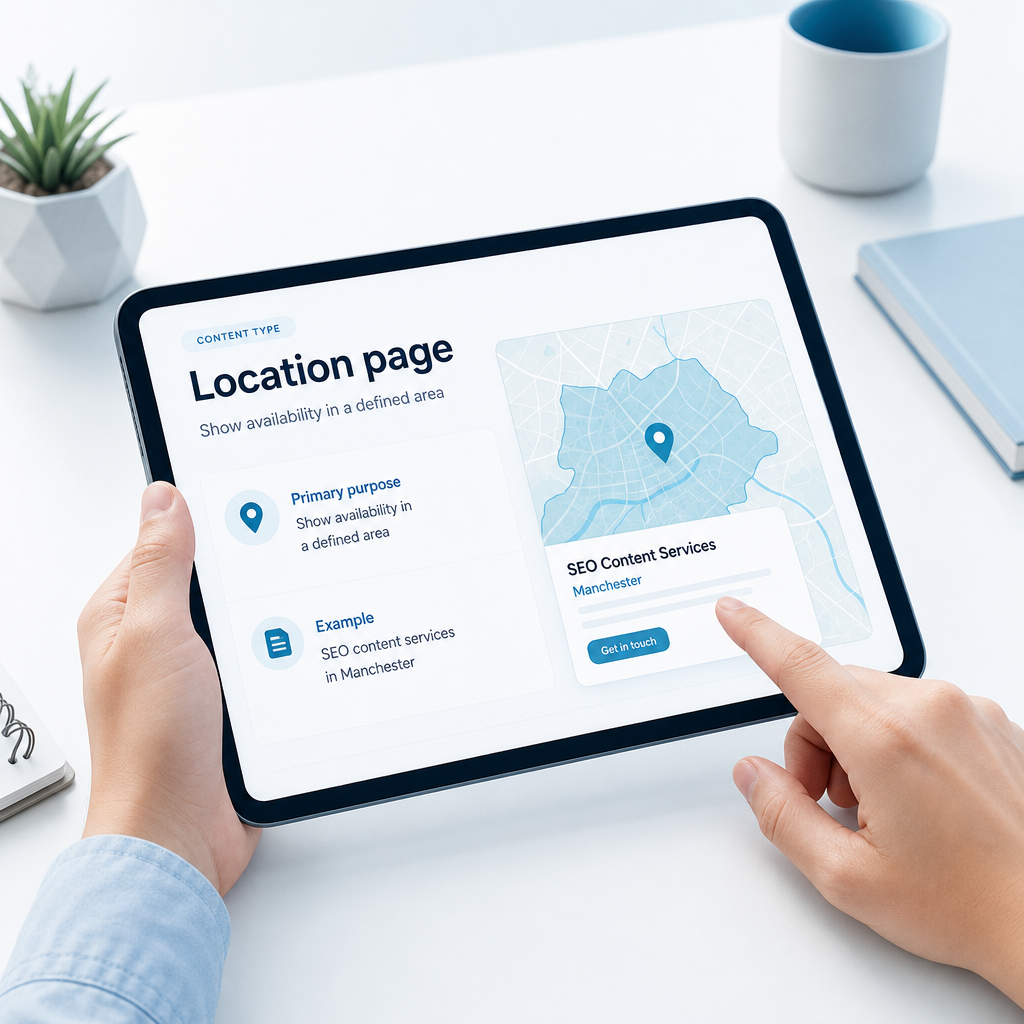
The right content mix depends on your services, customers and coverage area. The following formats are useful starting points for many service businesses.
| Content type | Primary purpose | Example |
|---|---|---|
| Service page | Explain a service and generate enquiries | Managed IT support for small businesses |
| Location page | Show availability in a defined area | SEO content services in Manchester |
| Service and location page | Match strong local commercial intent | Private tutoring in Birmingham |
| How-to guide | Answer questions before purchase | How to prepare for a property valuation |
| Comparison guide | Support provider or solution evaluation | In-house content versus an AI SEO content platform |
| FAQ page | Reduce objections and support enquiries | How much does local SEO content cost? |
How to measure local SEO content performance
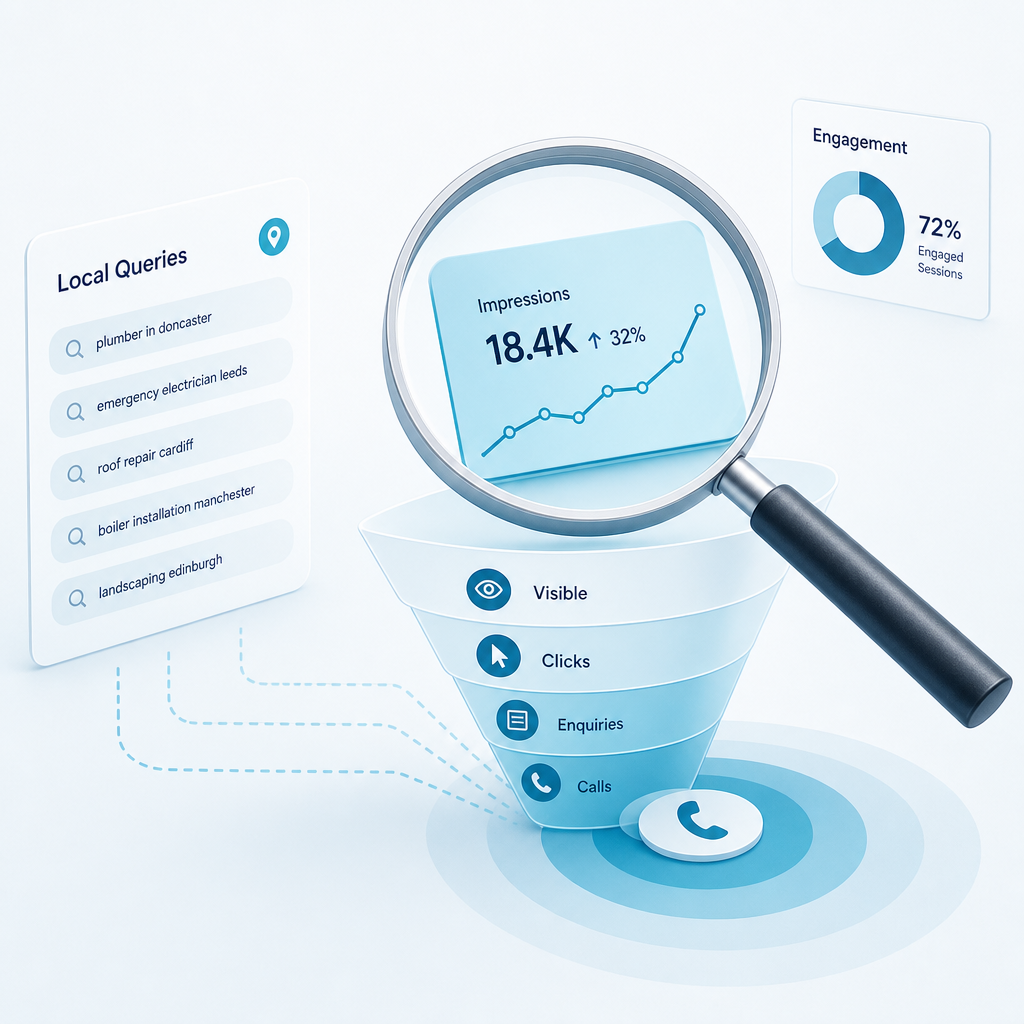
Measurement should focus on whether your content is becoming more visible to the right audience and helping people take meaningful next steps. Rankings can be useful, but they are only one part of the picture.
Google Search Console can show impressions, clicks, click-through rate and average position for queries and pages. Google Analytics can help you understand engagement, landing pages and actions taken on the website. Together, these tools provide a stronger view than relying on a single rank position.
Track indicators such as:
- Impressions for relevant local queries.
- Clicks and click-through rate from search.
- Visibility for service and location combinations.
- Engagement on local landing pages.
- Enquiry form submissions, calls or consultation requests.
- Assisted conversions from informational articles.
- Pages that gain visibility but need stronger conversion elements.
Review performance regularly and update pages when the data shows a clear opportunity. A page receiving impressions for related searches may need additional sections, stronger internal links or a clearer explanation of the service.
Common local SEO content mistakes
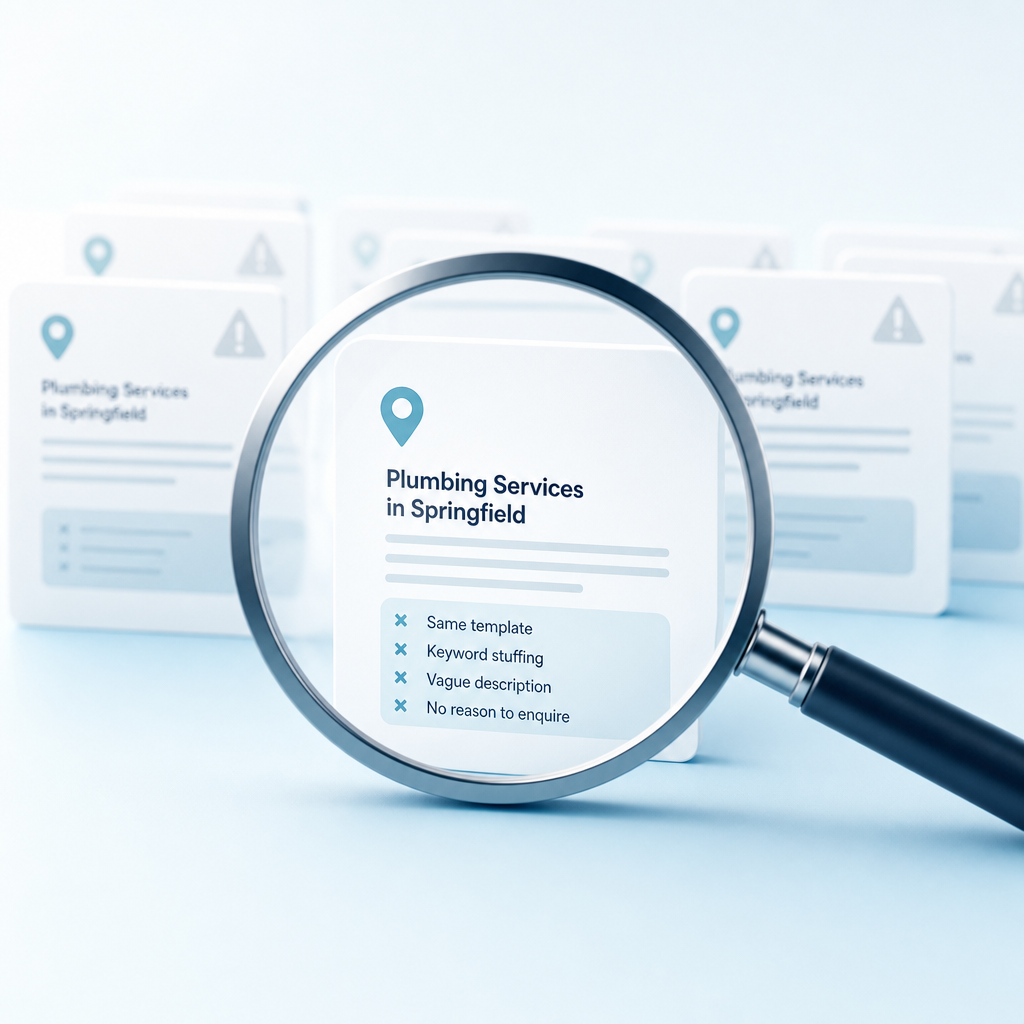
Local content fails when it is created to satisfy a checklist rather than to help a customer. Many small businesses publish pages with repeated location names, vague service descriptions and no clear reason to enquire.
Avoid these common problems:
- Creating almost identical pages for multiple locations.
- Choosing keywords without checking local search intent.
- Writing for broad traffic instead of commercially relevant searches.
- Publishing AI-generated text without reviewing facts, tone or usefulness.
- Ignoring existing Google Search Console visibility.
- Leaving service areas, contact details or opening information unclear.
- Using unsupported claims, inflated results or unverified testimonials.
- Publishing once and never reviewing performance.
AI content writing for SEO can save time, but the quality depends on the inputs. Generic AI writing tools can produce fluent text without understanding your existing rankings, competitors, customers or commercial priorities. A stronger workflow combines business knowledge, search data, human review and structured content planning.
Choosing a local SEO content provider or platform
You may be comparing an SEO agency, content marketing agency, freelance SEO writer, generic AI writing tool or SEO content software. Each option can suit a different situation. The right choice depends on your budget, internal capacity, need for strategic input and desired level of control.
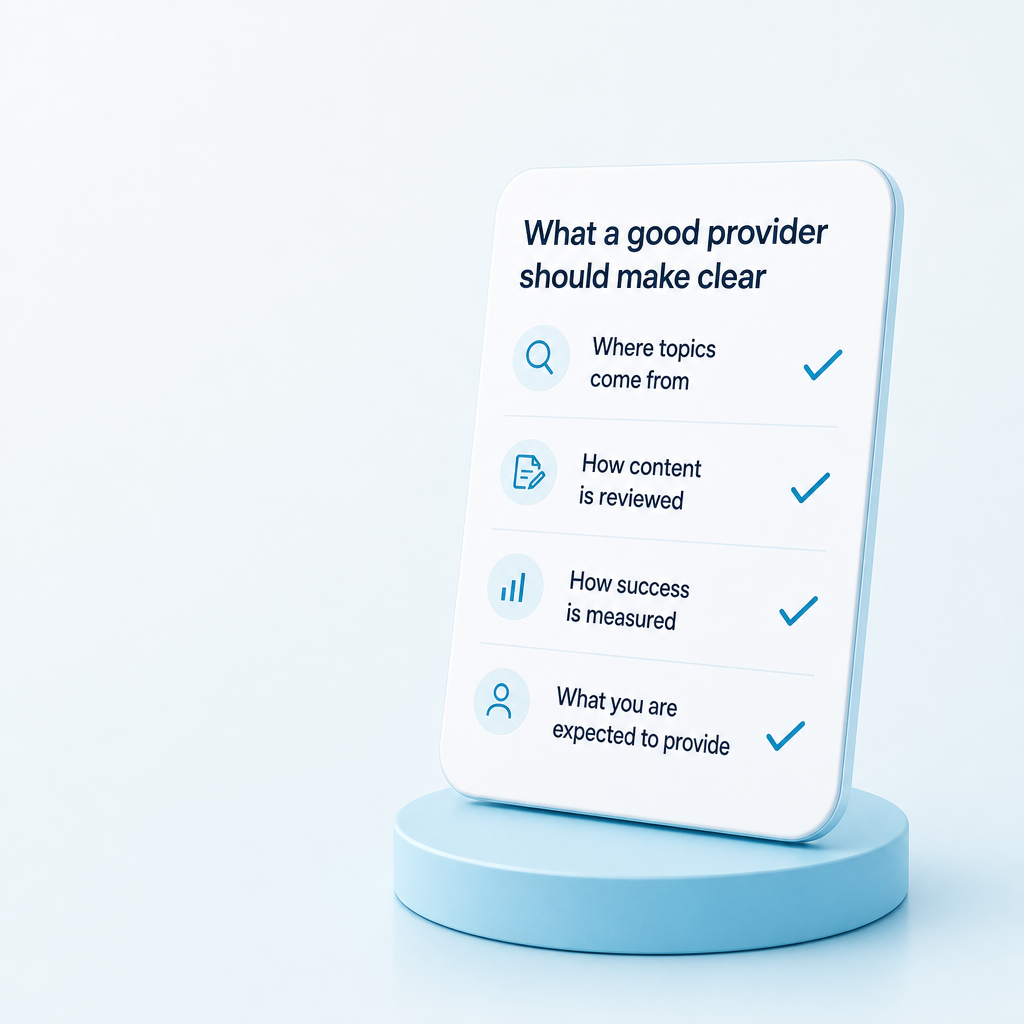
A good provider or platform should make the process clear. You should understand where topics come from, how content is reviewed, how success is measured and what you are expected to provide.
| Approach | Strength | Potential limitation | Suitable for |
|---|---|---|---|
| Traditional SEO agency | Strategic support and managed delivery | May require a larger budget and longer commitment | Businesses needing an outsourced SEO function |
| Freelance SEO writer | Flexible content production | Research and strategy depth can vary | Businesses with an established content plan |
| Generic AI writing tool | Fast drafting and ideation | May lack search-performance and competitor context | Teams able to provide their own research and editing |
| AI SEO content platform | Combines opportunity research, planning and content creation | Still requires business review and accurate inputs | Small teams seeking repeatable, data-informed SEO workflows |
Ammpli is an AI SEO content platform built for small and growing businesses. It combines Google Search Console and Analytics data with competitor content-gap analysis, search-intent research and semantic keyword mapping. This helps users identify realistic opportunities, plan relevant content and create search-optimised articles without managing every research task manually.
When should you start creating local SEO content?
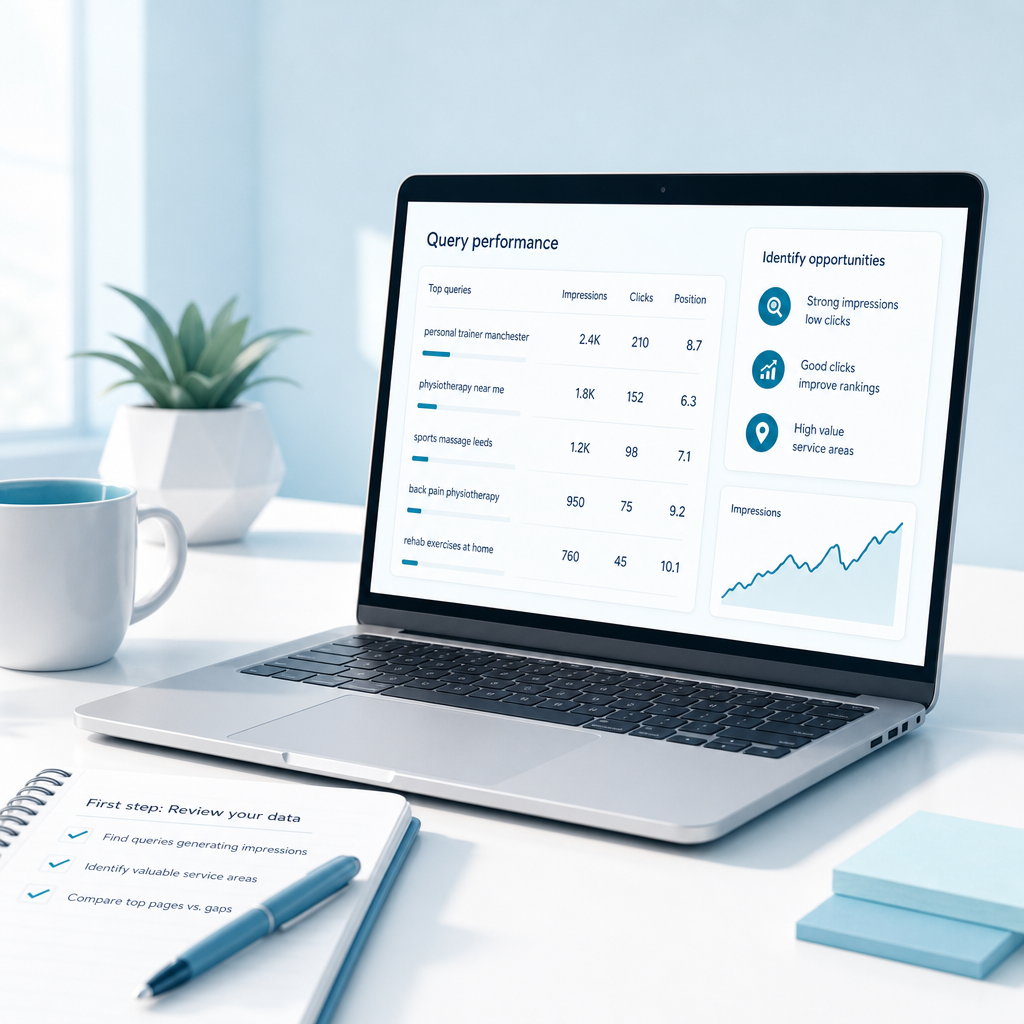
Start when your website has a clear service offering, some existing search visibility and a willingness to publish and improve content consistently. You do not need a large marketing department or a perfect website to begin.
The most useful first step is often a review of your current data. Find the queries already generating impressions, identify the service areas with commercial value and compare the pages that perform well with those that need improvement.
If you are entering a new location, launching a service or seeing competitors attract searches you should be earning, a focused local SEO content plan can help you act with less guesswork. Build the plan around evidence, publish useful pages and review performance as new data becomes available.
Frequently Asked Questions
How do I create local SEO content for my services?
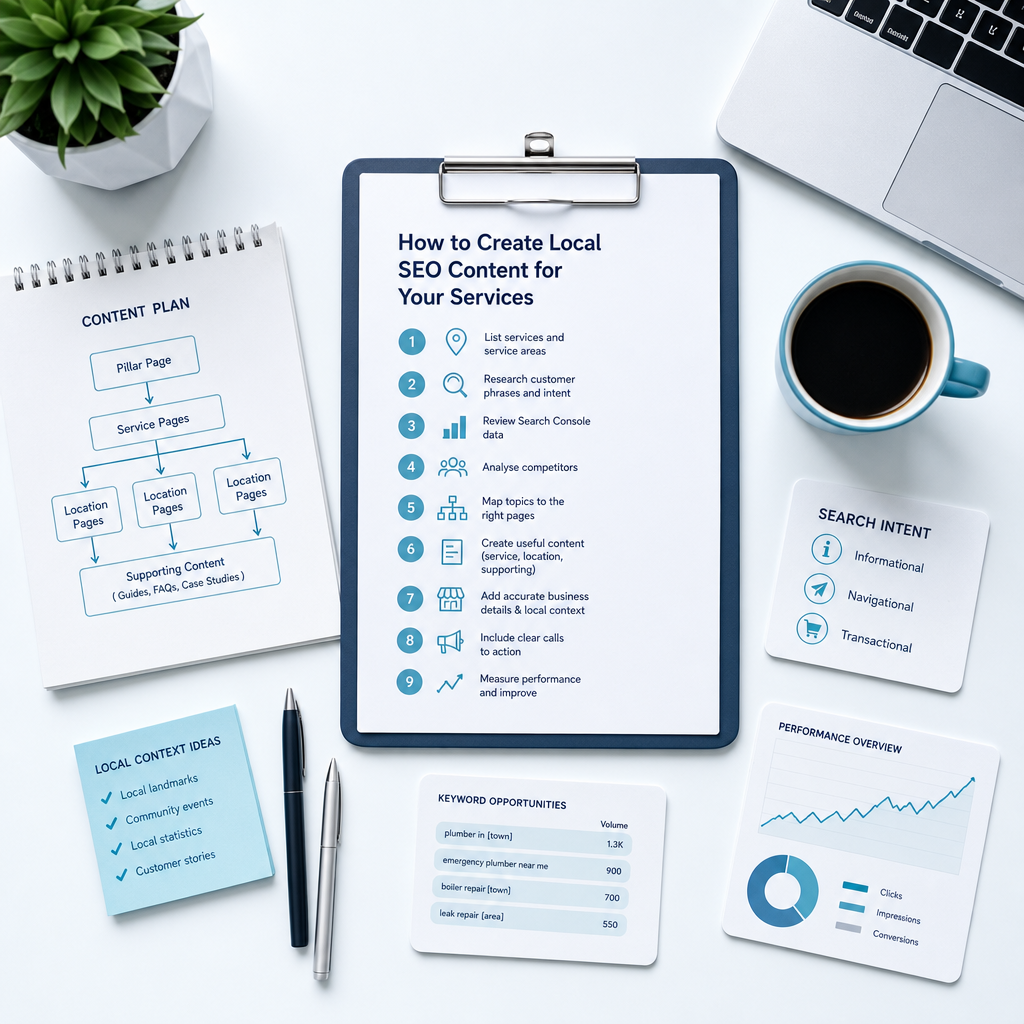
Start by listing your services and service areas, then research the phrases customers use and classify their search intent. Review Google Search Console data, analyse competitors, map topics to the right pages and create useful service, location and supporting content. Include accurate business details, relevant local context, clear calls to action and a process for measuring performance.
Should every service have a separate local landing page?
Separate pages are useful when services have different customer needs, search intent or locations. Avoid creating pages that are almost identical apart from a town name. Each page should provide genuinely useful information about the service, availability, local relevance and next steps.
Can AI create local SEO content for my business?
AI can help with research, outlines, drafting, semantic topic coverage and content production. It should work from accurate business information and reliable search data, and a person should review the final content for accuracy, usefulness, tone and compliance. A platform connected to Google Search Console and Analytics can provide stronger context than a generic writing tool.
How much does local SEO content cost?
Pricing depends on the number of services and locations, research depth, content length, technical requirements, review time and whether strategy, publishing and reporting are included. A single service page usually requires less work than a full local content system covering opportunity research, competitor analysis, content creation and ongoing updates. Ask providers to explain what is included rather than comparing a headline price alone.
How long does local SEO content take to produce results?
Results vary according to competition, website authority, content quality, search demand, technical health and publishing consistency. Some pages may gain impressions relatively quickly, while meaningful visibility and enquiry trends can take longer. Use Search Console and Analytics to monitor progress and improve pages based on evidence rather than expecting a fixed timeframe.
What makes Ammpli different from a generic AI writing tool?
Ammpli combines AI-powered content creation with Google Search Console and Analytics data, competitor research, search-intent analysis, content-gap analysis and semantic keyword mapping. This gives small teams a way to connect content production with real search opportunities and a practical content plan. It is designed to reduce guesswork and manual research while leaving businesses in control of their expertise and final review.
Create your local SEO content plan with Ammpli
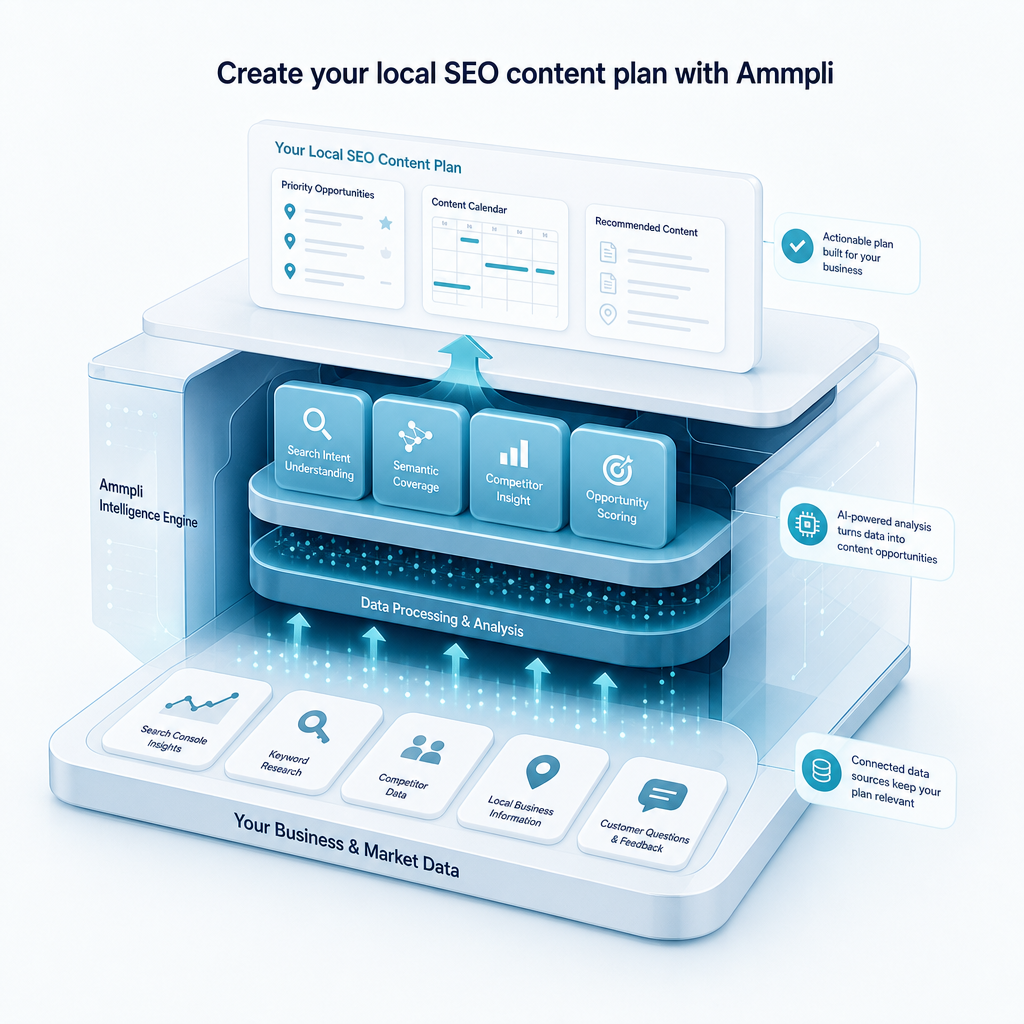
Creating local SEO content for your services is easier when every page has a clear audience, location, search intent and commercial purpose. The strongest process combines accurate business information, competitor insight, semantic coverage and ongoing performance analysis.
Ammpli helps small businesses turn search data into practical content decisions. Use it to identify your next ranking opportunity, build an SEO content calendar, create data-driven SEO content and improve organic visibility across the United Kingdom and English-speaking international markets.
Start your 14-day free trial and see how Ammpli can help you create your SEO content plan. No credit card required.