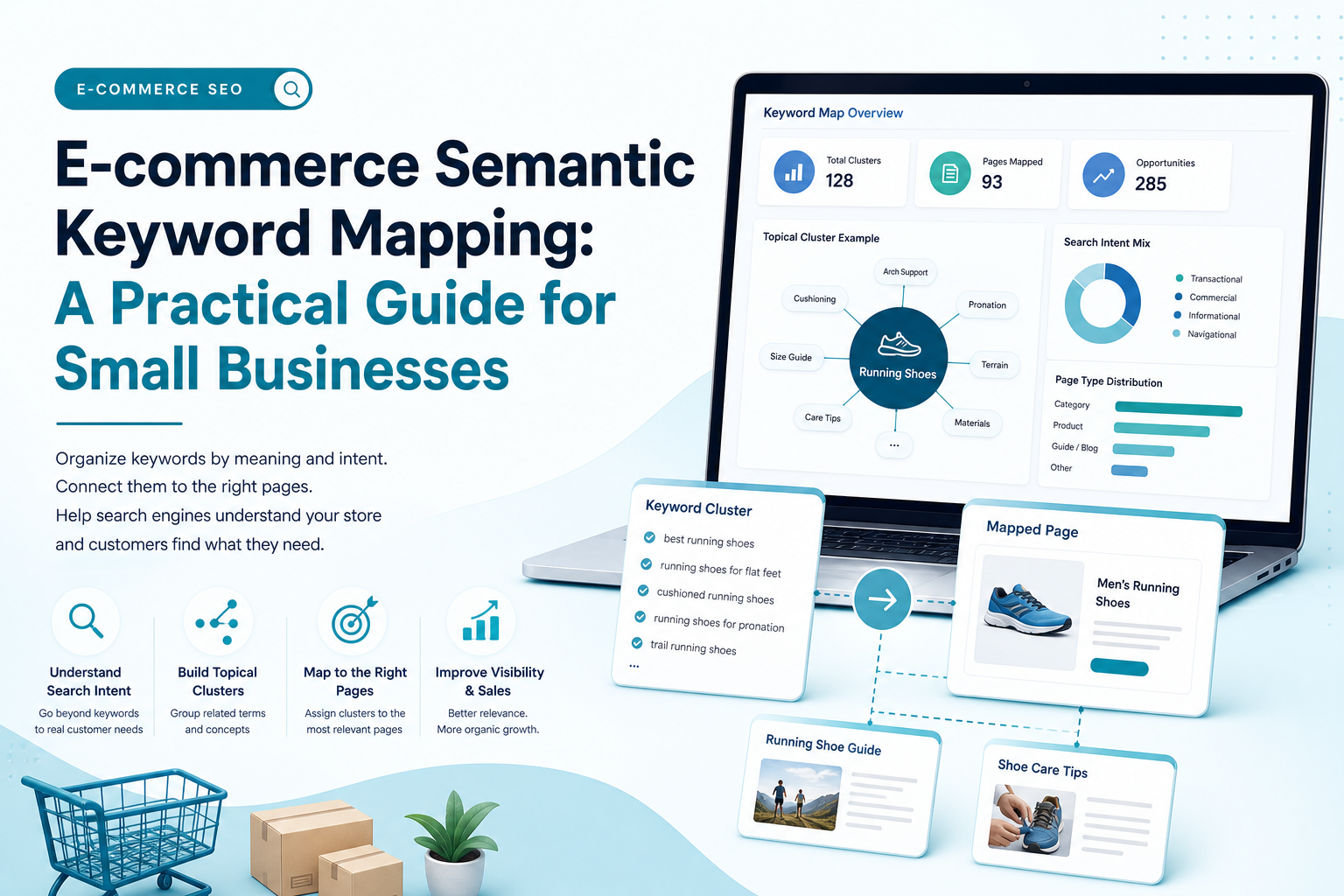
Your online shop may have useful products, well-written descriptions and a professional design, yet still struggle to appear for the searches that matter. A common reason is that keywords have been collected as a long list rather than organised into a clear plan showing which search belongs on which page.
E-commerce semantic keyword mapping solves that problem. It connects products, categories, attributes, related concepts and search intent so that search engines can understand your store and customers can find the right page more easily. It also gives a small marketing team a practical way to decide what to improve, what to publish and what not to create.
This guide explains how e-commerce semantic keyword mapping works, why it matters, how to build a map, which data to use and where an AI SEO content platform such as Ammpli can reduce the manual work.
What is e-commerce semantic keyword mapping?
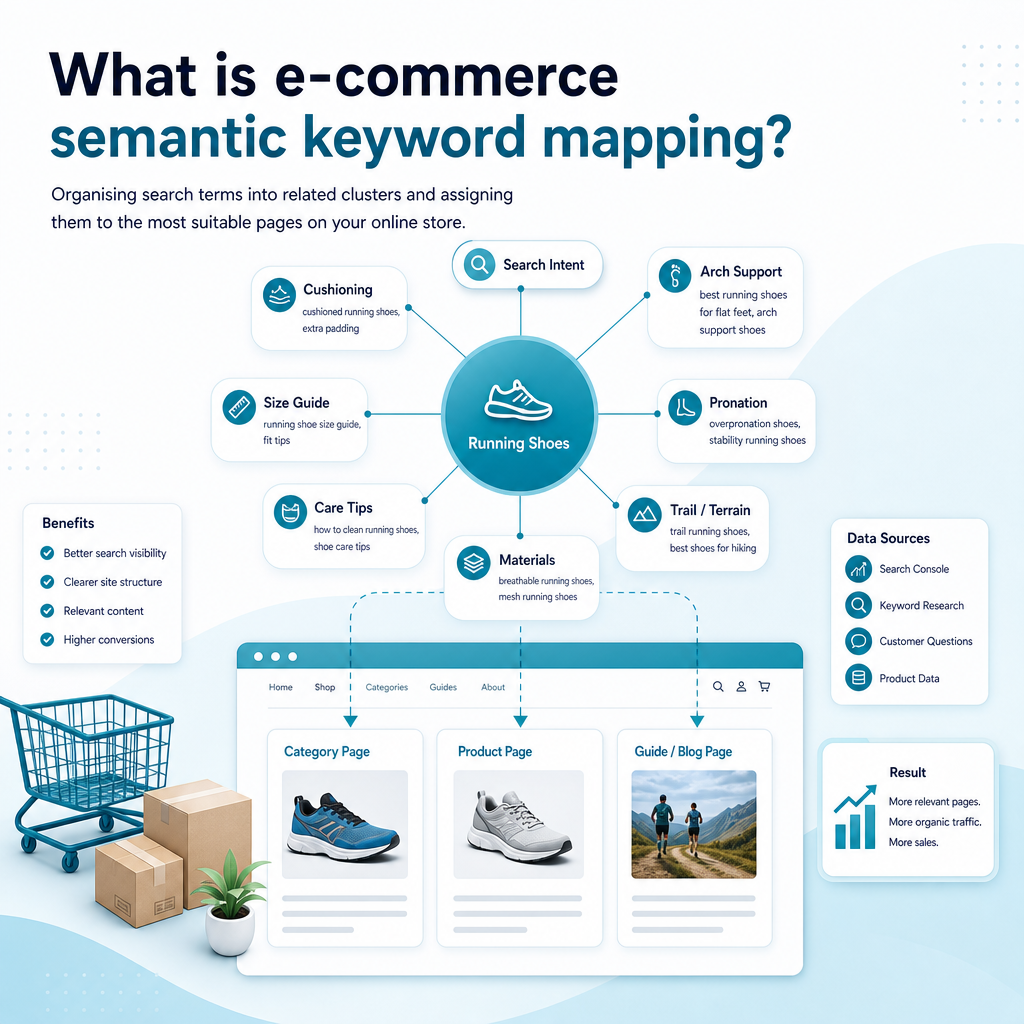
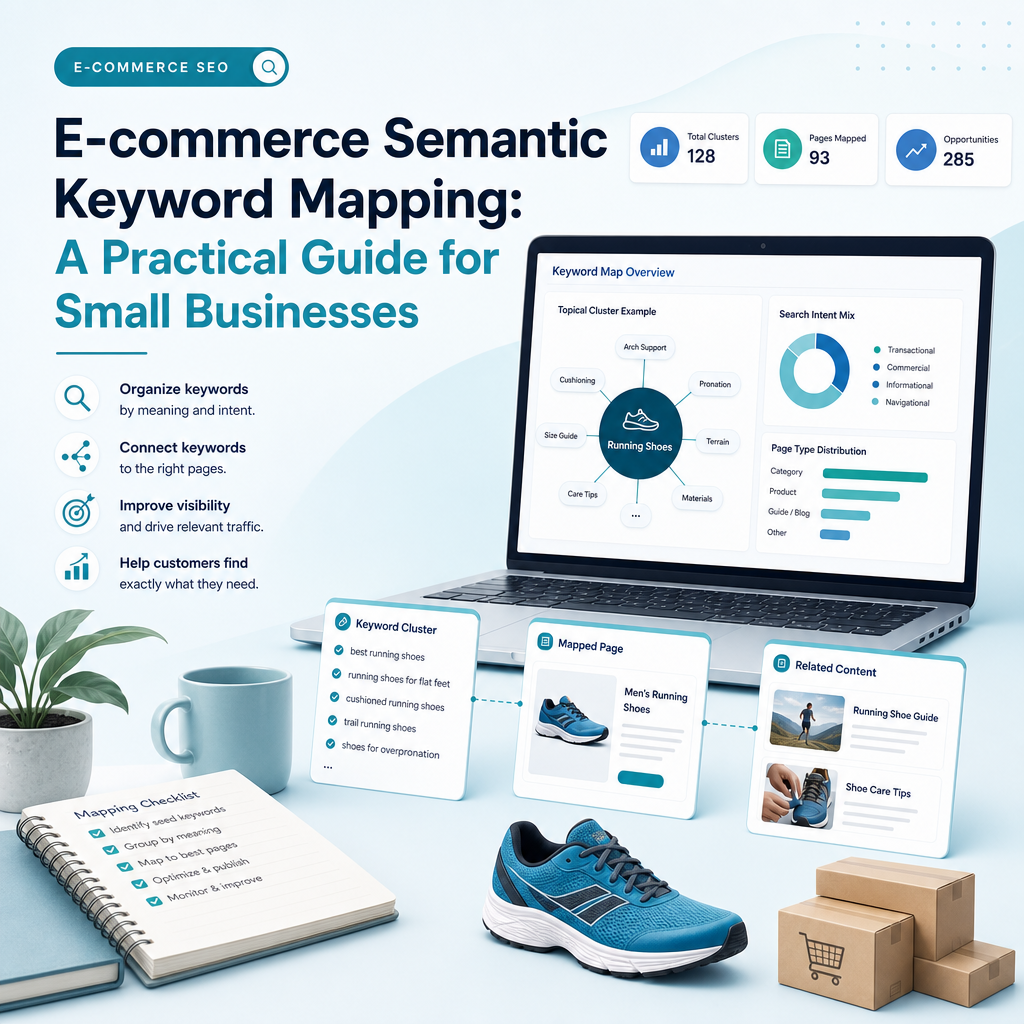
E-commerce semantic keyword mapping is the process of organising search terms into related clusters and assigning those clusters to the most suitable pages on an online store. The map looks beyond exact-match phrases and includes the meanings, entities, attributes, questions and buying needs connected to a product or category.
Traditional keyword mapping might assign “running shoes” to a category page and “running shoes for flat feet” to a guide. Semantic mapping goes further by identifying the relationships between running shoes, cushioning, arch support, pronation, terrain, size, materials, price and customer type. Those relationships help determine whether a term belongs on a product page, category page, buying guide, comparison page, filter or FAQ.
The result is a structured SEO plan that supports product discovery, content planning, internal linking and topical authority. It helps a store target a broad set of relevant searches without creating several pages that compete for the same intent.
Semantic keywords, entities and topics
Semantic keywords are related terms and phrases that add context to a primary topic. They are not limited to synonyms. They can include features, use cases, questions, product types, locations, brands, materials and problems a shopper wants to solve.
Entities are identifiable things or concepts that search engines can distinguish, such as a brand, product type, material, place or technology. A page about sustainable footwear might refer to recycled polyester, vegan leather, cushioning and running gait. These entities help clarify what the page is about and how its subject relates to the wider market.
A topic is the broad subject, such as “eco-friendly running shoes”. Semantic keywords and entities provide the detail that makes the topic useful. E-commerce semantic keyword mapping brings these elements together and assigns them to a logical page structure.
Why semantic keyword mapping matters for e-commerce SEO
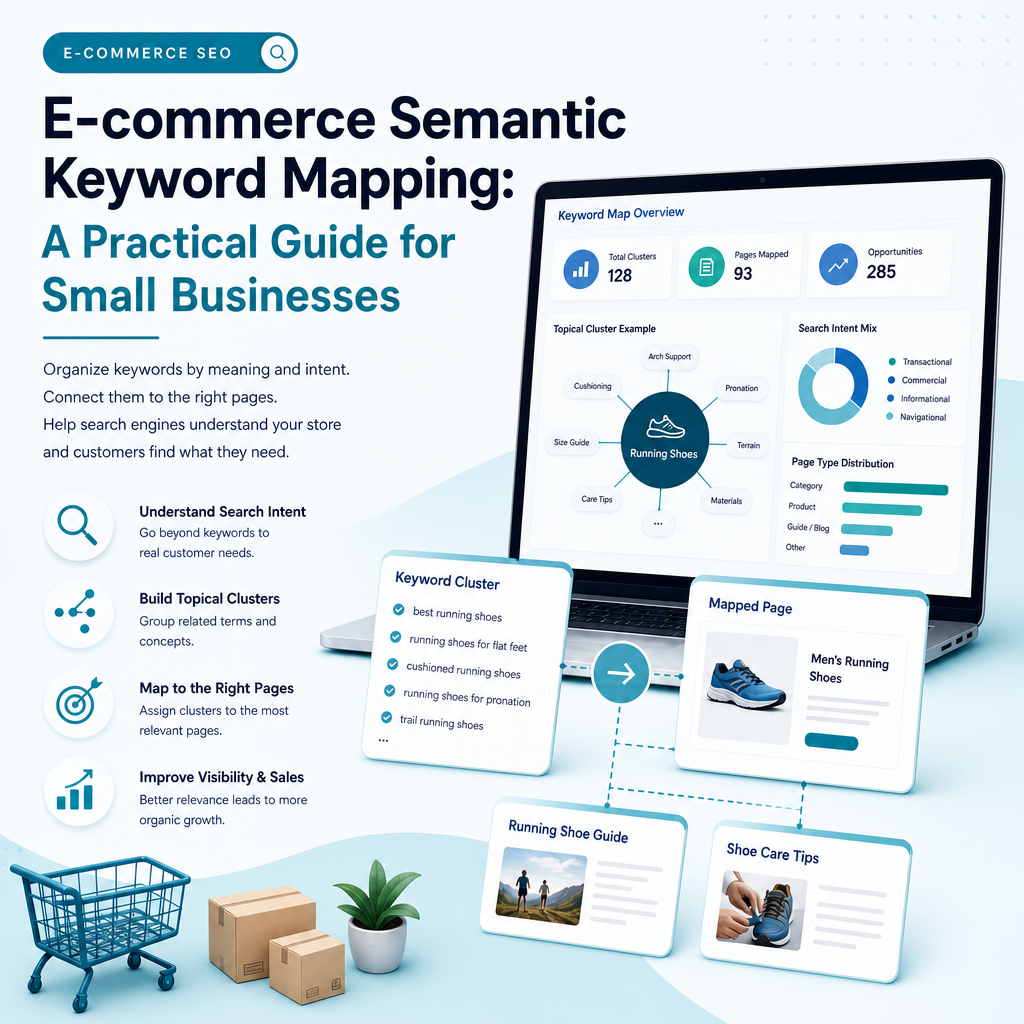
Online stores often have complex websites. A single product can be described by type, brand, material, colour, size, use case, price range and technical specification. Without a clear mapping process, these details can create duplicated pages, weak category structures and content that does not match what shoppers want. Here’s our e-commerce guide on how to choose the right strategy for sustainable growth.
A semantic map gives your e-commerce SEO strategy a shared framework. It helps you make decisions based on search intent and real performance data rather than publishing content because a keyword appears attractive in a tool.
It connects search intent to the right page
Someone searching “best waterproof hiking boots” may be comparing options, while someone searching “women’s waterproof hiking boots size 6” may be ready to browse products. Both searches relate to the same product area, but they may require different page experiences.
Mapping intent prevents a product page from trying to answer a broad buying guide query and prevents an informational article from competing with a category page. Each page can have a clear purpose, audience and conversion path.
It reduces keyword cannibalisation
Keyword cannibalisation occurs when several pages target the same search intent and compete with one another. This can happen when an online store creates separate pages for minor keyword variations that search engines treat as the same need.
A map gives each important cluster an intended owner URL. If two existing pages overlap, you can merge them, differentiate their purpose, improve internal links or redirect a weaker page where appropriate. The aim is not to force every phrase onto a separate URL. It is to give each meaningful search need a clear destination.
It reveals content gaps and page opportunities
Competitors may rank for questions, attributes or use cases that your store does not cover. A content gap analysis tool can reveal these missing areas, but the gap only becomes useful when you decide how to cover it.
For example, a homeware retailer may discover searches around “small living room storage”, “storage for rented flats” and “narrow hallway furniture”. These may lead to a buying guide, a collection page, improved category copy or new product filters. Semantic mapping turns the findings into actions.
It supports topical authority
Topical authority comes from demonstrating useful coverage around a subject, not from repeating one phrase on every page. A store selling cycling equipment can build a connected content ecosystem covering bike types, frame materials, sizing, maintenance, accessories, terrain and safety.
When relevant pages link together clearly, users can move from education to product discovery. Search engines also receive stronger signals about the relationships between those pages.
The building blocks of an e-commerce semantic keyword map
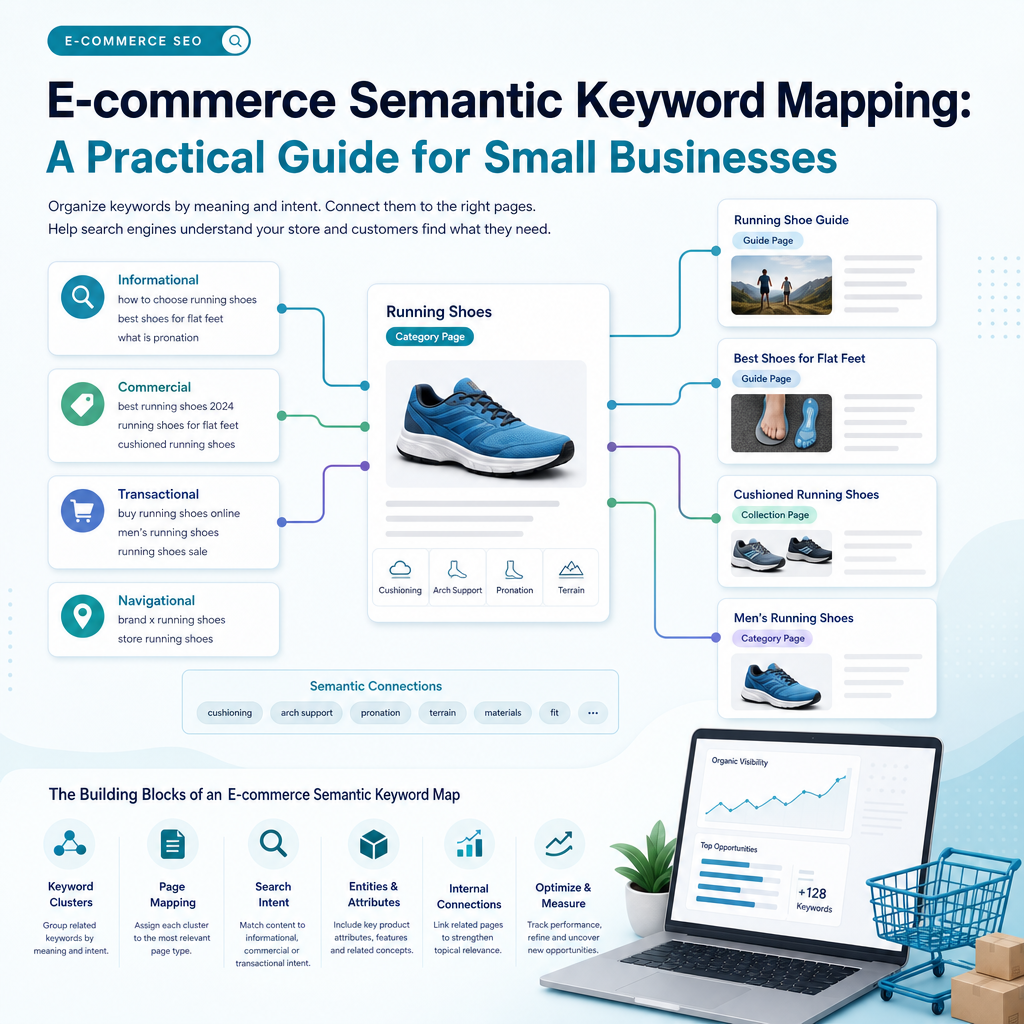
A useful map is more than a keyword spreadsheet. It should show how search terms relate to the products, pages and decisions within your store. The exact columns will depend on your business, but the following fields create a strong starting point.
| Field | Purpose |
|---|---|
| Primary topic | Defines the main product or category being mapped. |
| Keyword cluster | Groups related searches that express a similar need. |
| Search intent | Identifies whether the user wants information, comparison, navigation or a product. |
| Entities and attributes | Records relevant features, materials, brands, uses and specifications. |
| Target URL | Assigns one page as the intended owner of the cluster. |
| Page type | Shows whether the target is a product, category, collection, guide or FAQ. |
| Priority | Ranks the opportunity according to relevance, performance and business value. |
| Internal links | Plans connections to parent, child and related pages. |
Product attributes and combinations
Attributes are central to e-commerce semantic keyword mapping. They describe the characteristics shoppers use to narrow a choice, such as colour, size, material, compatibility, flavour, skin type, capacity or location.
Not every attribute deserves its own indexable page. Some are valuable for product information and filtering but have little independent search demand. Others become powerful when combined with another attribute.
For example, “full sun” may have limited value as a standalone seed category, while “full sun flower seeds” or “perennial herbs for zone 6” may reflect meaningful searches. The map should record both the attribute and the combinations that have evidence of demand or strong customer value.
How to build an e-commerce semantic keyword map
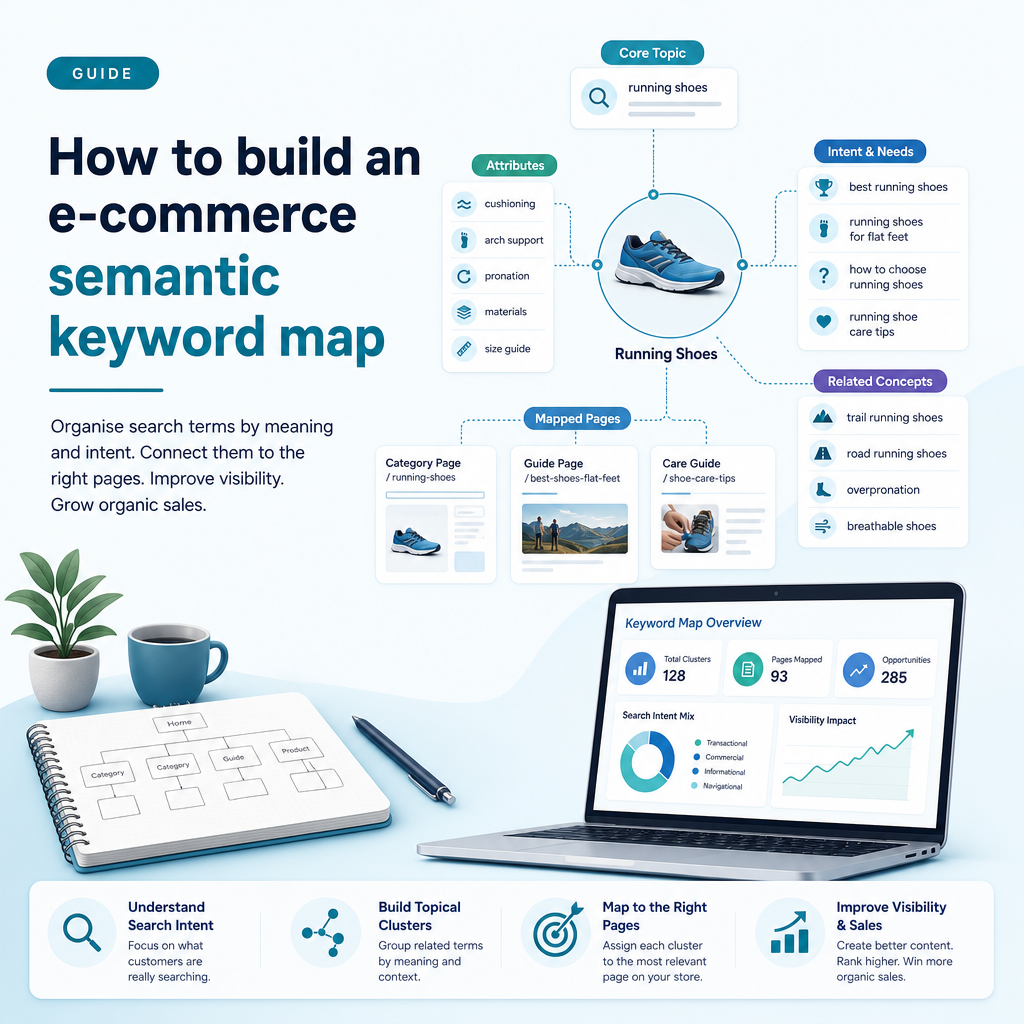
The process can be completed manually, but small teams benefit from a repeatable workflow. Start with the products and markets that matter most to the business, then expand the map as you learn from performance data.
1. Define the scope
Begin with a focused commercial question. You might map one product category, a group of collections, a new market or the content supporting a major product line. Trying to map an entire catalogue in one step can produce a large dataset without clear priorities.
Record the products you sell, the countries or regions you serve, the languages you publish in and the commercial goals behind the project. A UK-based store may need different terms and product information from a business serving English-speaking customers internationally. Search behaviour, spelling, delivery expectations and local intent can vary by market.
Choose a scope that your team can implement. If your platform cannot create useful indexable collection pages, do not build a plan that depends on hundreds of filter URLs being indexed.
2. Understand the main entity and its attributes
Choose the main entity, such as “organic skincare”, “standing desks”, “pet supplements” or “women’s cycling jackets”. Then list the attributes and related entities that help customers make a decision.
Useful research sources include your product catalogue, customer support questions, reviews, sales conversations, competitor category structures, product specifications, community discussions and search results. AI can help generate initial ideas, but every suggested attribute should be checked for relevance and accuracy.
Ask practical questions: What problem does the product solve? Which features affect suitability? Which alternatives do customers compare? What objections delay purchase? Which details are necessary for a confident decision? These answers create a richer semantic foundation than a list of high-volume terms.
3. Collect keyword and performance data
Use several sources because no single tool shows the complete opportunity. Google Search Console is particularly valuable for established websites because it shows queries for which your pages already receive impressions and clicks.
Look for relevant searches where a page is visible but not performing as strongly as it could. These terms are often practical opportunities because Google already associates the page with the topic. Google Analytics can add information about engagement and commercial behaviour, while competitor research can reveal topics your store has not covered.
Keyword research platforms can provide search demand, competition estimates, related questions and ranking pages. Treat these metrics as decision aids rather than guarantees. Relevance, intent, product availability, site quality and the strength of the current results all matter.
4. Cluster terms by meaning and intent
Clustering is where the raw keyword list becomes a strategy. Group terms that represent the same underlying need, then separate terms that deserve their own page because the intent or product set is materially different.
Common e-commerce intent groups include:
- Informational searches, such as how to choose, how to use or how to compare a product.
- Commercial investigation searches, such as best, reviews, alternatives and comparisons.
- Category searches, where shoppers want to browse a product type or collection.
- Transactional searches, where the user is looking for a specific product or variant.
- Local searches, where availability, delivery, collection or service area affects the decision.
- Attribute combinations, such as material, size, colour, compatibility or use case.
Search engine results pages help validate the grouping. If the same pages appear for several terms, those terms may belong to one cluster. If the results show a different page type or audience, separate mapping may be more appropriate.
5. Audit existing URLs before creating new pages
Always check what already exists. A store may have a product page, category page, blog post and filter URL all covering similar language. Creating another article without resolving that overlap can make the site harder to manage.
For each cluster, decide whether to keep an existing URL, improve it, merge pages, create a new page or leave the term uncovered for now. The strongest choice depends on search intent, product range, internal links, content quality and the business value of the opportunity.
Google Search Console can show which URL receives impressions for a query. If the wrong page appears, review the page focus, internal linking, canonical signals and content structure. The goal is to make the intended page the clearest answer, not simply to force a technical signal.
6. Assign primary and supporting terms to each page
Each important URL should have one primary topic and a set of supporting semantic terms. The primary topic gives the page direction, while supporting terms help it answer the wider set of related needs.
A category page for “women’s waterproof hiking boots” might cover waterproof membranes, ankle support, grip, terrain, sizing and seasonal use. A supporting guide might target how to choose waterproof hiking boots and link to the category page. A product page should focus on its own specifications, stock, fit and benefits rather than trying to rank for the entire category.
Do not chase a fixed keyword count. Add a term when it helps explain the product or answer a real customer question. Remove it when it creates awkward copy or takes the page away from its purpose.
7. Build the page and internal-linking architecture
The map should show how pages connect. Broad category pages can link to relevant subcategories, buying guides and priority products. Supporting content can link back to the relevant category and across to related guides where the connection helps the reader.
Use descriptive, varied anchor text that explains the destination. Avoid adding links simply to increase the number of internal links. A well-planned structure helps shoppers move from research to consideration and purchase while reinforcing the relationships between topics.
For larger stores, review faceted navigation carefully. Filters can improve usability, but creating indexable URLs for every combination can lead to duplication and crawl inefficiency. Only recommend indexable combinations that have a clear purpose, useful product coverage and evidence of search demand or customer value.
8. Optimise pages for clarity and completeness
Apply the map to titles, headings, product descriptions, category copy, FAQs, image descriptions, structured data and internal links. Write naturally and prioritise useful information over repetition.
Product pages should explain what the product is, who it suits, its specifications, limitations, care instructions, delivery details and compatibility where relevant. Category pages should help shoppers understand the range and make a choice. Guides should answer the research questions that lead people towards your products without turning every paragraph into a sales pitch.
Technical SEO also matters. Pages should be accessible to search engines, usable on mobile devices, clearly linked and supported by accurate product or organisation information. Semantic mapping cannot compensate for blocked pages, poor navigation or an unavailable product range.
9. Review and update the map
Search behaviour and product ranges change. Review your map regularly using Google Search Console, analytics, sales information, new customer questions and competitor changes. A quarterly review is a sensible starting point for many small businesses, with more frequent checks for seasonal catalogues.
Watch for pages gaining impressions for unplanned but relevant terms. These may indicate an opportunity to add a section, improve a heading or create a supporting page. Also watch for declining pages, overlapping URLs and clusters where the business no longer has suitable products.
A semantic map is a working document, not a one-off file. It should guide new content, page updates, internal-link decisions and reporting.
Example: mapping an e-commerce category
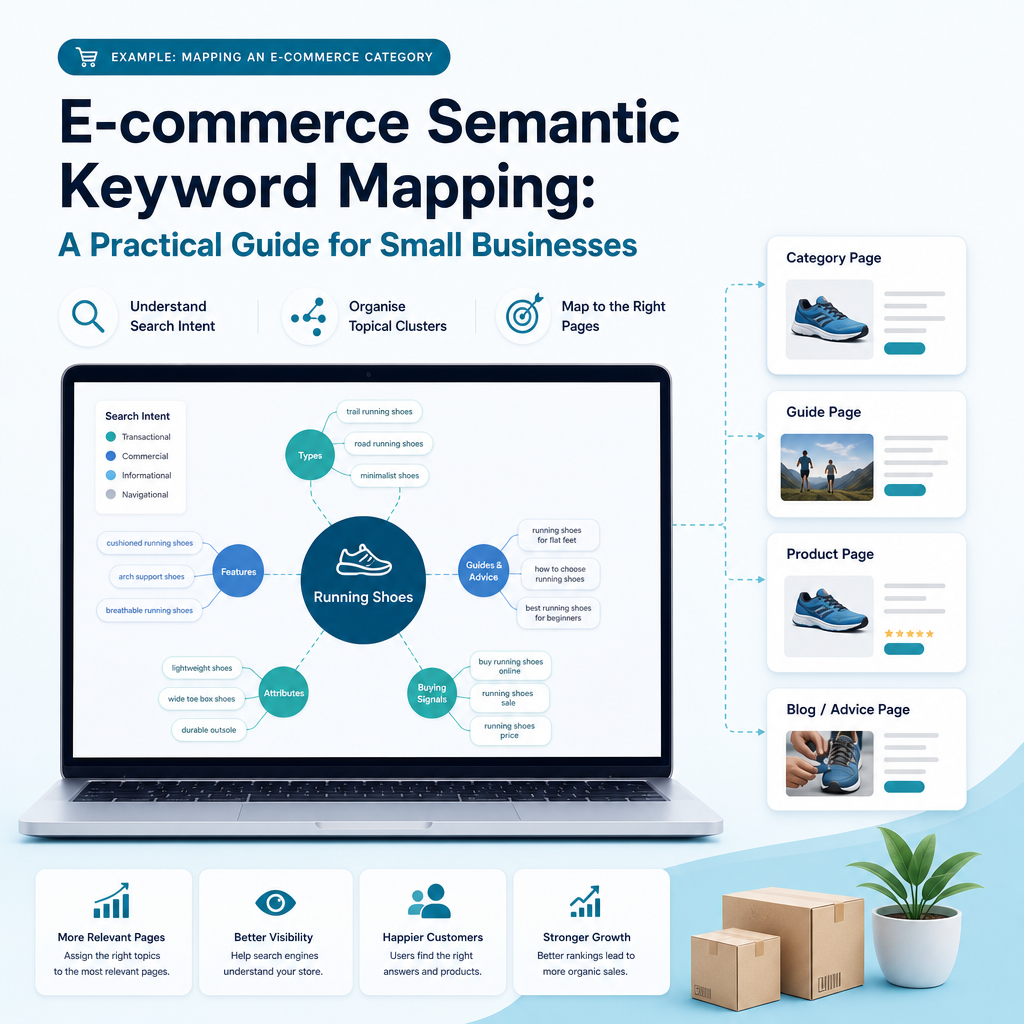
Imagine an online retailer selling high end furniture such as RBTwelve. The broad entity is “high end furniture”, but that phrase alone does not describe the customer journey.
Research may reveal related concepts including espresso machines, pour-over coffee makers, French presses, coffee grinders, grind size, water temperature, home barista equipment, compact machines and beginner bundles. These terms do not all belong on one page.
| Search need | Suitable page | Supporting concepts |
|---|---|---|
| Browse espresso machines | Espresso machine category | Home espresso, pressure, milk frothing, automatic and manual machines |
| Choose equipment for a small kitchen | Buying guide | Compact design, counter space, storage and ease of cleaning |
| Buy a specific machine | Product page | Specifications, capacity, warranty, accessories and availability |
| Understand brewing methods | Educational guide | Pour-over, French press, extraction, grind size and water temperature |
| Find a grinder for espresso | Grinder category or subcategory | Burr grinder, grind settings, dosing and compatibility |
This structure gives each page a clear role. It also creates natural internal links between education, product discovery and purchase. The map can be expanded with local delivery terms, seasonal gift searches or product bundles if those areas fit the business.
Common e-commerce semantic mapping mistakes
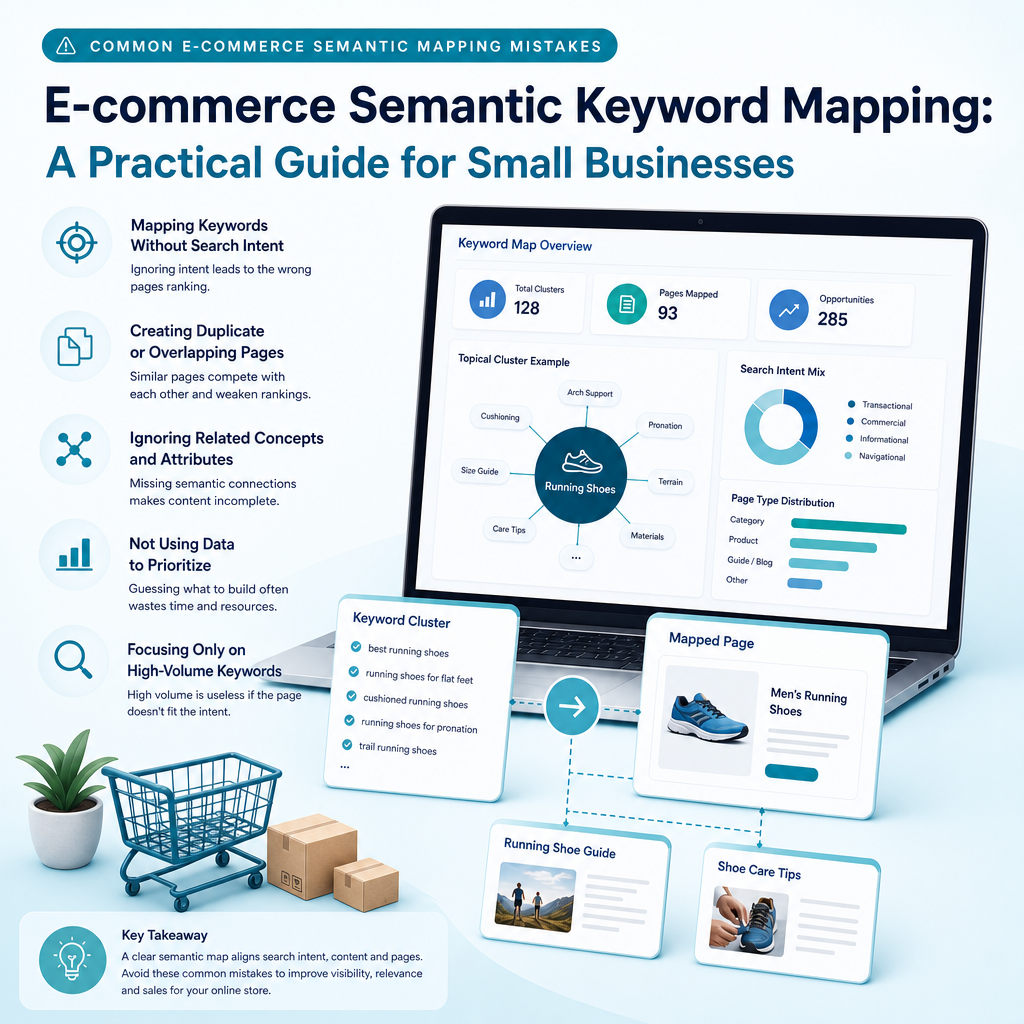
Semantic mapping is useful only when it reflects customer needs and the realities of the website. Several mistakes can make the map larger without making the SEO strategy better.
Building pages for every minor variation
Changing the word order or adding a close synonym does not automatically justify a new page. If the same products, SERP results and customer need apply, keep the terms in one cluster and strengthen the existing page.
Treating search volume as the only priority
A high-volume term may be too broad, competitive or commercially irrelevant. A lower-volume search that matches your products, service area and customer needs may be more valuable. Use search performance, intent, business relevance and implementation effort together.
Adding related terms without adding useful information
Semantic SEO is not a licence to insert a list of loosely related phrases. Every concept should earn its place by improving understanding, navigation or decision-making. Forced language reduces trust and can make product pages harder to read.
Ignoring existing Google Search Console data
New keyword research is useful, but your own search data shows how Google currently interprets your website. Ignoring queries that already generate impressions can lead to missed opportunities that are closer to improvement than entirely new topics.
Making every filter indexable
Faceted navigation can generate many URL combinations. Index only combinations that provide distinct value, a suitable product set and a clear search purpose. Keep other filters useful for shoppers without treating each combination as an SEO landing page.
Forgetting regional and language differences
Terms used by shoppers in the United Kingdom may differ from those used in other English-speaking markets. Product availability, delivery, spelling and local intent also influence the value of a query. Map each priority market separately where the differences affect the page experience.
How to measure whether the map is working
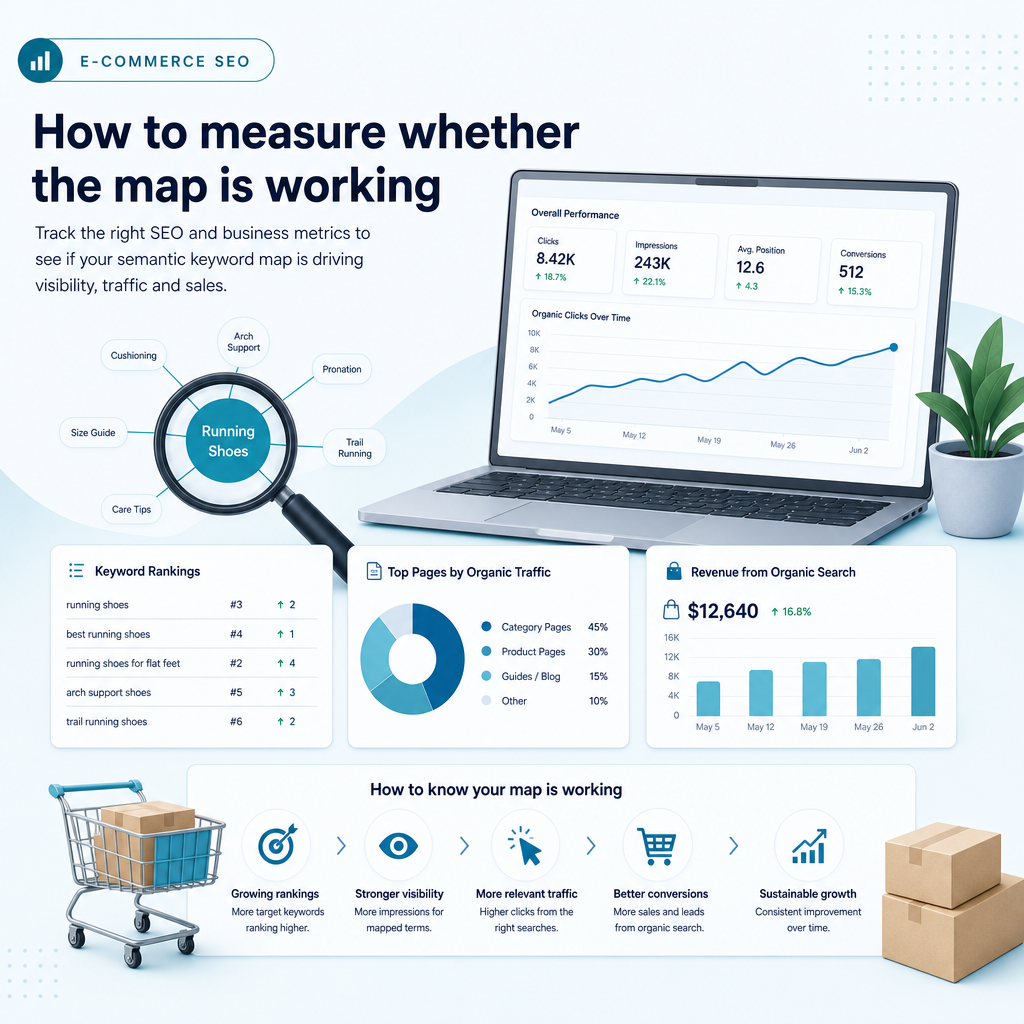
Measurement should focus on whether the map leads to better decisions and more useful pages, not just whether a spreadsheet has been completed. Set a baseline before making changes, then track performance by page and cluster.
Useful measures include impressions and clicks from Google Search Console, the number of relevant queries associated with each URL, average position trends, organic click-through rate, engagement, product views, assisted conversions and completed purchases. For informational pages, monitor whether readers move to relevant category or product pages.
Also review ownership. If a category page is intended to rank for a cluster but a thin filter URL repeatedly appears instead, investigate the cause. The solution may involve improving the category, changing internal links, consolidating duplicate pages or revising the cluster.
Ammpli helps small teams use Google Search Console and Analytics data alongside competitor research and search-intent analysis. This makes it easier to identify realistic ranking opportunities, including relevant searches where a website already has visibility but has not yet reached a strong position.
When should you use an SEO tool or specialist?
You can build a basic map with a spreadsheet, Google Search Console and manual SERP research. That approach works well for a small catalogue or a focused first project. The challenge grows when you have many products, several markets, frequent catalogue changes or limited time to review data.
An SEO tool or AI SEO content platform can help collect opportunities, group related terms, identify content gaps, prepare briefs and monitor performance. A specialist may be useful when your site has major duplication, a complex migration, large-scale technical problems or unclear commercial priorities.
The best choice depends on your resources. Generic AI writing tools can generate text, but they may not know which opportunities your website can realistically pursue. Traditional agencies offer strategic support but may not fit every growing business’s budget. A data-driven SEO content workflow can give smaller teams more control while reducing manual research.
How Ammpli supports e-commerce semantic keyword mapping
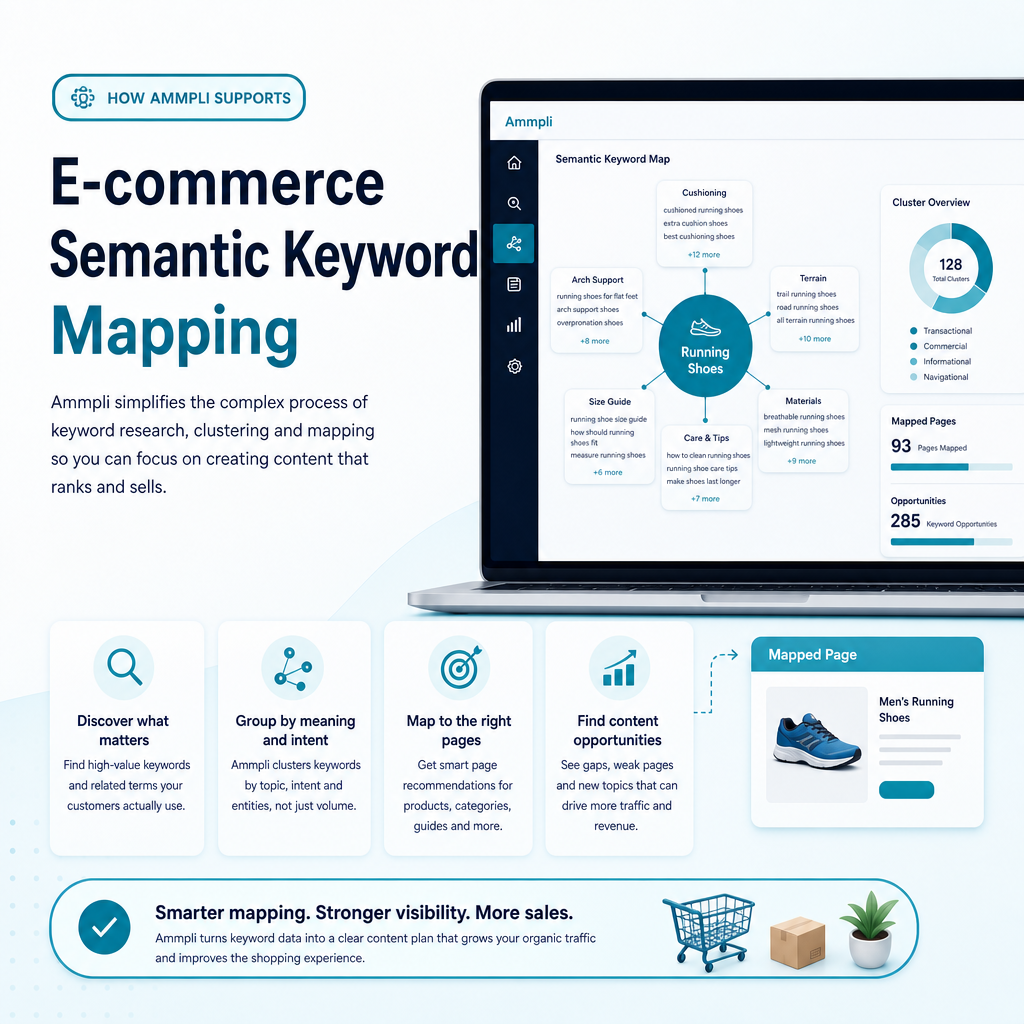
Ammpli is an AI SEO content platform for small and growing businesses in the United Kingdom and English-speaking international markets. It combines Google Search Console and Analytics data with competitor research, search-intent analysis and semantic keyword mapping.
Instead of starting with a generic list, Ammpli can help identify where your existing website has relevant visibility, which topics competitors cover, which content gaps are realistic and how those opportunities can become an organised plan. The resulting insight can support category content, product education, blog articles, local SEO content creation and wider topical authority planning.
The platform also connects planning with AI-powered SEO content creation, SEO content calendars, blog and brand analysis, direct CMS publishing and SEO performance reporting. That can help a small team move from opportunity analysis to a consistent publishing process without managing every task manually.
Ammpli does not replace judgement. Your team still decides which products, markets and priorities matter. Its role is to reduce guesswork, organise search data and turn useful findings into a practical content plan.
Frequently Asked Questions
What is e-commerce semantic keyword mapping?
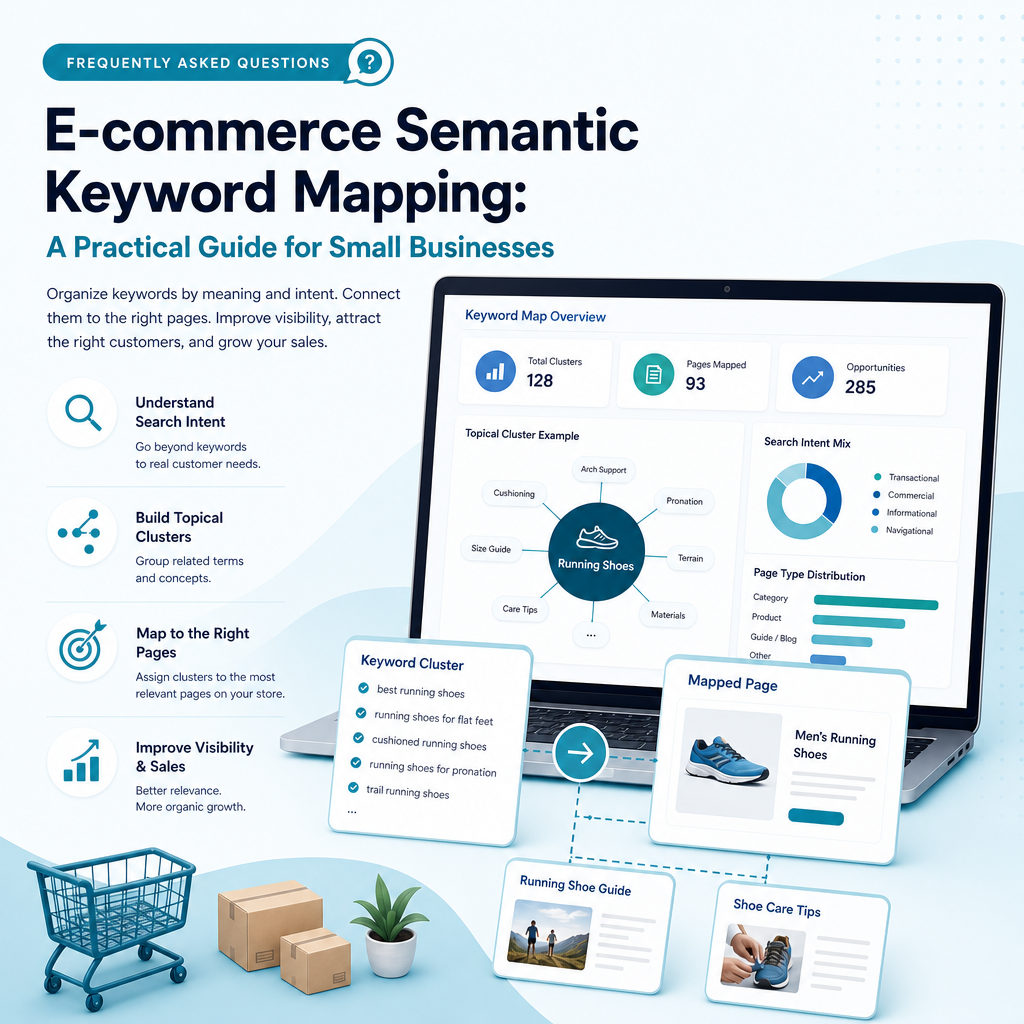
E-commerce semantic keyword mapping organises related search terms, entities, product attributes and user intents into clusters assigned to specific store pages. It helps each category, product, guide and filter serve a clear purpose without relying on repeated exact-match phrases.
How is semantic mapping different from traditional keyword mapping?
Traditional keyword mapping often assigns individual target phrases to URLs. Semantic mapping also examines meaning, relationships, attributes, questions and intent, helping one relevant page address a group of connected searches while avoiding unnecessary page duplication.
Should every product attribute have its own SEO page?
No. Some attributes are useful for product information and filtering but do not justify separate indexable pages. Create dedicated pages for combinations that have a distinct search need, suitable products and enough business value to support a useful experience.
Can small businesses build a semantic keyword map themselves?
Yes. A small business can begin with Google Search Console, Analytics, customer questions, competitor research and a structured spreadsheet. An SEO content planning tool can help when the catalogue, markets or content requirements become too large for manual research.
How often should an e-commerce keyword map be updated?
Review the map at least quarterly and whenever your catalogue, markets, competitors or customer language changes. Seasonal retailers may need more frequent reviews so category pages and content reflect current demand and stock.
Does semantic keyword mapping guarantee higher rankings?
No. Mapping improves strategic clarity and helps align pages with search intent, but rankings also depend on content quality, technical accessibility, competition, authority, product relevance and many other factors. Use it as an evidence-based planning framework rather than a promise of a particular position.
Build a clearer SEO plan from your search data
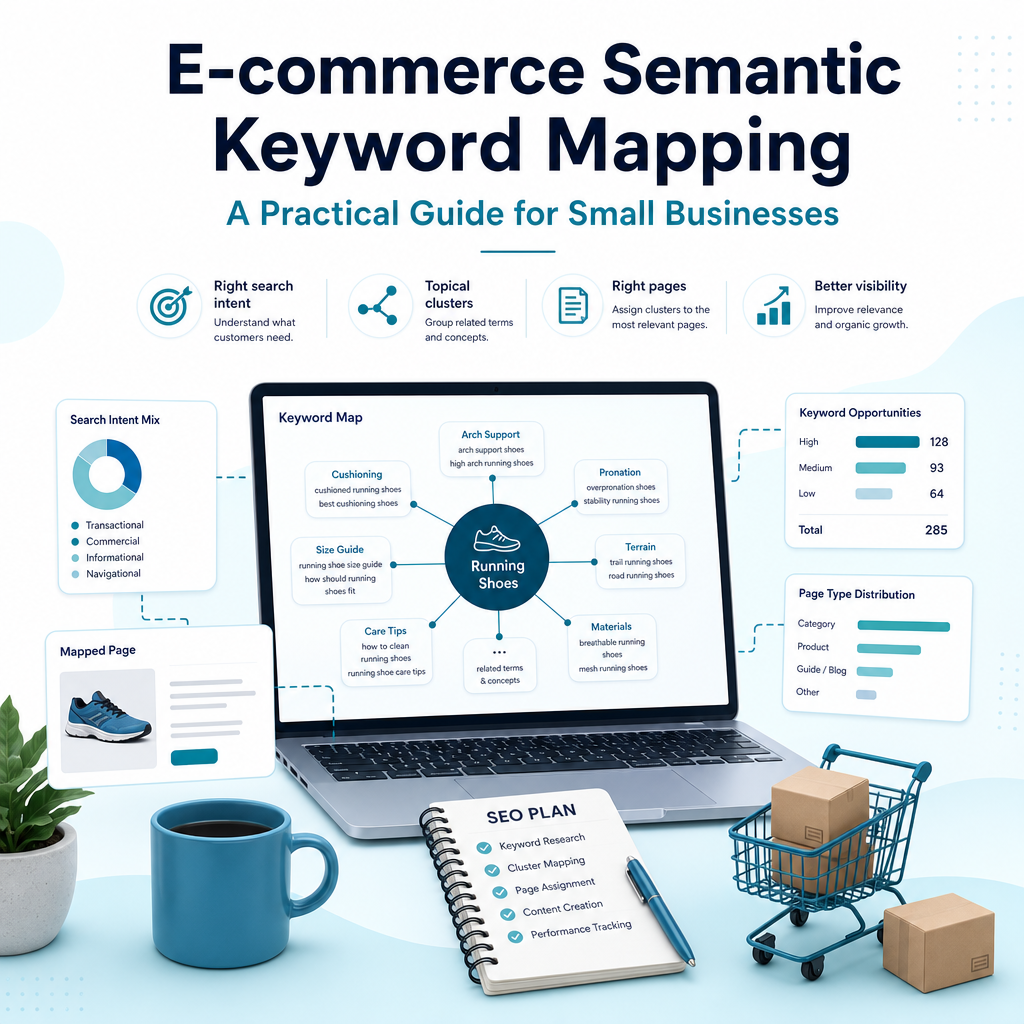
E-commerce semantic keyword mapping helps turn a complex product catalogue into a structure that people and search engines can understand. It connects search intent to page type, brings product attributes into the right context, reduces overlap and reveals where useful content can support commercial pages.
Start with one category, use your own Google Search Console data, validate clusters against the search results and map every priority opportunity to a page with a clear purpose. Then review the map as your business grows.
Ready to find realistic opportunities for your store? Start your 14-day free trial with Ammpli, turn your search data into better content and create your SEO content plan. No credit card required.