Types of Ecommerce SEO Content: 15 Formats That Build Visibility and Sales

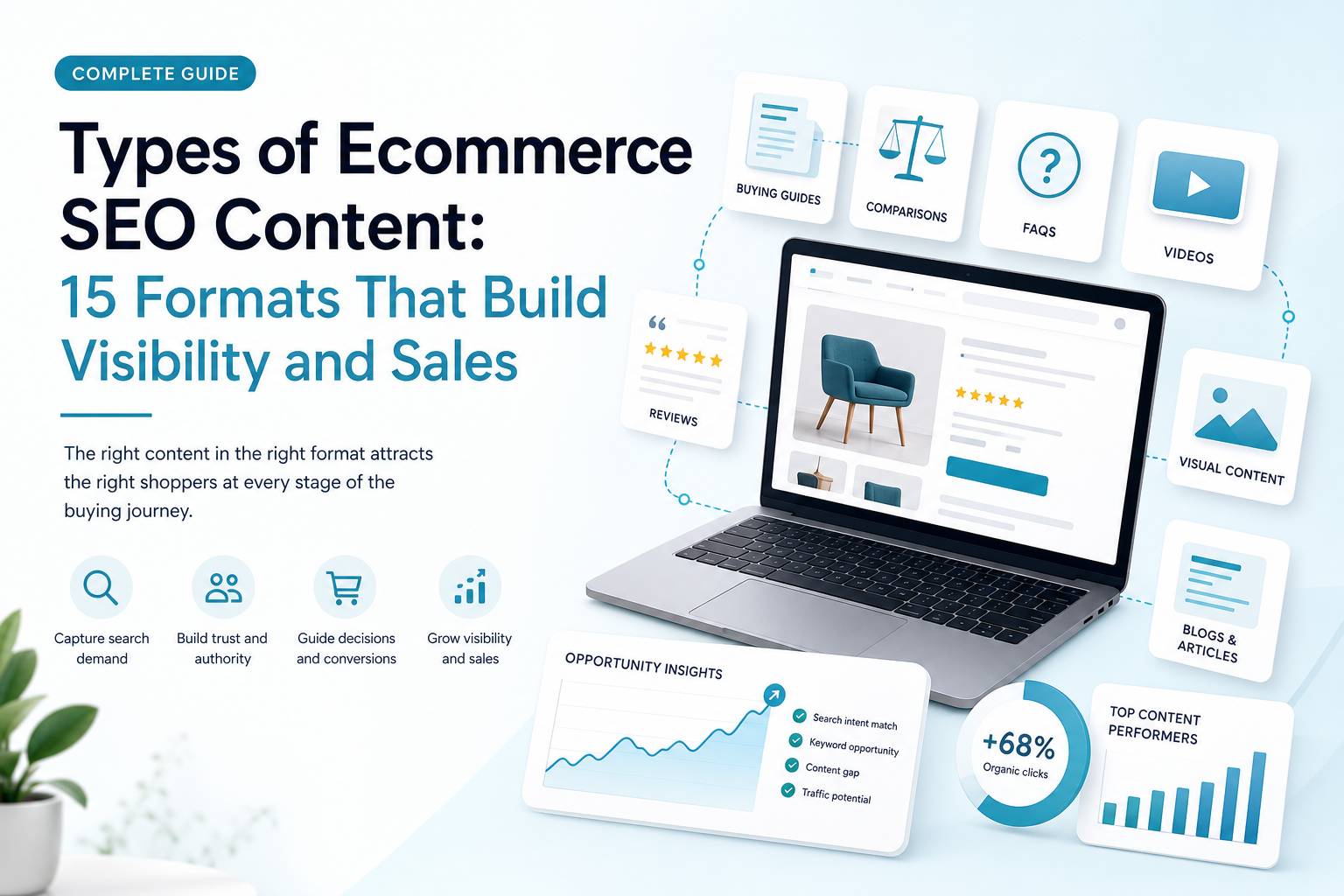
Types of Ecommerce SEO Content: 15 Formats That Build Visibility and Sales

If your ecommerce website is receiving impressions but not enough clicks, enquiries or sales, the issue may not be your product range. It may be the type of content you are publishing, the pages you are prioritising and how closely each page matches what shoppers want to find.

The most effective ecommerce SEO content mix covers the entire buying journey. Product and category pages capture commercial searches, while buying guides, comparisons, FAQs and educational articles help shoppers make decisions. Supporting formats such as reviews, videos, visual assets and brand pages can build trust and strengthen the connections between important pages.

This guide explains the main types of ecommerce SEO content, what each format is designed to achieve, and how a small or growing ecommerce business can choose a practical mix without creating hundreds of low-value pages. It also explains how Ammpli uses Google Search Console data, competitor research, search-intent analysis and semantic keyword mapping to identify realistic opportunities before content is created.

What Is Ecommerce SEO Content?
What Is Ecommerce SEO Content?

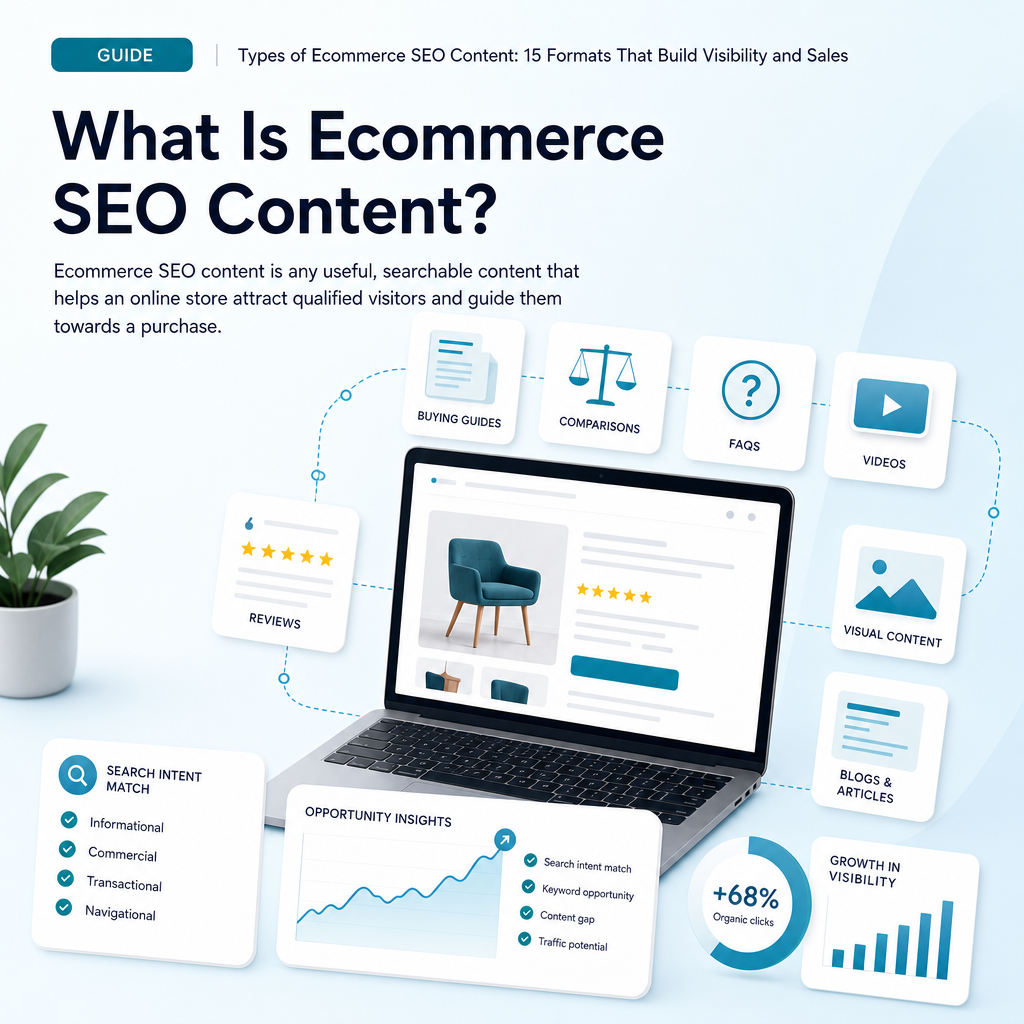
Ecommerce SEO content is any useful, searchable content that helps an online store attract qualified visitors and guide them towards a purchase. This includes visible page copy, metadata, product information, buying resources, customer reviews, videos, comparison pages and structured content such as FAQs.

Different formats serve different search intents. A page targeting “buy ergonomic office chair” needs a different structure from an article targeting “how to choose an ergonomic office chair”. Matching the page type to the search intent is one of the foundations of effective SEO for ecommerce.

Why Your Ecommerce Website Needs More Than Product Descriptions
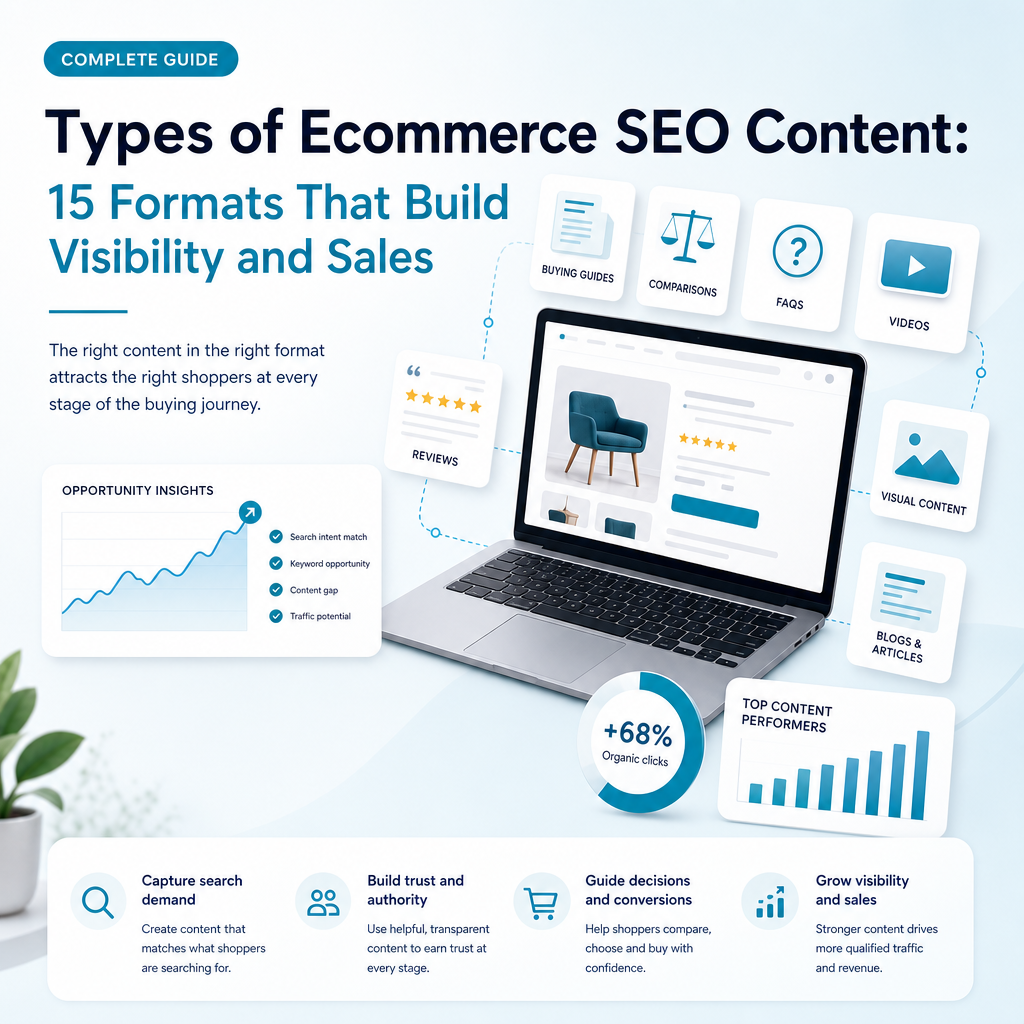
Why Your Ecommerce Website Needs More Than Product Descriptions

Product pages matter, but they cannot answer every question a prospective customer has. Shoppers may want to compare options, understand materials, check compatibility, find a local supplier, learn how to use a product or confirm delivery and returns information before they buy.

A broader content strategy gives search engines more relevant pages to understand and gives shoppers more opportunities to discover your brand. It can also reduce reliance on paid advertising by building organic visibility around product, category and informational searches.

For small and growing ecommerce brands in the United Kingdom and English-speaking international markets, the practical challenge is deciding where to focus limited time and budget. Publishing every possible format at once usually creates inconsistency. A smaller set of well-planned formats is more useful than a large library of disconnected pages.

15 Types of Ecommerce SEO Content to Use
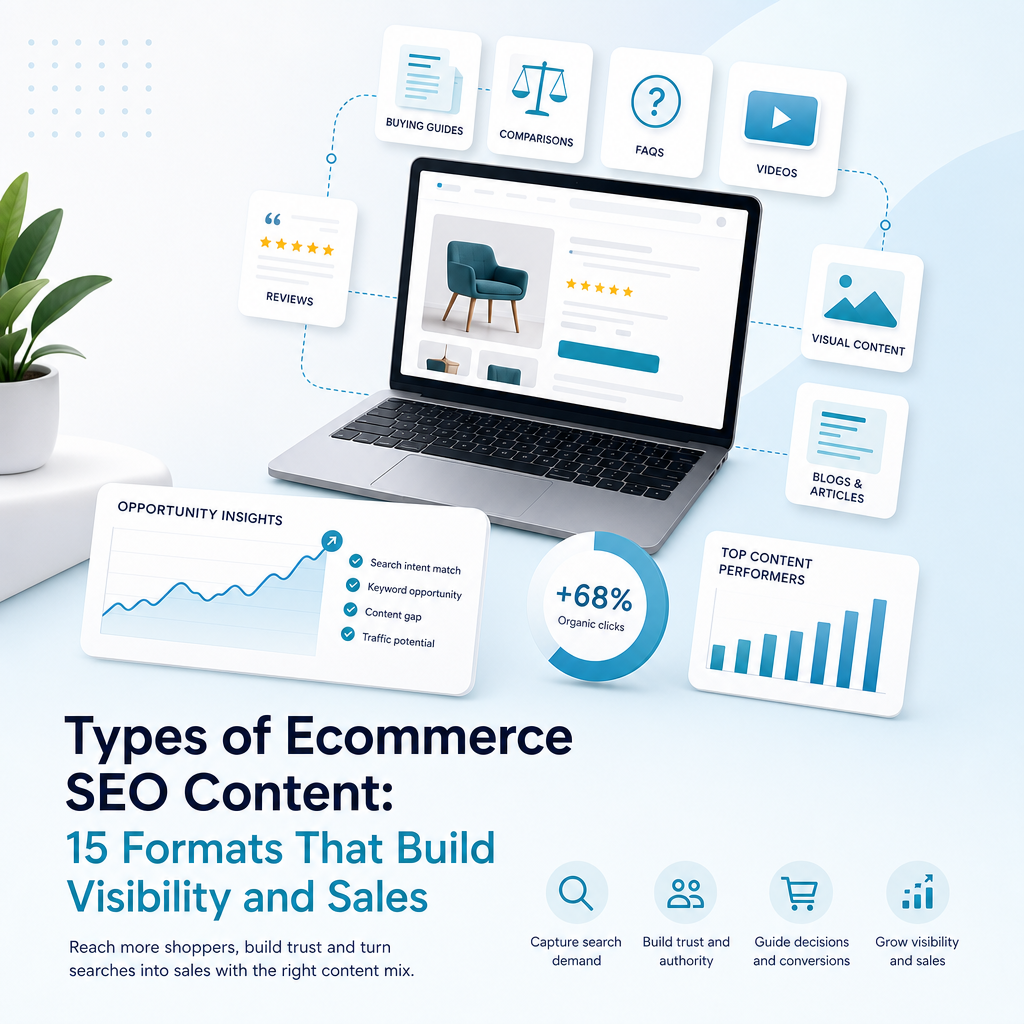
15 Types of Ecommerce SEO Content to Use

1. Product Pages

Product pages are usually the closest content asset to a transaction. They should target specific searches involving product names, models, materials, sizes, colours, features and use cases.

A strong product page includes an original title, clear description, benefits, specifications, images, descriptive alt text, pricing, stock status, delivery and returns information, reviews, related products and relevant structured data. Avoid copying manufacturer descriptions across your catalogue. Original content helps explain why the product is useful for your audience and gives each page a clearer purpose.

Product information should answer practical buying questions. Instead of only stating that a product is made from stainless steel, explain how that material affects durability, cleaning or suitability for a particular environment.

2. Ecommerce Category and Collection Pages

Category pages group related products and often target broader commercial searches than individual product pages. They can rank for terms such as “women’s waterproof jackets”, “office furniture online” or “industrial safety equipment”.

Optimised category pages need more than a product grid. Include a useful introduction, a clear H1, relevant metadata, subcategory links, filters that support shopping, descriptive images, internal links and helpful content below the products.

Each category should have unique copy that reflects the products and the customer’s needs. A short explanation can help shoppers understand what is included, while additional headings can cover product types, selection criteria, applications and common questions.

3. Brand Pages

Brand pages are valuable when customers search for a specific manufacturer alongside a product category. Searches such as a brand name combined with “running shoes”, “laptops” or “coffee equipment” often show clear commercial intent.

A useful brand page can explain the brand’s positioning, product range, key features, price level and relevant categories. Link from the brand page to products and categories that shoppers can browse next.

Do not create a page for every brand automatically without checking demand or adding useful information. A thin page containing only a logo and product grid is unlikely to provide a strong search experience.

4. Faceted and Filter-Based Pages

Filters help shoppers find products by colour, size, material, price, application or other attributes. Some filtered combinations also represent valuable long-tail searches, such as “waterproof hiking boots for women” or “oak dining tables under a specific budget”.

Not every filter combination should be indexed. Uncontrolled faceted navigation can create thousands of near-duplicate URLs, waste crawling resources and weaken the site’s structure. Only create dedicated, indexable pages where there is clear search demand and enough unique value to justify the page.

Use canonicalisation, noindex rules or other technical controls where appropriate. The correct implementation depends on the platform, URL structure and the value of each combination.

5. Buying Guides

Buying guides target shoppers who know they need a product but have not decided which option is right. They can capture commercial investigation searches such as “how to choose a coffee grinder” or “what office chair is best for back support”.

A useful guide explains the selection criteria, compares relevant features and links naturally to suitable categories and products. It should help the reader make a decision rather than simply repeat product specifications.

Buying guides also support internal linking. A guide about choosing hiking footwear can link to waterproof boots, trail shoes, size information and care instructions, creating a connected journey from research to purchase.

6. Product Comparison Pages

Comparison pages address searches where shoppers are evaluating two or more options. Examples include “manual versus electric coffee grinders”, “standing desk versus traditional desk” and “Product A versus Product B”.

Good comparisons use consistent criteria, explain which type of buyer each option suits and avoid unsupported claims. Include differences in features, materials, capacity, compatibility, price range, maintenance and intended use where those factors matter.

Comparison content works best when it leads to clear next steps. Link to the relevant products, category pages or buying guides without forcing the reader towards an option that does not match their needs.

7. Best-Of and Use-Case Pages

Best-of pages target searches such as “best office chair for a small room” or “best gifts for new homeowners”. They are commercial pages, but the reader often needs guidance before selecting a product.

These pages need genuine selection criteria. Explain why each item appears, who it suits and where it may not be suitable. A short list of relevant products with meaningful analysis is more useful than a long catalogue with shallow descriptions.

Use-case pages can also support seasonal or audience-specific demand, provided the page offers distinct value rather than simply changing a few words in a template.

8. How-To Guides

How-to content answers practical questions before and after purchase. Examples include how to clean a coffee machine, how to measure for a desk, how to install a product or how to care for a particular material.

Use clear headings, numbered steps, concise instructions and warnings about common mistakes. Include images or video where they genuinely improve understanding.

Link from each guide to products, accessories and related resources. This helps informational visitors discover relevant commercial pages without making the article feel like an advertisement.

9. FAQ Content

FAQs address specific questions that may prevent a purchase. Common subjects include sizing, compatibility, delivery, installation, warranties, returns, materials and maintenance.

FAQs can appear on product pages, category pages, service pages or as a dedicated resource. Keep each answer direct and make sure it matches the information shown elsewhere on the site.

Use structured data only when the questions and answers are visible to users and meet search-engine guidelines. Markup does not guarantee enhanced search results, but accurate structured data can help search engines interpret page content.

10. Reviews and Testimonials

Customer reviews provide original language from real users and can help future shoppers judge quality, suitability and performance. Product reviews may mention the exact features or concerns that new customers are searching for.

Display reviews clearly on product pages and consider creating broader customer story content where it adds value. Encourage specific feedback about the product, use case and experience rather than generic praise.

Review and rating structured data must accurately reflect visible information. Never add ratings or review details that users cannot verify on the page.

11. Video Content

Video can demonstrate products in a way that written copy cannot. Product demonstrations, installation instructions, comparisons, unboxing videos and care tutorials can all support ecommerce SEO and conversion decisions.

Embed relevant videos on the matching product, category or guide page. Include a written transcript or summary so the page remains useful to people who cannot watch the video and so the subject is clear in crawlable text.

Use descriptive titles, thumbnails and accessible captions. Video should support the buying journey rather than appear as an unrelated asset added for decoration.

12. Infographics and Visual Guides

Infographics can explain specifications, product differences, sizing systems, processes or industry data. They may earn shares and editorial references when they contain original, accurate information.

Do not publish an infographic as a standalone image and expect it to rank for a competitive query. Add supporting HTML text, a descriptive heading and useful alt text. Explain the key points in the visual and provide sources when presenting research or statistics.

13. Industry Reports and Original Research

Original research can support authority and attract links from publishers, suppliers and industry websites. Ecommerce businesses might publish research about customer preferences, product usage, sustainability, pricing patterns or sector trends.

Only publish findings that you can support with reliable data and a clear methodology. A smaller report with transparent evidence is more credible than a collection of unverified claims.

The report landing page should be written in HTML with a clear summary, key findings and relevant internal links. If a downloadable document is offered, treat the HTML page as the main search asset.

14. Seasonal and Promotional Content

Seasonal pages can capture demand around gifting, holidays, new academic terms, events or recurring purchasing periods. They should be planned early enough to be crawled, indexed and linked before interest peaks.

Keep useful seasonal pages when the subject returns each year, updating dates, products, availability and advice. Avoid producing near-identical pages for every year unless there is a clear reason to maintain separate URLs.

Promotional content should remain accurate and should not create confusion when products sell out or offers expire. Redirect, update or archive pages according to their ongoing value.

15. Pillar Pages and Content Clusters

A pillar page provides a broad overview of a topic and connects to more focused supporting content. For ecommerce, a pillar page might cover home coffee equipment, outdoor clothing, workplace furniture or sustainable packaging.

Supporting pages can cover product categories, comparisons, how-to advice, care instructions and common questions. Internal links should help users move between the overview and the detailed resources.

Pillar content works best when it reflects real search demand and the products or categories you actually offer. Long pages are not automatically better; depth should be guided by the questions a customer needs answered.

How to Choose the Right Ecommerce SEO Content Mix

You do not need to publish all 15 formats. Your priorities should reflect your catalogue, margins, search performance, resources and customers’ decision process.

Start by checking which pages already receive impressions and which queries show potential. Google Search Console can reveal pages that appear for relevant searches but receive few clicks, including queries where the site is visible but not yet in a strong position.

Then compare the search results for important terms. Note whether Google displays category pages, product pages, comparisons, guides, videos or other formats. The current result type is a useful signal about what searchers and the search engine expect.

Which ecommerce SEO content format should you prioritise?
Business need Recommended content Primary purpose
More visibility for products Product pages and category pages Capture commercial and transactional searches
Help shoppers choose Buying guides, comparisons and best-of pages Support commercial research
Answer customer questions FAQs and how-to guides Reduce uncertainty and attract long-tail searches
Build trust Reviews, testimonials, videos and case studies Provide evidence and product context
Grow topical authority Pillar pages and connected supporting articles Build depth around important categories
Scale a large catalogue Selective brand, category and filter pages Expand useful search coverage without uncontrolled page creation

A Practical Ecommerce SEO Content Process
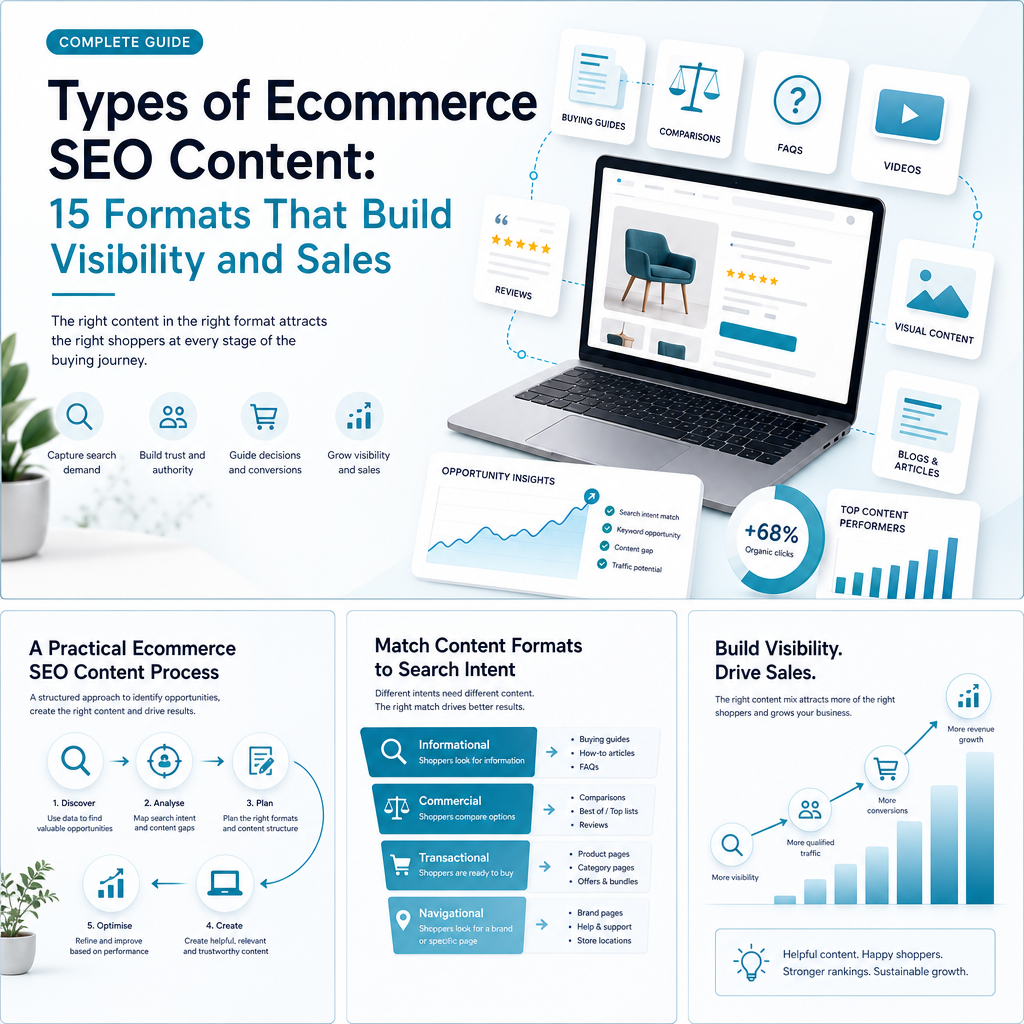
A Practical Ecommerce SEO Content Process

A repeatable process helps a small team create content that supports business goals rather than publishing based on guesswork.

1. Analyse Existing Search Performance

Review impressions, clicks, click-through rate, average position, landing pages and query themes in Google Search Console. Look for relevant searches where pages already have visibility but need stronger alignment, clearer metadata, better internal links or more useful content.

2. Map Keywords to Search Intent

Group keywords into informational, navigational, commercial and transactional intent. Assign one primary purpose to each page so that product, category, comparison and blog content do not compete for the same search.

3. Identify Competitor Content Gaps

Review the topics and formats used by pages ranking for your target searches. Look for missing information, weak product guidance, poor category copy, unanswered questions and opportunities to provide a more helpful experience.

4. Build a Semantic Content Map

Map related concepts, attributes, questions, products and categories around each topic. Semantic keyword mapping helps a page cover the subject naturally without repeating the same phrase.

5. Create and Optimise the Page

Write for the shopper first, then refine the title, headings, internal links, images, metadata and structured data. AI can speed up research, outlining and drafting, but content should reflect the business, catalogue and customer needs.

6. Publish, Monitor and Refresh

Track how pages perform after publication. Refresh content when products, prices, regulations, availability or customer questions change. Pages that already earn impressions can be strong candidates for improvement.

Common Ecommerce SEO Content Mistakes

Many ecommerce websites have plenty of pages but not enough useful content. Avoiding a few recurring problems can improve clarity and reduce wasted effort.

  • Using copied manufacturer descriptions across multiple products.
  • Creating category pages with only a product grid and no useful context.
  • Indexing every filter combination without checking search demand.
  • Publishing articles that do not link to relevant products or categories.
  • Targeting the same keyword and intent on several competing pages.
  • Using vague metadata that does not explain the page’s value.
  • Ignoring mobile usability, image size and page performance.
  • Creating pages for products or brands with no unique information.
  • Leaving discontinued products without a plan for alternatives, redirects or retained information.
  • Publishing large volumes of automatically generated content without review.

How Ammpli Helps Plan Ecommerce SEO Content

Choosing the right types of ecommerce SEO content is easier when your plan is based on your own search data rather than general assumptions. Ammpli combines Google Search Console and Analytics data with competitor research, search-intent analysis and semantic keyword mapping.

For a small ecommerce team, this can help identify pages and searches where there is already evidence of demand. Ammpli can highlight relevant opportunities where your website receives impressions but has not yet reached its strongest position, then turn those insights into a practical content calendar.

The platform supports SEO opportunity analysis, keyword and search-intent research, competitor content-gap analysis, semantic mapping, topical authority planning, AI-powered SEO content creation, local SEO content creation, direct CMS publishing and SEO performance reporting. This gives founders and marketing managers a way to create data-driven SEO content without paying for the cost or complexity of a traditional SEO agency.

A generic AI writing tool can produce text, but it may not know which categories matter most to your business, which queries already bring visibility or how your pages compare with the current search results. Ammpli connects content creation to those decisions so your publishing effort has a clearer commercial purpose.

Frequently Asked Questions

What are the most important types of ecommerce SEO content?

Start with unique product pages, useful category pages and content that supports purchase decisions, such as buying guides, comparisons and FAQs. The right priority depends on your catalogue, customer journey, current rankings and the searches where your website already receives impressions.

Should ecommerce businesses prioritise product pages or category pages?

Both matter, but category pages often provide a stronger starting point because they target broader commercial searches and connect to multiple products. Product pages should then be improved for specific models, features, sizes, materials and use cases. Google Search Console data can help show which page type has the clearest opportunity.

How can I avoid thin content on ecommerce pages?

Add information that is genuinely specific to the page, such as product attributes, selection guidance, use cases, compatibility details, customer questions, reviews or category-level advice. Do not create large numbers of near-identical pages from templates unless each page has enough unique value and a clear search purpose.

Is AI-generated content suitable for ecommerce SEO?

AI can assist with research, outlines, drafting, semantic coverage and content production, but it should be guided by real business information and reviewed for accuracy. The strongest approach combines AI efficiency with original product knowledge, customer insight, useful examples and accurate stock, pricing and policy information.

How often should ecommerce SEO content be updated?

Review pages when products, stock, prices, delivery details, regulations or customer questions change. High-value pages can also be reviewed regularly using performance data. A page receiving relevant impressions but few clicks may need a stronger title, clearer intent alignment, better content or improved internal linking.

How do I know which ecommerce SEO content opportunity to pursue first?

Prioritise opportunities that combine search relevance, business value and realistic competition. Pages with existing impressions, clear commercial intent and a reasonable gap between current visibility and stronger positions are often practical candidates. Ammpli helps identify these opportunities using Search Console data, competitor analysis and intent mapping.

Build a More Focused Ecommerce Content Plan
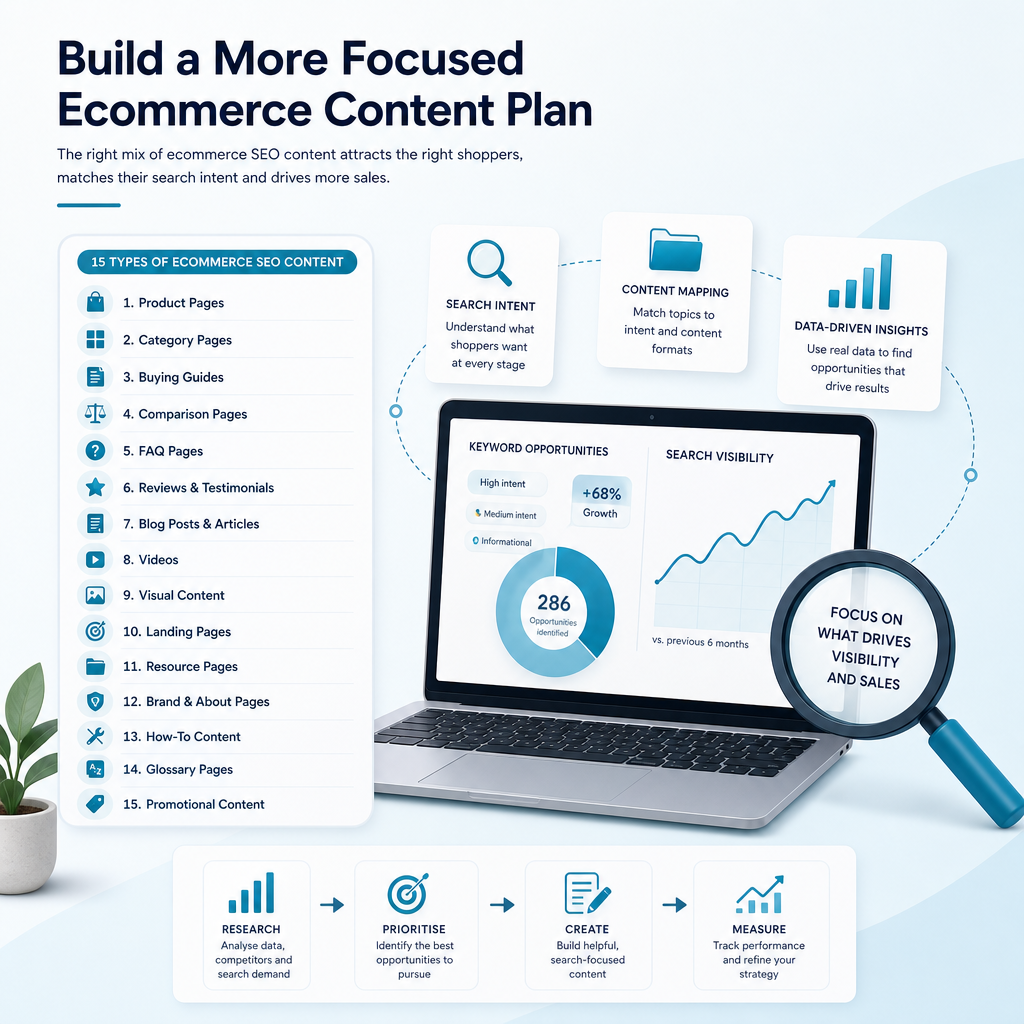
Build a More Focused Ecommerce Content Plan

The best ecommerce SEO content strategy is not the one with the most formats. It is the one that connects the right page type to the right search intent, supports the customer journey and can be maintained by your team.

Begin with the pages closest to revenue, then add buying guidance, comparison content, FAQs and supporting resources where customers need more confidence. Review performance regularly and improve the pages that already show signs of search demand.

If you want to find your next ranking opportunity and turn your search data into better content, start your 14-day free trial with Ammpli. No credit card is required.
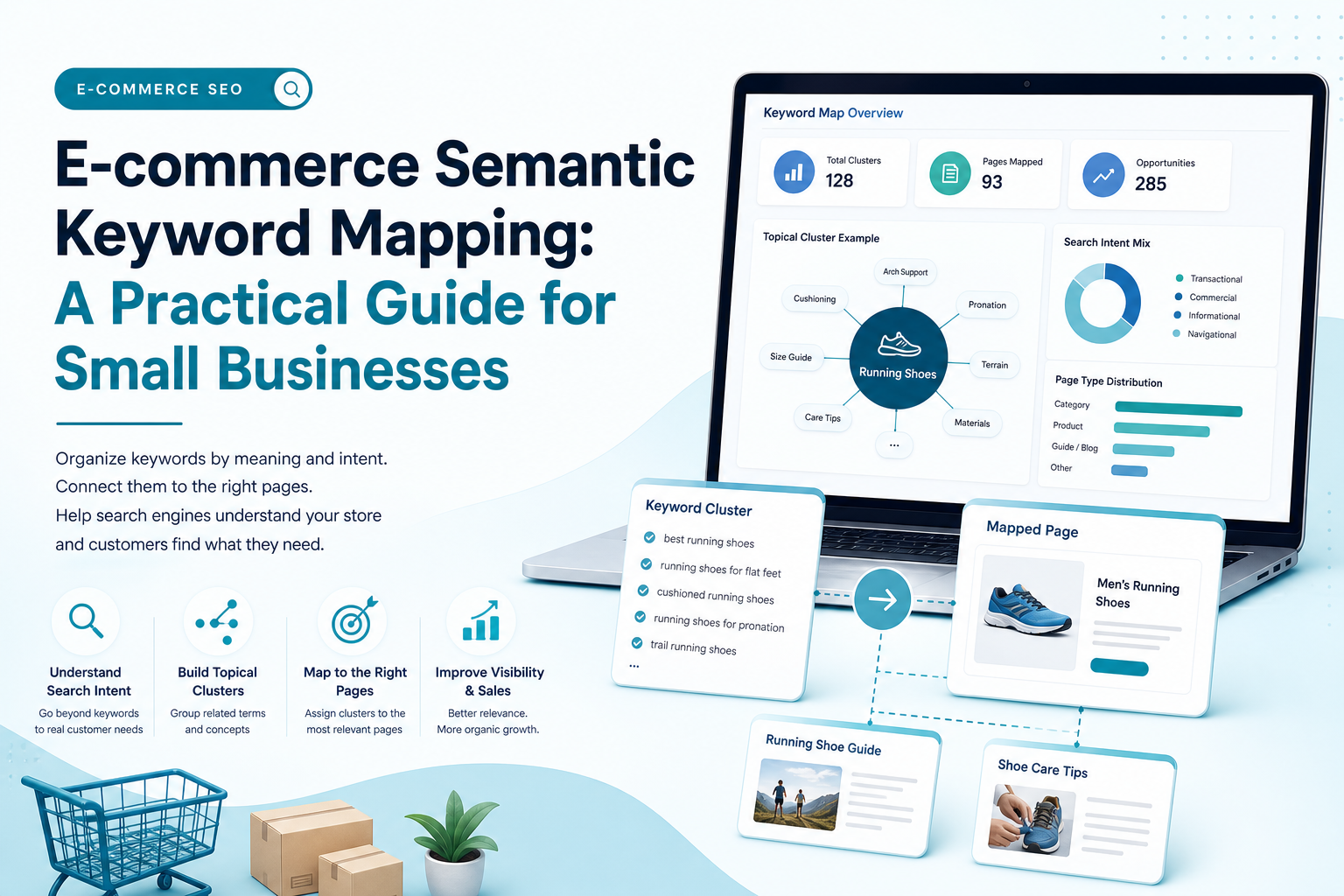
E-commerce Semantic Keyword Mapping: A Practical Guide for Small Businesses

E-commerce Semantic Keyword Mapping: A Practical Guide for Small Businesses

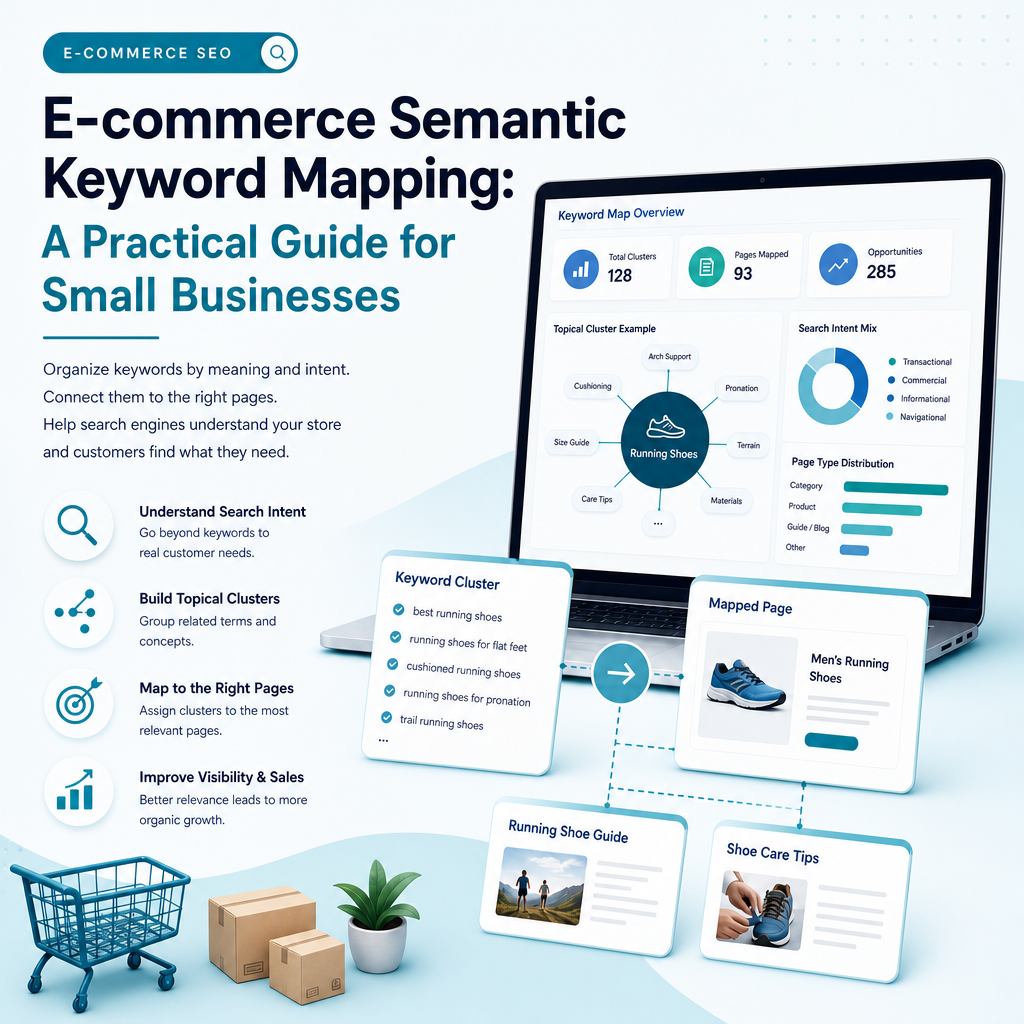
Your online shop may have useful products, well-written descriptions and a professional design, yet still struggle to appear for the searches that matter. A common reason is that keywords have been collected as a long list rather than organised into a clear plan showing which search belongs on which page.

E-commerce semantic keyword mapping solves that problem. It connects products, categories, attributes, related concepts and search intent so that search engines can understand your store and customers can find the right page more easily. It also gives a small marketing team a practical way to decide what to improve, what to publish and what not to create.

This guide explains how e-commerce semantic keyword mapping works, why it matters, how to build a map, which data to use and where an AI SEO content platform such as Ammpli can reduce the manual work.

What is e-commerce semantic keyword mapping?

What is e-commerce semantic keyword mapping?

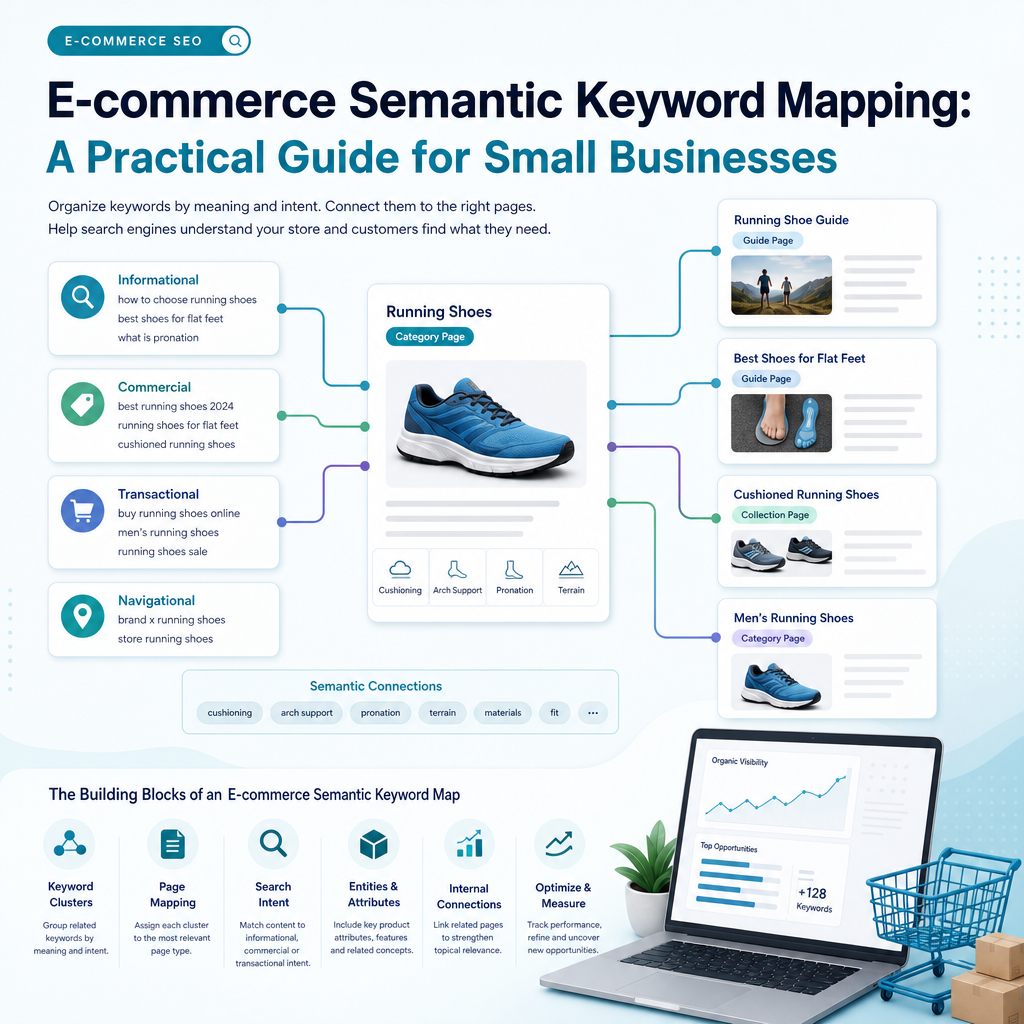
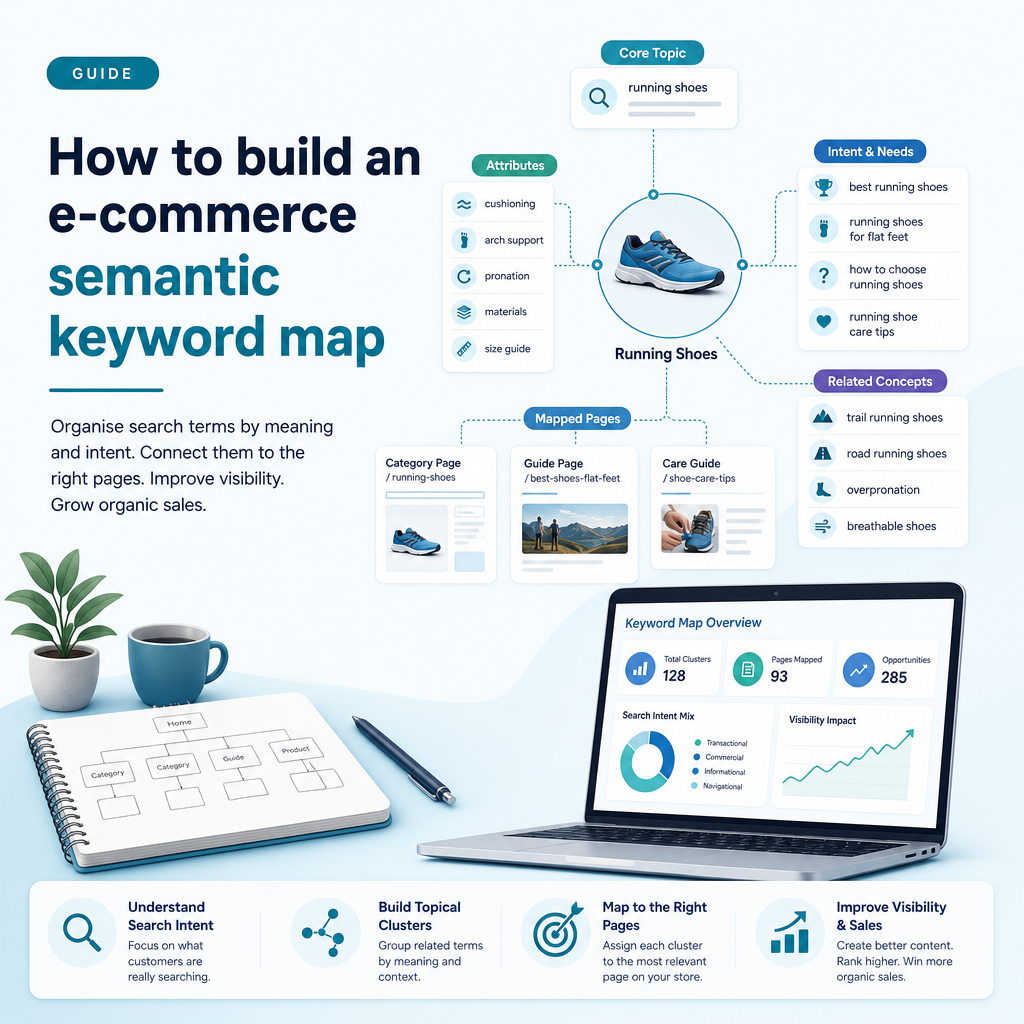
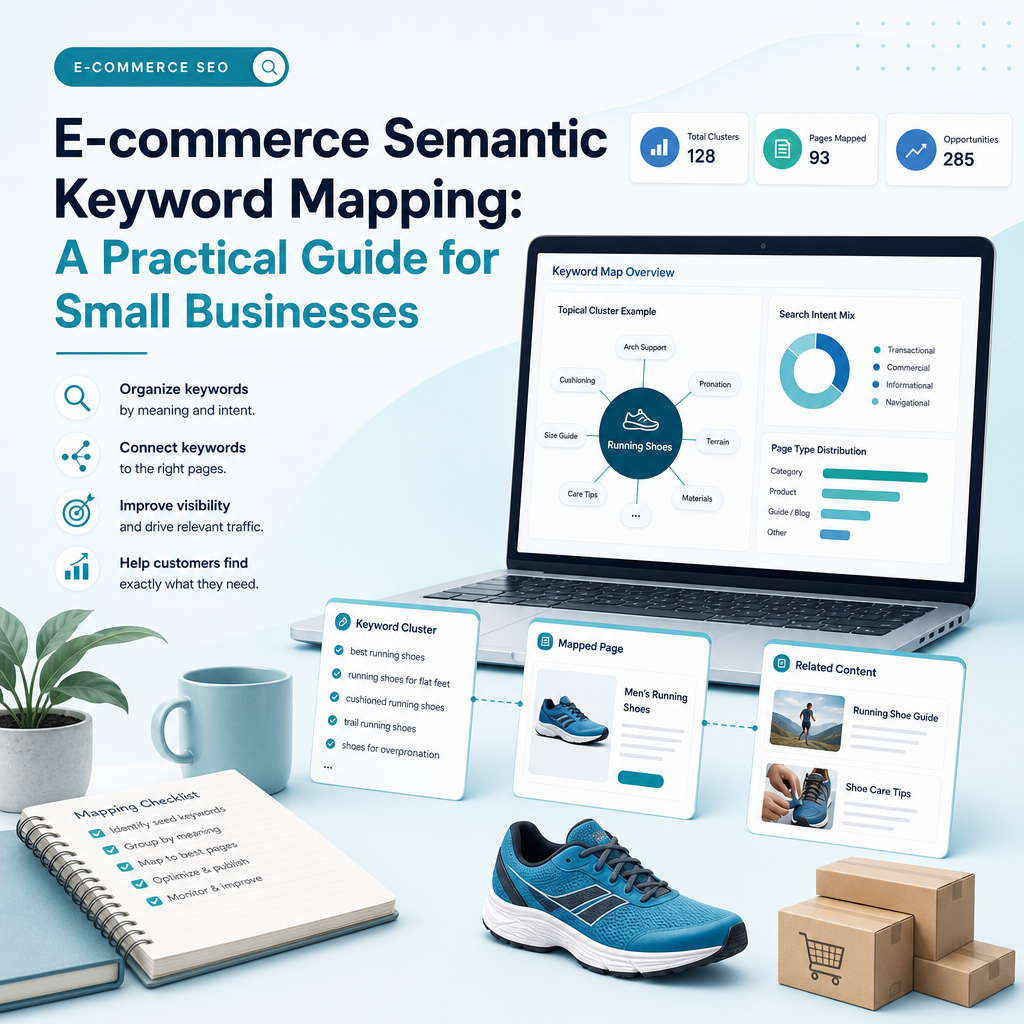
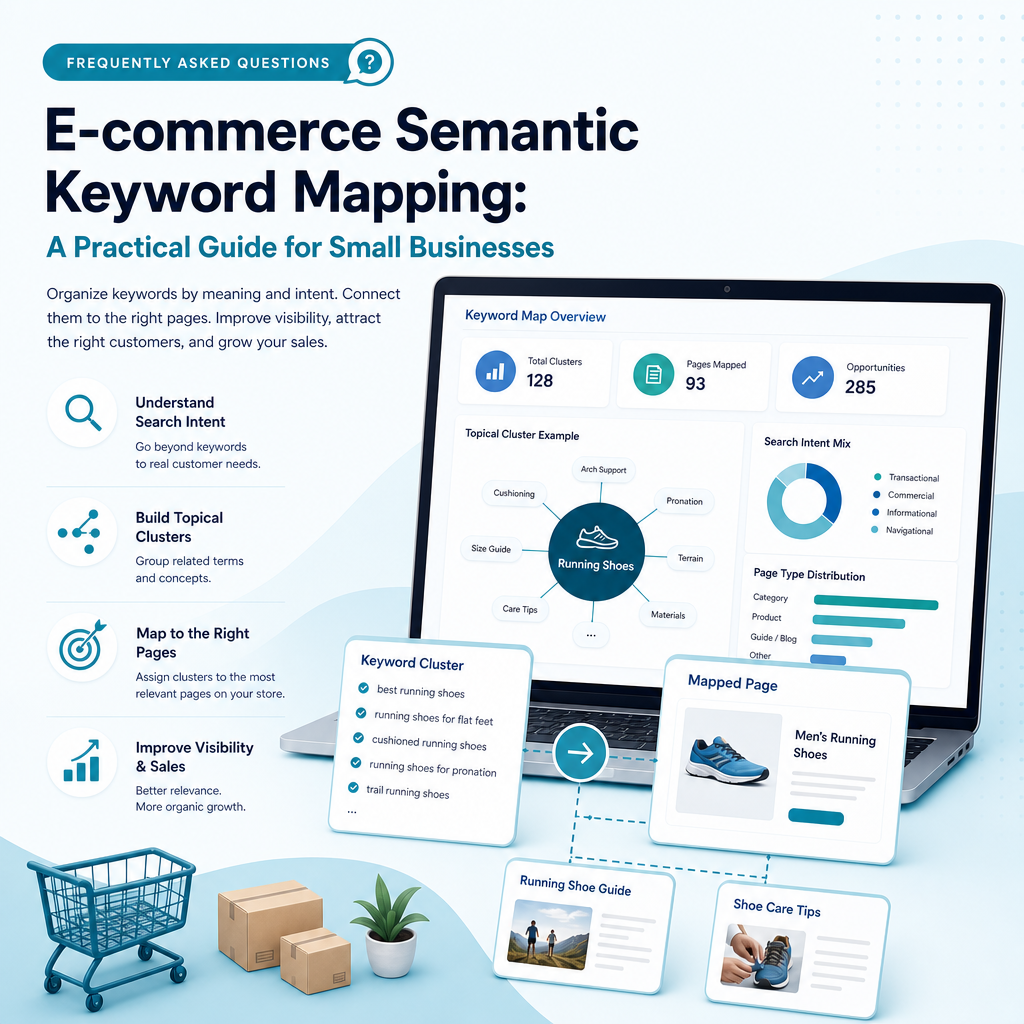
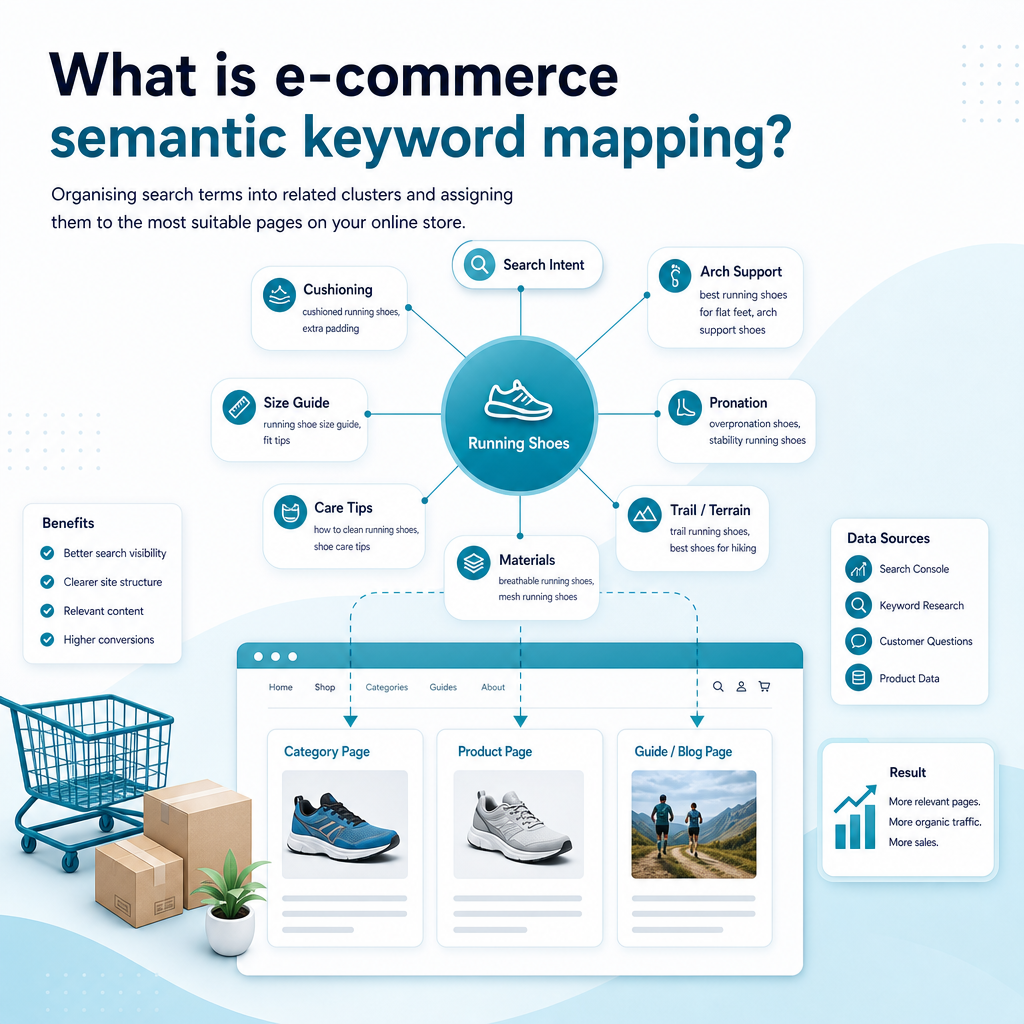
E-commerce semantic keyword mapping is the process of organising search terms into related clusters and assigning those clusters to the most suitable pages on an online store. The map looks beyond exact-match phrases and includes the meanings, entities, attributes, questions and buying needs connected to a product or category.

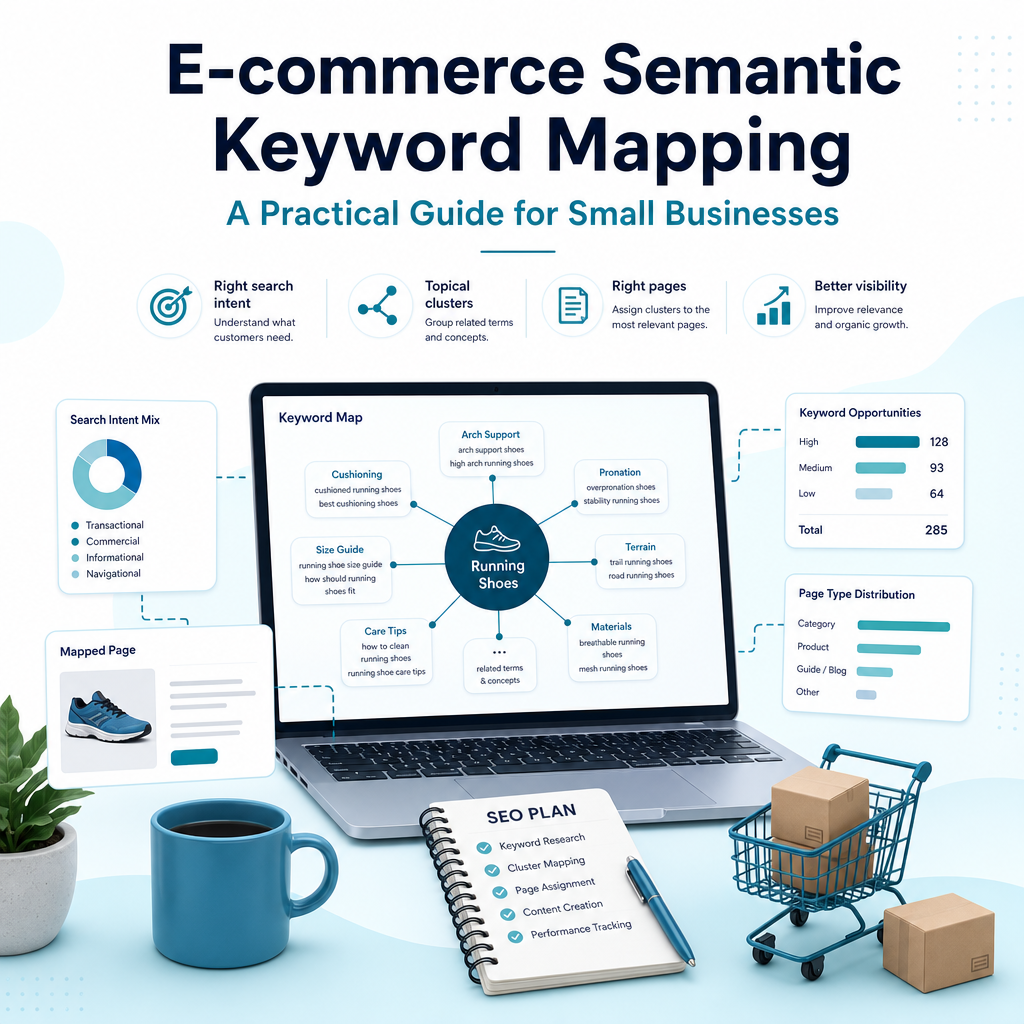
Traditional keyword mapping might assign “running shoes” to a category page and “running shoes for flat feet” to a guide. Semantic mapping goes further by identifying the relationships between running shoes, cushioning, arch support, pronation, terrain, size, materials, price and customer type. Those relationships help determine whether a term belongs on a product page, category page, buying guide, comparison page, filter or FAQ.

The result is a structured SEO plan that supports product discovery, content planning, internal linking and topical authority. It helps a store target a broad set of relevant searches without creating several pages that compete for the same intent.

Semantic keywords, entities and topics

Semantic keywords are related terms and phrases that add context to a primary topic. They are not limited to synonyms. They can include features, use cases, questions, product types, locations, brands, materials and problems a shopper wants to solve.

Entities are identifiable things or concepts that search engines can distinguish, such as a brand, product type, material, place or technology. A page about sustainable footwear might refer to recycled polyester, vegan leather, cushioning and running gait. These entities help clarify what the page is about and how its subject relates to the wider market.

A topic is the broad subject, such as “eco-friendly running shoes”. Semantic keywords and entities provide the detail that makes the topic useful. E-commerce semantic keyword mapping brings these elements together and assigns them to a logical page structure.

Why semantic keyword mapping matters for e-commerce SEO

Why semantic keyword mapping matters for e-commerce SEO

Online stores often have complex websites. A single product can be described by type, brand, material, colour, size, use case, price range and technical specification. Without a clear mapping process, these details can create duplicated pages, weak category structures and content that does not match what shoppers want. Here’s our e-commerce guide on how to choose the right strategy for sustainable growth.

A semantic map gives your e-commerce SEO strategy a shared framework. It helps you make decisions based on search intent and real performance data rather than publishing content because a keyword appears attractive in a tool.

It connects search intent to the right page

Someone searching “best waterproof hiking boots” may be comparing options, while someone searching “women’s waterproof hiking boots size 6” may be ready to browse products. Both searches relate to the same product area, but they may require different page experiences.

Mapping intent prevents a product page from trying to answer a broad buying guide query and prevents an informational article from competing with a category page. Each page can have a clear purpose, audience and conversion path.

It reduces keyword cannibalisation

Keyword cannibalisation occurs when several pages target the same search intent and compete with one another. This can happen when an online store creates separate pages for minor keyword variations that search engines treat as the same need.

A map gives each important cluster an intended owner URL. If two existing pages overlap, you can merge them, differentiate their purpose, improve internal links or redirect a weaker page where appropriate. The aim is not to force every phrase onto a separate URL. It is to give each meaningful search need a clear destination.

It reveals content gaps and page opportunities

Competitors may rank for questions, attributes or use cases that your store does not cover. A content gap analysis tool can reveal these missing areas, but the gap only becomes useful when you decide how to cover it.

For example, a homeware retailer may discover searches around “small living room storage”, “storage for rented flats” and “narrow hallway furniture”. These may lead to a buying guide, a collection page, improved category copy or new product filters. Semantic mapping turns the findings into actions.

It supports topical authority

Topical authority comes from demonstrating useful coverage around a subject, not from repeating one phrase on every page. A store selling cycling equipment can build a connected content ecosystem covering bike types, frame materials, sizing, maintenance, accessories, terrain and safety.

When relevant pages link together clearly, users can move from education to product discovery. Search engines also receive stronger signals about the relationships between those pages.

The building blocks of an e-commerce semantic keyword map

The building blocks of an e-commerce semantic keyword map

A useful map is more than a keyword spreadsheet. It should show how search terms relate to the products, pages and decisions within your store. The exact columns will depend on your business, but the following fields create a strong starting point.

Core fields for an e-commerce semantic keyword map
Field Purpose
Primary topic Defines the main product or category being mapped.
Keyword cluster Groups related searches that express a similar need.
Search intent Identifies whether the user wants information, comparison, navigation or a product.
Entities and attributes Records relevant features, materials, brands, uses and specifications.
Target URL Assigns one page as the intended owner of the cluster.
Page type Shows whether the target is a product, category, collection, guide or FAQ.
Priority Ranks the opportunity according to relevance, performance and business value.
Internal links Plans connections to parent, child and related pages.

Product attributes and combinations

Attributes are central to e-commerce semantic keyword mapping. They describe the characteristics shoppers use to narrow a choice, such as colour, size, material, compatibility, flavour, skin type, capacity or location.

Not every attribute deserves its own indexable page. Some are valuable for product information and filtering but have little independent search demand. Others become powerful when combined with another attribute.

For example, “full sun” may have limited value as a standalone seed category, while “full sun flower seeds” or “perennial herbs for zone 6” may reflect meaningful searches. The map should record both the attribute and the combinations that have evidence of demand or strong customer value.

How to build an e-commerce semantic keyword map

How to build an e-commerce semantic keyword map

The process can be completed manually, but small teams benefit from a repeatable workflow. Start with the products and markets that matter most to the business, then expand the map as you learn from performance data.

1. Define the scope

Begin with a focused commercial question. You might map one product category, a group of collections, a new market or the content supporting a major product line. Trying to map an entire catalogue in one step can produce a large dataset without clear priorities.

Record the products you sell, the countries or regions you serve, the languages you publish in and the commercial goals behind the project. A UK-based store may need different terms and product information from a business serving English-speaking customers internationally. Search behaviour, spelling, delivery expectations and local intent can vary by market.

Choose a scope that your team can implement. If your platform cannot create useful indexable collection pages, do not build a plan that depends on hundreds of filter URLs being indexed.

2. Understand the main entity and its attributes

Choose the main entity, such as “organic skincare”, “standing desks”, “pet supplements” or “women’s cycling jackets”. Then list the attributes and related entities that help customers make a decision.

Useful research sources include your product catalogue, customer support questions, reviews, sales conversations, competitor category structures, product specifications, community discussions and search results. AI can help generate initial ideas, but every suggested attribute should be checked for relevance and accuracy.

Ask practical questions: What problem does the product solve? Which features affect suitability? Which alternatives do customers compare? What objections delay purchase? Which details are necessary for a confident decision? These answers create a richer semantic foundation than a list of high-volume terms.

3. Collect keyword and performance data

Use several sources because no single tool shows the complete opportunity. Google Search Console is particularly valuable for established websites because it shows queries for which your pages already receive impressions and clicks.

Look for relevant searches where a page is visible but not performing as strongly as it could. These terms are often practical opportunities because Google already associates the page with the topic. Google Analytics can add information about engagement and commercial behaviour, while competitor research can reveal topics your store has not covered.

Keyword research platforms can provide search demand, competition estimates, related questions and ranking pages. Treat these metrics as decision aids rather than guarantees. Relevance, intent, product availability, site quality and the strength of the current results all matter.

4. Cluster terms by meaning and intent

Clustering is where the raw keyword list becomes a strategy. Group terms that represent the same underlying need, then separate terms that deserve their own page because the intent or product set is materially different.

Common e-commerce intent groups include:

  • Informational searches, such as how to choose, how to use or how to compare a product.
  • Commercial investigation searches, such as best, reviews, alternatives and comparisons.
  • Category searches, where shoppers want to browse a product type or collection.
  • Transactional searches, where the user is looking for a specific product or variant.
  • Local searches, where availability, delivery, collection or service area affects the decision.
  • Attribute combinations, such as material, size, colour, compatibility or use case.

Search engine results pages help validate the grouping. If the same pages appear for several terms, those terms may belong to one cluster. If the results show a different page type or audience, separate mapping may be more appropriate.

5. Audit existing URLs before creating new pages

Always check what already exists. A store may have a product page, category page, blog post and filter URL all covering similar language. Creating another article without resolving that overlap can make the site harder to manage.

For each cluster, decide whether to keep an existing URL, improve it, merge pages, create a new page or leave the term uncovered for now. The strongest choice depends on search intent, product range, internal links, content quality and the business value of the opportunity.

Google Search Console can show which URL receives impressions for a query. If the wrong page appears, review the page focus, internal linking, canonical signals and content structure. The goal is to make the intended page the clearest answer, not simply to force a technical signal.

6. Assign primary and supporting terms to each page

Each important URL should have one primary topic and a set of supporting semantic terms. The primary topic gives the page direction, while supporting terms help it answer the wider set of related needs.

A category page for “women’s waterproof hiking boots” might cover waterproof membranes, ankle support, grip, terrain, sizing and seasonal use. A supporting guide might target how to choose waterproof hiking boots and link to the category page. A product page should focus on its own specifications, stock, fit and benefits rather than trying to rank for the entire category.

Do not chase a fixed keyword count. Add a term when it helps explain the product or answer a real customer question. Remove it when it creates awkward copy or takes the page away from its purpose.

7. Build the page and internal-linking architecture

The map should show how pages connect. Broad category pages can link to relevant subcategories, buying guides and priority products. Supporting content can link back to the relevant category and across to related guides where the connection helps the reader.

Use descriptive, varied anchor text that explains the destination. Avoid adding links simply to increase the number of internal links. A well-planned structure helps shoppers move from research to consideration and purchase while reinforcing the relationships between topics.

For larger stores, review faceted navigation carefully. Filters can improve usability, but creating indexable URLs for every combination can lead to duplication and crawl inefficiency. Only recommend indexable combinations that have a clear purpose, useful product coverage and evidence of search demand or customer value.

8. Optimise pages for clarity and completeness

Apply the map to titles, headings, product descriptions, category copy, FAQs, image descriptions, structured data and internal links. Write naturally and prioritise useful information over repetition.

Product pages should explain what the product is, who it suits, its specifications, limitations, care instructions, delivery details and compatibility where relevant. Category pages should help shoppers understand the range and make a choice. Guides should answer the research questions that lead people towards your products without turning every paragraph into a sales pitch.

Technical SEO also matters. Pages should be accessible to search engines, usable on mobile devices, clearly linked and supported by accurate product or organisation information. Semantic mapping cannot compensate for blocked pages, poor navigation or an unavailable product range.

9. Review and update the map

Search behaviour and product ranges change. Review your map regularly using Google Search Console, analytics, sales information, new customer questions and competitor changes. A quarterly review is a sensible starting point for many small businesses, with more frequent checks for seasonal catalogues.

Watch for pages gaining impressions for unplanned but relevant terms. These may indicate an opportunity to add a section, improve a heading or create a supporting page. Also watch for declining pages, overlapping URLs and clusters where the business no longer has suitable products.

A semantic map is a working document, not a one-off file. It should guide new content, page updates, internal-link decisions and reporting.

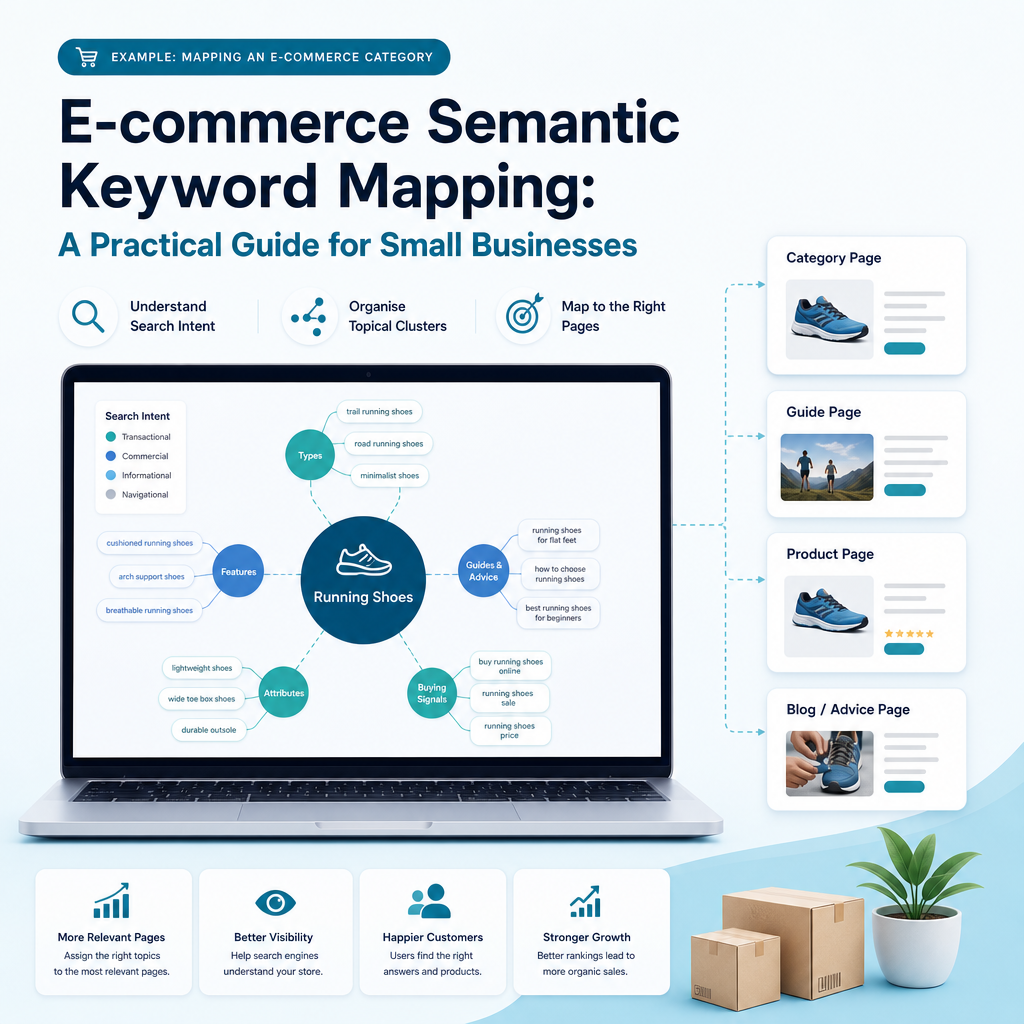
Example: mapping an e-commerce category

Example: mapping an e-commerce category

Imagine an online retailer selling high end furniture such as RBTwelve. The broad entity is “high end furniture”, but that phrase alone does not describe the customer journey.

Research may reveal related concepts including espresso machines, pour-over coffee makers, French presses, coffee grinders, grind size, water temperature, home barista equipment, compact machines and beginner bundles. These terms do not all belong on one page.

Example semantic mapping for a coffee equipment store
Search need Suitable page Supporting concepts
Browse espresso machines Espresso machine category Home espresso, pressure, milk frothing, automatic and manual machines
Choose equipment for a small kitchen Buying guide Compact design, counter space, storage and ease of cleaning
Buy a specific machine Product page Specifications, capacity, warranty, accessories and availability
Understand brewing methods Educational guide Pour-over, French press, extraction, grind size and water temperature
Find a grinder for espresso Grinder category or subcategory Burr grinder, grind settings, dosing and compatibility

This structure gives each page a clear role. It also creates natural internal links between education, product discovery and purchase. The map can be expanded with local delivery terms, seasonal gift searches or product bundles if those areas fit the business.

Common e-commerce semantic mapping mistakes

Common e-commerce semantic mapping mistakes

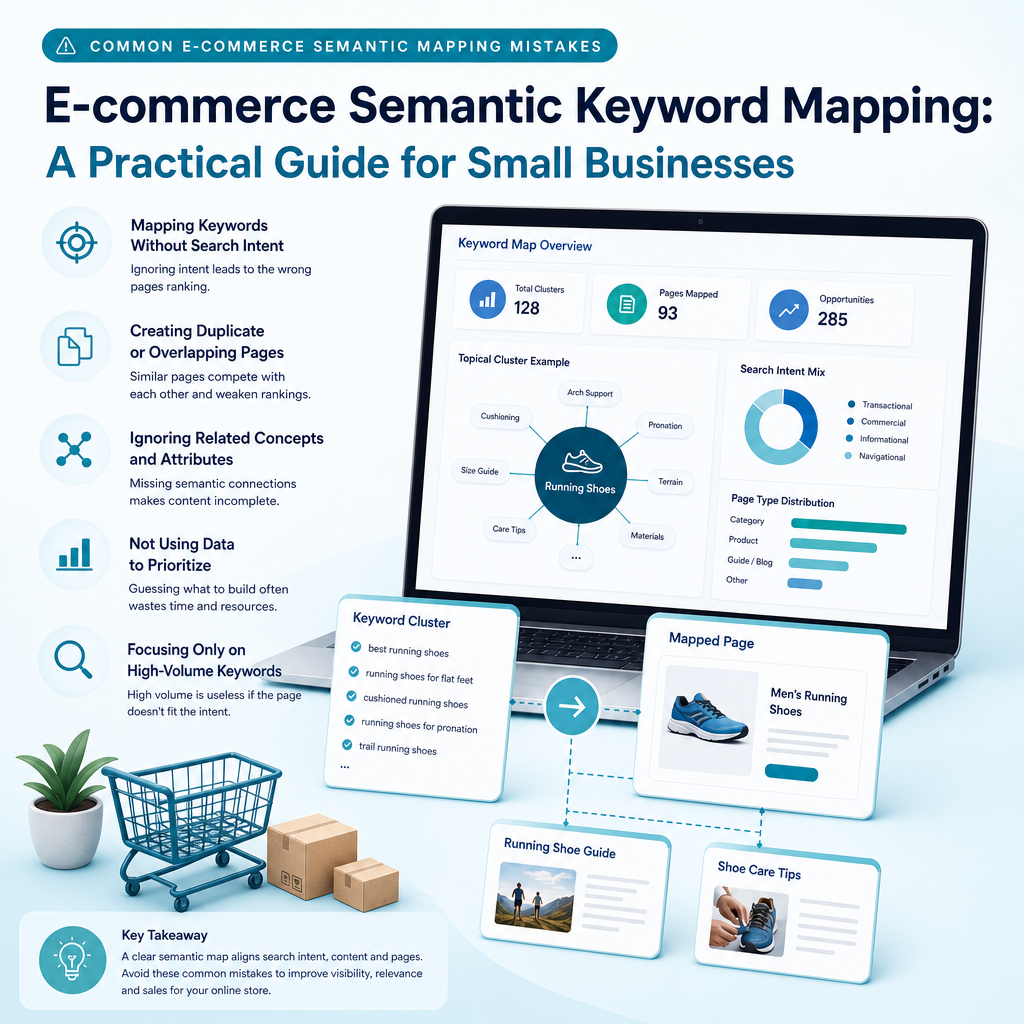
Semantic mapping is useful only when it reflects customer needs and the realities of the website. Several mistakes can make the map larger without making the SEO strategy better.

Building pages for every minor variation

Changing the word order or adding a close synonym does not automatically justify a new page. If the same products, SERP results and customer need apply, keep the terms in one cluster and strengthen the existing page.

Treating search volume as the only priority

A high-volume term may be too broad, competitive or commercially irrelevant. A lower-volume search that matches your products, service area and customer needs may be more valuable. Use search performance, intent, business relevance and implementation effort together.

Adding related terms without adding useful information

Semantic SEO is not a licence to insert a list of loosely related phrases. Every concept should earn its place by improving understanding, navigation or decision-making. Forced language reduces trust and can make product pages harder to read.

Ignoring existing Google Search Console data

New keyword research is useful, but your own search data shows how Google currently interprets your website. Ignoring queries that already generate impressions can lead to missed opportunities that are closer to improvement than entirely new topics.

Making every filter indexable

Faceted navigation can generate many URL combinations. Index only combinations that provide distinct value, a suitable product set and a clear search purpose. Keep other filters useful for shoppers without treating each combination as an SEO landing page.

Forgetting regional and language differences

Terms used by shoppers in the United Kingdom may differ from those used in other English-speaking markets. Product availability, delivery, spelling and local intent also influence the value of a query. Map each priority market separately where the differences affect the page experience.

How to measure whether the map is working

How to measure whether the map is working

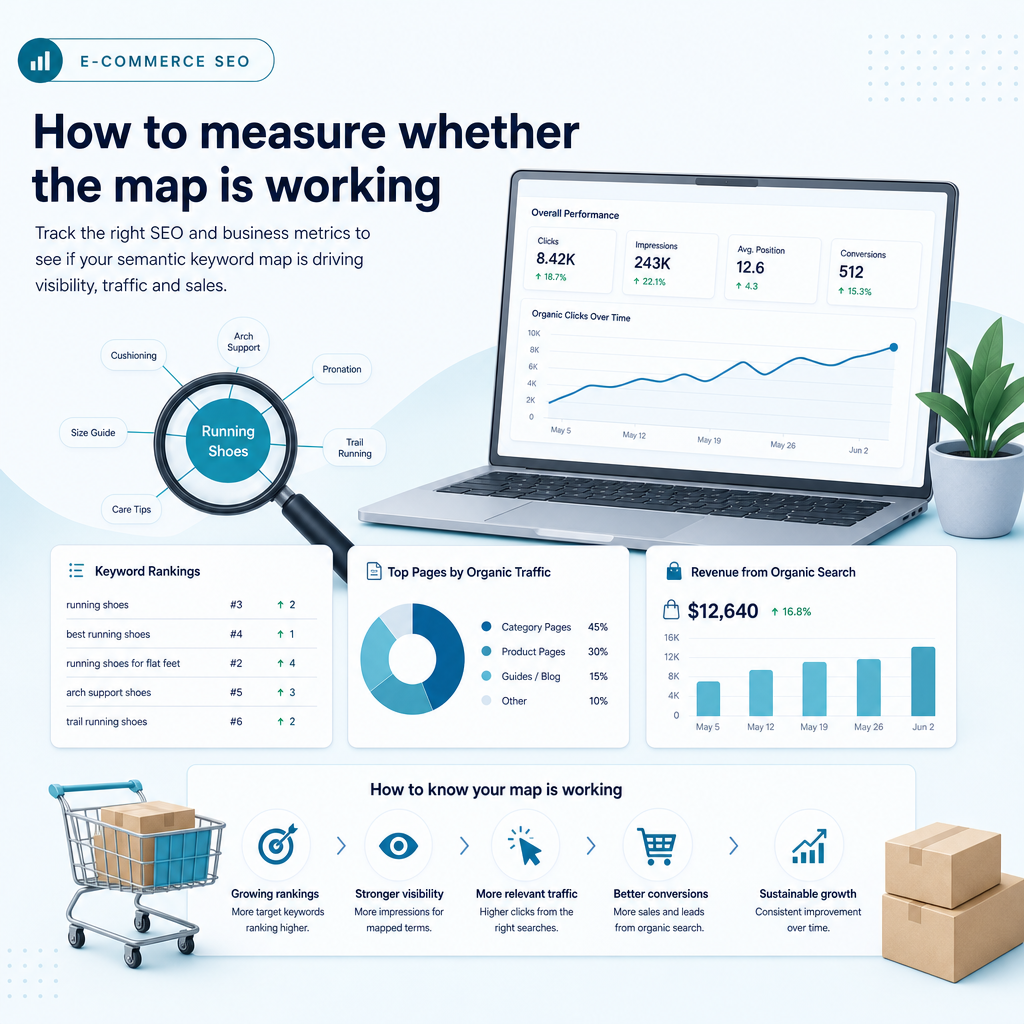
Measurement should focus on whether the map leads to better decisions and more useful pages, not just whether a spreadsheet has been completed. Set a baseline before making changes, then track performance by page and cluster.

Useful measures include impressions and clicks from Google Search Console, the number of relevant queries associated with each URL, average position trends, organic click-through rate, engagement, product views, assisted conversions and completed purchases. For informational pages, monitor whether readers move to relevant category or product pages.

Also review ownership. If a category page is intended to rank for a cluster but a thin filter URL repeatedly appears instead, investigate the cause. The solution may involve improving the category, changing internal links, consolidating duplicate pages or revising the cluster.

Ammpli helps small teams use Google Search Console and Analytics data alongside competitor research and search-intent analysis. This makes it easier to identify realistic ranking opportunities, including relevant searches where a website already has visibility but has not yet reached a strong position.

When should you use an SEO tool or specialist?

When should you use an SEO tool or specialist?

You can build a basic map with a spreadsheet, Google Search Console and manual SERP research. That approach works well for a small catalogue or a focused first project. The challenge grows when you have many products, several markets, frequent catalogue changes or limited time to review data.

An SEO tool or AI SEO content platform can help collect opportunities, group related terms, identify content gaps, prepare briefs and monitor performance. A specialist may be useful when your site has major duplication, a complex migration, large-scale technical problems or unclear commercial priorities.

The best choice depends on your resources. Generic AI writing tools can generate text, but they may not know which opportunities your website can realistically pursue. Traditional agencies offer strategic support but may not fit every growing business’s budget. A data-driven SEO content workflow can give smaller teams more control while reducing manual research.

How Ammpli supports e-commerce semantic keyword mapping

How Ammpli supports e-commerce semantic keyword mapping

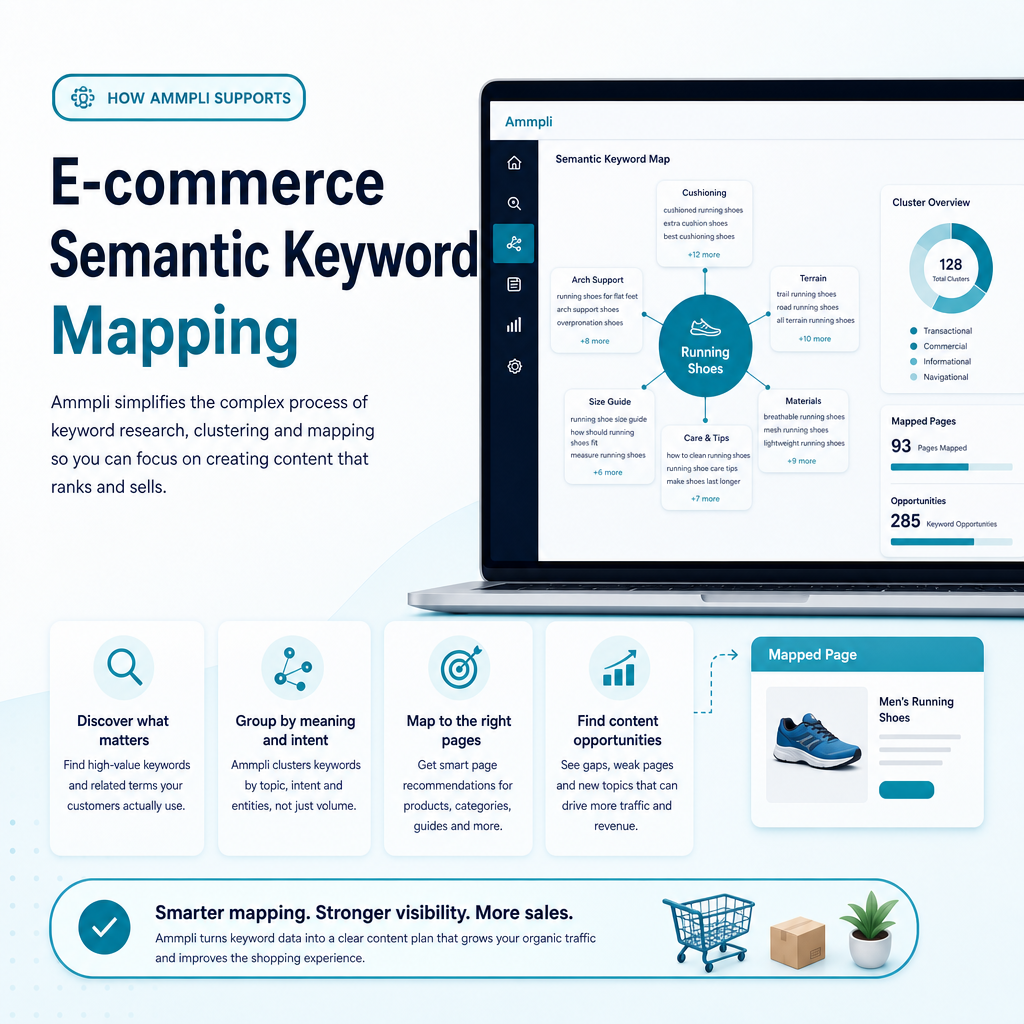
Ammpli is an AI SEO content platform for small and growing businesses in the United Kingdom and English-speaking international markets. It combines Google Search Console and Analytics data with competitor research, search-intent analysis and semantic keyword mapping.

Instead of starting with a generic list, Ammpli can help identify where your existing website has relevant visibility, which topics competitors cover, which content gaps are realistic and how those opportunities can become an organised plan. The resulting insight can support category content, product education, blog articles, local SEO content creation and wider topical authority planning.

The platform also connects planning with AI-powered SEO content creation, SEO content calendars, blog and brand analysis, direct CMS publishing and SEO performance reporting. That can help a small team move from opportunity analysis to a consistent publishing process without managing every task manually.

Ammpli does not replace judgement. Your team still decides which products, markets and priorities matter. Its role is to reduce guesswork, organise search data and turn useful findings into a practical content plan.

Frequently Asked Questions

Frequently Asked Questions

What is e-commerce semantic keyword mapping?

E-commerce semantic keyword mapping organises related search terms, entities, product attributes and user intents into clusters assigned to specific store pages. It helps each category, product, guide and filter serve a clear purpose without relying on repeated exact-match phrases.

How is semantic mapping different from traditional keyword mapping?

Traditional keyword mapping often assigns individual target phrases to URLs. Semantic mapping also examines meaning, relationships, attributes, questions and intent, helping one relevant page address a group of connected searches while avoiding unnecessary page duplication.

Should every product attribute have its own SEO page?

No. Some attributes are useful for product information and filtering but do not justify separate indexable pages. Create dedicated pages for combinations that have a distinct search need, suitable products and enough business value to support a useful experience.

Can small businesses build a semantic keyword map themselves?

Yes. A small business can begin with Google Search Console, Analytics, customer questions, competitor research and a structured spreadsheet. An SEO content planning tool can help when the catalogue, markets or content requirements become too large for manual research.

How often should an e-commerce keyword map be updated?

Review the map at least quarterly and whenever your catalogue, markets, competitors or customer language changes. Seasonal retailers may need more frequent reviews so category pages and content reflect current demand and stock.

Does semantic keyword mapping guarantee higher rankings?

No. Mapping improves strategic clarity and helps align pages with search intent, but rankings also depend on content quality, technical accessibility, competition, authority, product relevance and many other factors. Use it as an evidence-based planning framework rather than a promise of a particular position.

Build a clearer SEO plan from your search data

Build a clearer SEO plan from your search data

E-commerce semantic keyword mapping helps turn a complex product catalogue into a structure that people and search engines can understand. It connects search intent to page type, brings product attributes into the right context, reduces overlap and reveals where useful content can support commercial pages.

Start with one category, use your own Google Search Console data, validate clusters against the search results and map every priority opportunity to a page with a clear purpose. Then review the map as your business grows.

Ready to find realistic opportunities for your store? Start your 14-day free trial with Ammpli, turn your search data into better content and create your SEO content plan. No credit card required.

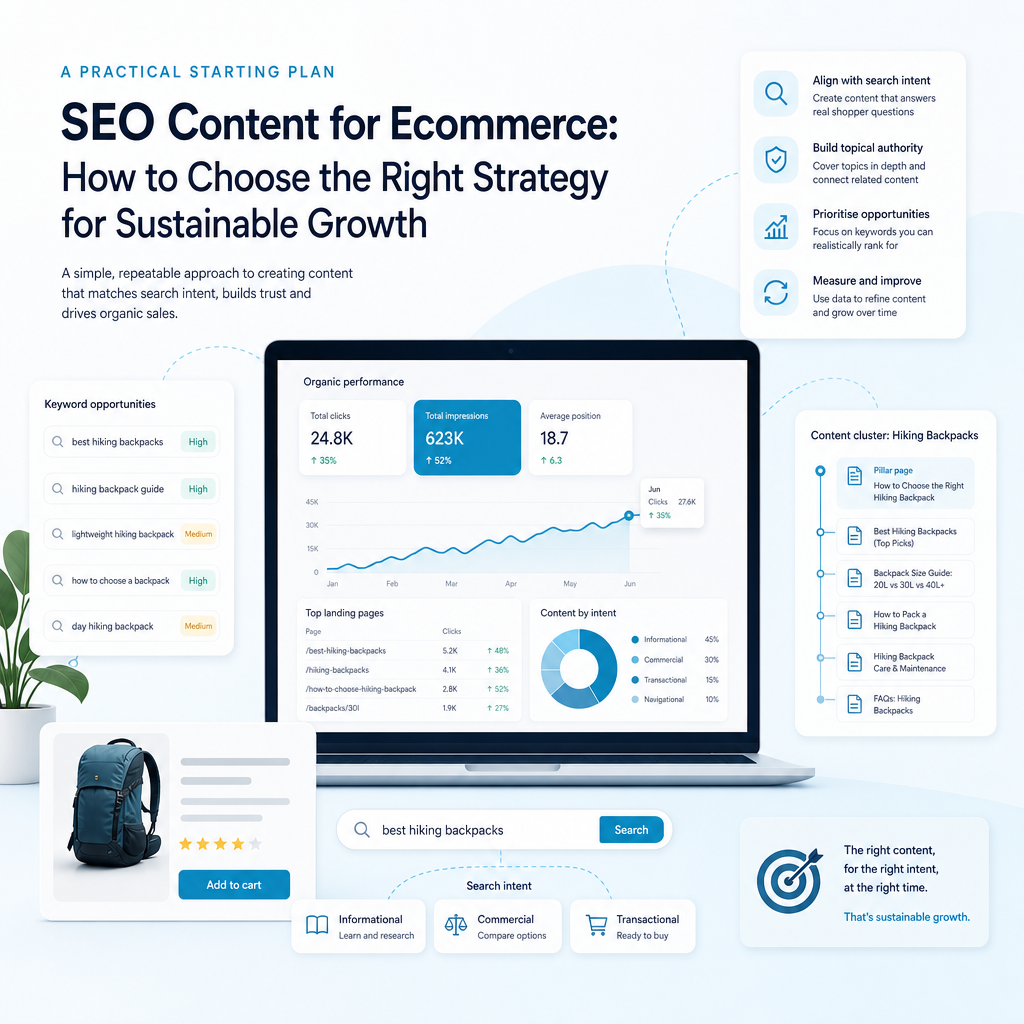
SEO Content for Ecommerce: How to Choose the Right Strategy for Sustainable Growth

SEO Content for Ecommerce: How to Choose the Right Strategy for Sustainable Growth

Your ecommerce store may have strong products, attractive photography and a reliable checkout, yet still struggle to attract customers from Google. The problem is often not a lack of content. It is a lack of direction: unclear search intent, product pages that repeat supplier descriptions, category pages with little useful information and blog posts aimed at keywords your business has little chance of ranking for.

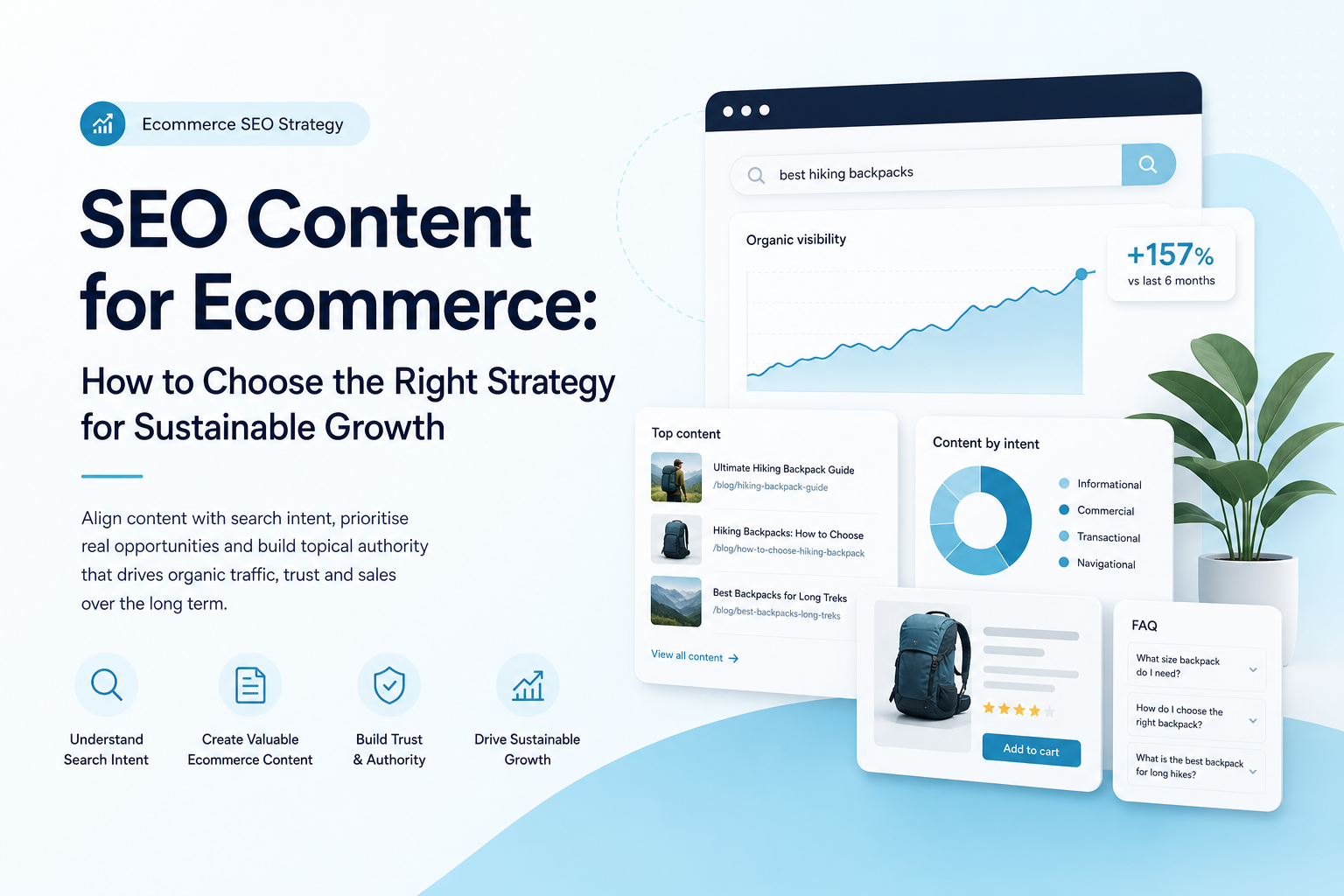
SEO content for ecommerce should connect what shoppers search for with what your store genuinely offers. That means improving product and category pages, answering questions before purchase, building trust through useful information and prioritising realistic opportunities rather than publishing at random.

This guide explains how to compare the main approaches to ecommerce SEO content, what a practical process looks like and how a small or growing business can use search data to make better decisions. It also explains where an AI SEO content platform such as Ammpli fits alongside internal marketing, freelance writers, specialist providers and traditional agencies.

What is SEO content for ecommerce?

SEO content for ecommerce is content created and structured to help an online store appear for relevant searches and guide visitors towards a purchase. It includes more than blog articles. Product descriptions, category introductions, buying guides, comparison pages, FAQs, local landing pages and customer reviews can all contribute to organic visibility.

The strongest ecommerce content satisfies both the shopper and the search engine. It helps a customer choose the right product, understand specifications, compare alternatives or resolve an objection. At the same time, it gives Google clear information about the page, its subject, its relevance and its relationship with other pages on the site.

Why ecommerce content needs a different approach

Ecommerce websites have several page types, each with a different role. A product page usually targets a specific item or model, while a category page targets a broader product group. An article may answer an informational question, and a buying guide can support shoppers who are comparing options.

These pages should work together rather than compete with each other. For example, a store selling home office equipment could create a category page for ergonomic office chairs, product pages for individual chairs and a guide explaining how to choose a chair for long working days. Each page serves a different search need and links naturally to the others.

  • Product pages: Support specific product, brand, model and specification searches.
  • Category pages: Target broader commercial searches and organise the product catalogue.
  • Buying guides: Help shoppers compare features, use cases, sizes, materials and price points.
  • Blog content: Answer informational questions and introduce customers to relevant products.
  • Reviews and questions: Add first-hand language, trust and useful detail to product pages.

The options for creating ecommerce SEO content

The options for creating ecommerce SEO content

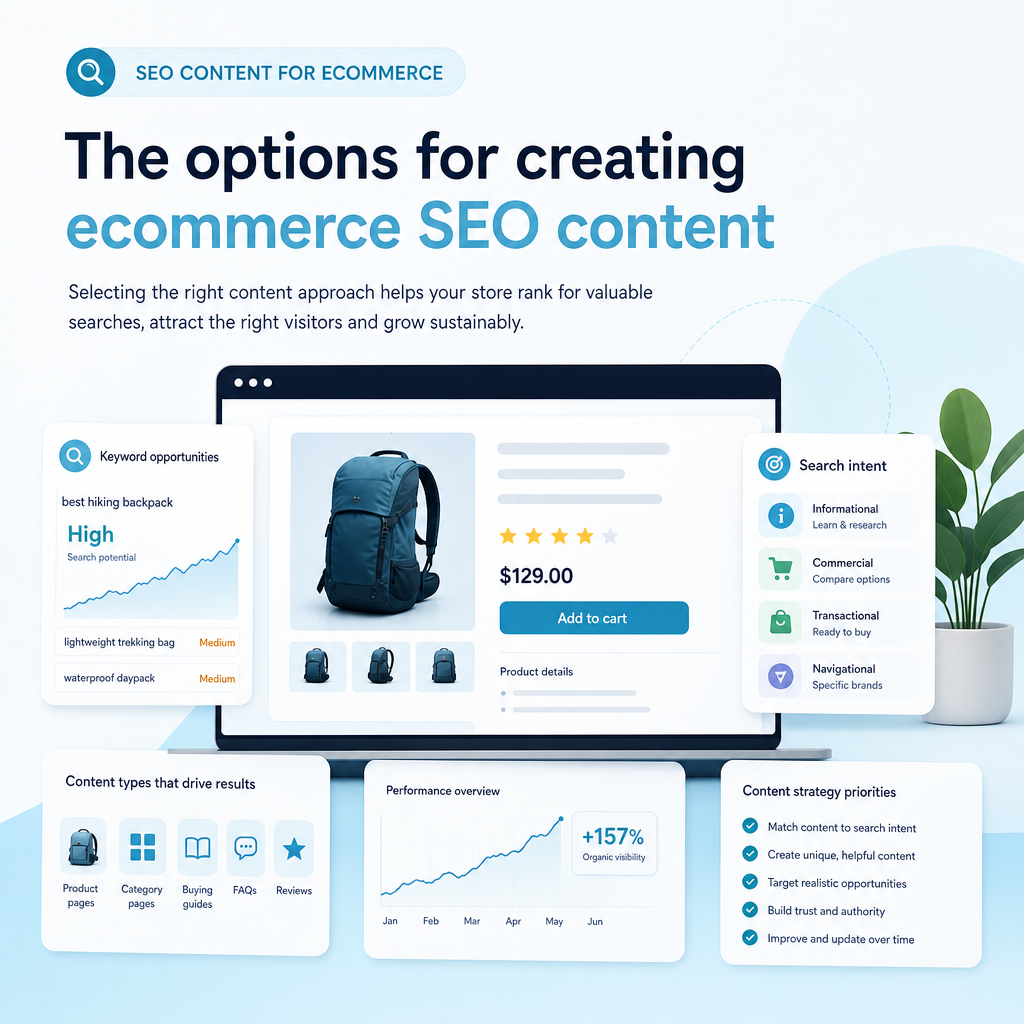
Small businesses normally choose between several content models. You can write content internally, hire freelancers, use generic AI writing tools, work with an agency or use an AI SEO content platform. None is suitable for every business, so the right choice depends on your catalogue size, internal expertise, budget, publishing goals and need for strategic guidance.

The main difference between these options is not simply writing speed. It is the quality of the research, the accuracy of the recommendations, the amount of human review and the connection between content production and business results.

Comparison of ecommerce SEO content options for small businesses
Option Best fit Strengths Limitations
Internal content creation Businesses with available marketing expertise Strong brand knowledge and direct product access Research and production can take substantial time
Freelance SEO writer Businesses needing specialist writing support Flexible capacity and human judgement Research quality and strategic consistency vary
Generic AI writing tool Early drafts, ideas and simple content tasks Fast and accessible May not understand search performance, competition or the catalogue
Content or SEO agency Businesses needing broad strategic support Access to specialists and established processes Higher ongoing cost and less direct control
AI SEO content platform Small teams wanting data-led planning and scalable production Connects opportunity research, planning and content creation Still requires business knowledge, review and quality control

DIY content creation

Writing content yourself can work well when you have a small catalogue, strong product knowledge and enough time to research each topic. Internal teams often understand customer objections, product differences and brand language better than an external provider.

The challenge is consistency. Keyword research, competitor analysis, content briefs, writing, editing, publishing and performance reporting can quickly become a large workload. DIY content can also become reactive, with the team publishing topics that sound useful without checking whether they match search demand or support a commercial goal.

Freelance writers and content specialists

A freelance writer can add valuable capacity without the commitment of a full agency relationship. This option is useful when you already have a content strategy and need someone to turn clear briefs into well-written pages.

The quality of the result depends heavily on the brief and the writer’s ecommerce experience. A writer may produce polished copy but still miss technical requirements, search intent, internal linking opportunities or gaps in the competitor landscape. You may also need to manage research, editing and publishing internally.

Generic AI writing tools

Generic AI writing tools such as ChatGPT can help with brainstorming, outlines, rewrites and first drafts. They can reduce the time needed to create basic copy, but they do not automatically know which searches your website is already appearing for, which competitors are strongest or which topics are realistic for your domain.

That distinction matters. Content can be grammatically correct and still be commercially weak. A generic tool may produce a broad article targeting a competitive term while overlooking a smaller search opportunity where your store already has impressions. AI-generated text also needs fact-checking, product review and brand editing before publication.

Traditional agencies and content marketing providers

An agency can provide strategic advice, technical SEO, content production, outreach and reporting under one relationship. This can be a good fit for larger catalogues, complex migrations or businesses that need broad marketing support.

For a small ecommerce brand, the cost and process may be more than necessary. Some agencies also work from standard packages that prioritise a fixed number of articles or keywords instead of the opportunities visible in your own search data. Ask how the provider chooses topics, how success is reported and who owns the content and strategy.

AI SEO content platforms

An AI SEO content platform is designed to bring research, planning and production into one workflow. Ammpli combines Google Search Console and Analytics data with competitor research, search-intent analysis and semantic keyword mapping to identify opportunities that are relevant to a specific website.

This approach is different from asking an AI tool to write an article from a single keyword. The aim is to understand where the site has existing visibility, what content competitors cover, which related terms belong together and what type of page best matches the search. Ammpli then turns those insights into a practical content plan and search-optimised articles.

Ecommerce SEO content options compared
Option Best fit Main limitation
In-house publishing Small catalogue and available expertise Research and production consume internal time
Freelance specialist Focused campaigns or product knowledge Strategy and reporting may vary
SEO agency Technical, content and authority needs Higher cost and longer onboarding
AI SEO content platform Repeatable planning and content production Quality depends on data and review process

How to build a practical ecommerce SEO content strategy

A useful strategy starts with the customer and the catalogue, not with a list of random keywords. Begin by identifying the products, categories, margins, seasonal priorities and questions that influence buying decisions. Then connect those business priorities with real search behaviour.

The process should be repeatable enough for a small team to manage, but flexible enough to respond to stock changes, new products and seasonal demand. A content calendar is useful, but only when each planned page has a clear purpose.

1. Map the buying journey

Shoppers use different searches at different stages. Someone looking for general advice may not be ready to buy, while someone searching for a specific product, size or feature may have strong purchase intent.

  • Informational: “How do I choose a standing desk?”
  • Commercial research: “Best standing desk for a small office”
  • Comparison: “Electric standing desk versus manual desk”
  • Transactional: “Buy white electric standing desk”
  • Local: “Office furniture shop in Manchester”

Match informational searches with guides and helpful articles, commercial searches with comparison content and category pages, and transactional searches with product and collection pages. A mismatch between the keyword and page type often leads to weak engagement, even if the page attracts impressions.

2. Use Google Search Console as a source of opportunity

Google Search Console shows the queries, pages, impressions, clicks, click-through rates and average positions associated with your website. This makes it especially useful for finding content opportunities that generic keyword tools may not reveal.

Look for relevant queries where your website receives impressions but has not yet achieved strong visibility. These searches can indicate that Google already associates your site with the topic. A new guide, improved category page or clearer product content may be more realistic than starting with an unrelated high-volume keyword.

Analytics data adds another layer. It can show which landing pages lead to engagement, product views, enquiries or sales. Together, Search Console and Analytics help you prioritise topics based on visibility and business relevance.

3. Analyse competitor content gaps

Competitor research should identify more than the keywords other stores rank for. Review the page types appearing in search results, the questions they answer, the product attributes they explain and the internal links they use.

A content gap may be a missing buying guide, an underdeveloped category page or a product comparison that customers need before making a decision. It may also reveal that competitors have created pages for searches your catalogue cannot satisfy. Do not copy their structure automatically. Use the research to identify a useful angle your business can support with accurate information.

4. Build semantic topic groups

Search engines understand relationships between words and concepts, not just exact keyword matches. Semantic keyword mapping groups related terms around a subject so that one page can address the topic naturally without repeating the same phrase.

For example, a page about waterproof hiking boots may need to cover grip, ankle support, walking conditions, materials, sizing, waterproof membranes and care. These related concepts help the page answer the underlying need behind the search.

Semantic mapping also reduces the risk of creating several thin pages that target nearly identical terms. Where one strong page can satisfy the intent, consolidate the information. Where the intent differs, create separate pages and link them clearly.

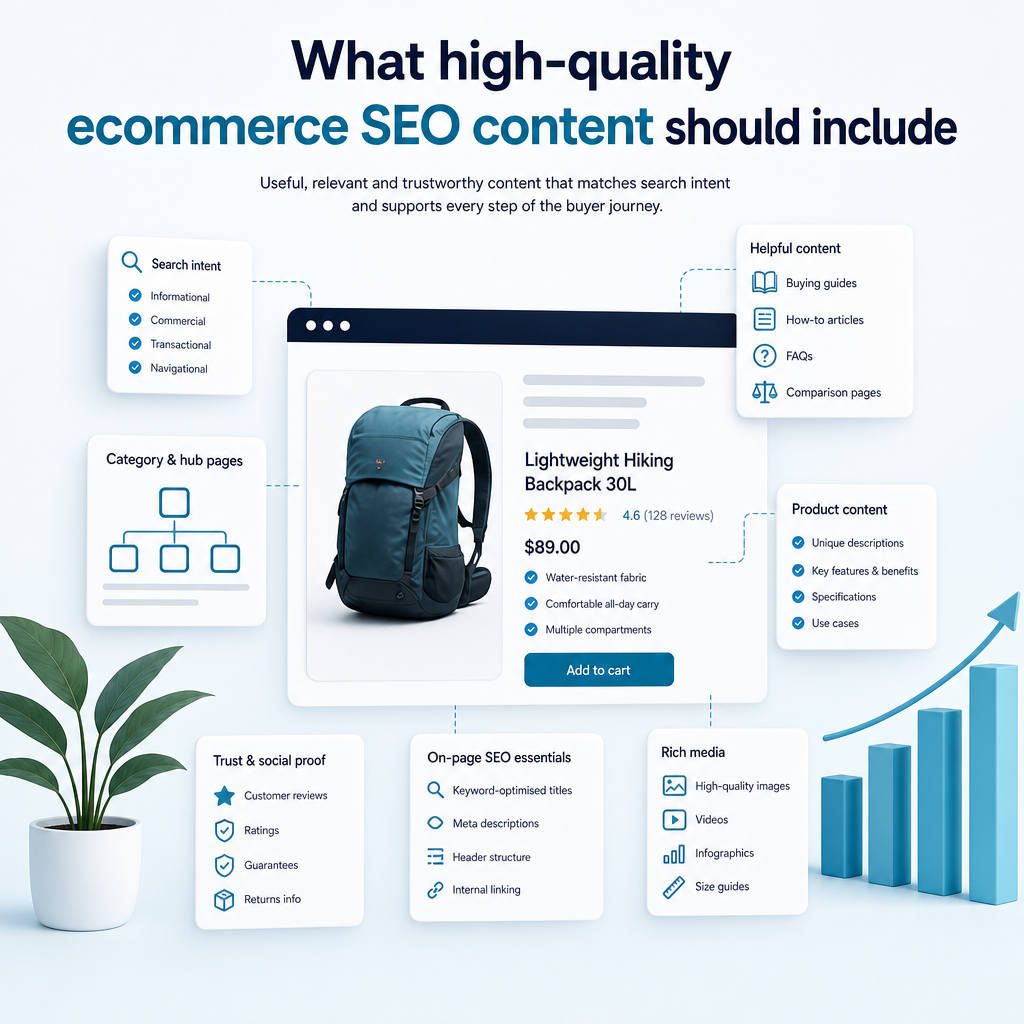
What high-quality ecommerce SEO content should include

What high-quality ecommerce SEO content should include

Good SEO content for ecommerce is useful before it is persuasive. The reader should be able to understand the product, compare options and decide what to do next without searching elsewhere for basic information.

Quality varies by page type, but the same principles apply: accuracy, originality, clarity, relevance and a visible connection to customer needs.

Product pages

Product pages should describe more than what the manufacturer supplied. Explain the benefits of important features, who the product suits, how it compares with alternatives and what the customer needs to know about size, compatibility, delivery, returns and care.

  • Use a clear, unique product title and H1.
  • Write original descriptions based on customer needs.
  • Include specifications in an easy-to-scan format.
  • Use descriptive image file names and relevant alt text.
  • Add genuine reviews and customer questions where available.
  • Link to related products, categories and buying guides.
  • Keep price, availability and delivery information accurate.

Category pages

Category pages are often the most valuable commercial pages on an ecommerce site. They should help shoppers understand the range, choose a suitable product and reach relevant product pages quickly.

A useful category page may include a concise introduction, buying advice, filters that reflect genuine product attributes, frequently asked questions and links to related categories. Avoid adding large blocks of generic copy simply to increase word count. The content should support the shopping task.

Buying guides and comparison content

Buying guides are valuable for middle-of-funnel shoppers who know the problem they want to solve but need help selecting a product. A strong guide explains the differences between options, identifies important features, sets realistic expectations and links to suitable products.

Comparison tables can make this information easier to use. Keep the claims accurate and explain which product is suitable for which use case rather than declaring one universal winner. This creates a better experience and gives the reader a clear route to purchase.

Reviews and user-generated content

Customer reviews add first-hand language that businesses may not think to include themselves. They can answer questions about fit, setup, durability, delivery and everyday use. Reviews also support trust, particularly when shoppers cannot see or test a product in person.

Request reviews after customers have had enough time to use the product. Encourage specific feedback, but do not attempt to control the sentiment. Authentic negative reviews can help shoppers make an informed decision and show that feedback is genuine.

Technical foundations that support content

Content cannot perform well if search engines cannot crawl, understand or index the pages. Ecommerce stores often have technical complications caused by filters, product variants, temporary stock changes, duplicate URLs and large image files.

A technical review should sit alongside content planning. You do not need to fix every issue at once, but you should know which problems affect priority pages and customer experience.

  • Site architecture: Keep the path from the homepage to important categories and products clear.
  • Internal links: Connect guides, categories and products with descriptive links.
  • Canonicalisation: Manage duplicate or near-duplicate URLs created by filters and sorting.
  • Indexing: Decide which pages provide enough value to appear in search.
  • XML sitemaps: Keep important product, category and editorial URLs discoverable.
  • Mobile experience: Check navigation, text, filters, images and checkout on smaller screens.
  • Performance: Monitor loading speed and Core Web Vitals across key templates.
  • Structured data: Use accurate product, offer, review, breadcrumb and article markup where appropriate.
  • Security: Use HTTPS and maintain a trustworthy shopping experience.

Google’s ecommerce guidance highlights product data, structured data, URL design, site structure and crawlable pagination as areas that store owners should manage carefully. Technical implementation does not replace useful content, but it helps search engines interpret and surface it.

How to measure the value of ecommerce SEO content

Traffic alone does not show whether your content is helping the business. A page can attract many visitors who have no interest in buying, while a smaller page may influence valuable purchases or repeat visits.

Choose measures that reflect the purpose of each page. Informational articles may be judged by relevant impressions, clicks, engagement and assisted product views. Product and category pages should be connected to organic revenue, add-to-cart activity and conversion behaviour where tracking is available.

  • Impressions and clicks in Google Search Console
  • Click-through rate for important queries
  • Average position by page and search intent
  • Organic sessions by product, category and article page
  • Product views and add-to-cart actions
  • Revenue or enquiries attributed to organic search
  • Conversion rate and average order value from organic visitors
  • Pages gaining or losing visibility over time
  • Queries that reveal new content opportunities

Review performance regularly, but avoid reacting to daily fluctuations. Use the data to improve titles, update outdated information, strengthen internal links, merge competing pages and create content where demand is clear.

Common mistakes when choosing an ecommerce content solution

Many small businesses choose a provider based on volume alone: how many articles are included, how quickly they can be produced or how low the monthly price appears. Those details matter, but they do not tell you whether the content will support your catalogue or attract the right shoppers.

Ask practical questions before committing to a solution. The answers will reveal whether the provider has a repeatable process or simply produces text.

  • Does the provider use your Google Search Console data?
  • How are search intent and page type determined?
  • Will competitor content gaps be reviewed?
  • How are semantic topics mapped?
  • Who checks product facts and brand accuracy?
  • How will internal links and content updates be managed?
  • Can the process support seasonal products and changing stock?
  • What reporting will show business relevance, not only publishing volume?
  • Can your team review, edit and approve content before publication?
  • Who owns the content, data and strategy if you change provider?

When should you use an AI SEO content platform?

An AI SEO content platform may suit your business if you already have an established website, receive Google impressions or rankings and need a more consistent way to identify and publish opportunities. It can be particularly useful when a small team cannot dedicate hours to manual research each week.

It is less suitable as a substitute for product expertise, editorial judgement or technical support. The best process combines automation for research and production with human review for accuracy, brand fit and customer usefulness.

Key capabilities to compare

  • Search-intent research: separates product, category, comparison and informational searches.
  • Content-gap analysis: identifies useful topics competitors cover that your store does not.
  • Semantic keyword mapping: connects related terms and entities to the right page type.
  • Commercial awareness: links content decisions to products, margins, seasons and customer questions.
  • Performance reporting: shows impressions, clicks, rankings and meaningful organic actions.

How Ammpli supports SEO content for ecommerce

Ammpli is an AI-powered SEO content platform for small and growing businesses in the United Kingdom and English-speaking international markets. It is designed for teams that need practical SEO support without the cost, complexity or time commitment associated with a traditional agency relationship.

Ammpli combines Google Search Console and Analytics data with competitor research, search-intent analysis and semantic keyword mapping. This helps identify relevant opportunities, including searches where a website already receives visibility but has not yet reached its strongest positions.

From there, Ammpli supports SEO opportunity analysis, content gap analysis, topical authority planning, SEO content calendars and AI-powered SEO content creation. Businesses can also use features such as local SEO content creation, blog and brand analysis, direct CMS publishing and SEO performance reporting.

The result is a more connected workflow: find a realistic opportunity, understand the intent, map the topic, create the content, publish it and monitor what happens. This approach gives a small team more structure without removing the business knowledge needed to produce trustworthy ecommerce content.

A practical starting plan for a small ecommerce team

A practical starting plan for a small ecommerce team

You do not need to optimise every product and category page at once. A focused first phase can reveal which type of content is most likely to support your commercial priorities and where the biggest weaknesses sit.

Start with pages that combine business value and existing search potential. This may be a category with healthy margins, a product range with clear demand or a guide that answers a question customers regularly ask before buying.

  1. Connect and review Google Search Console and Analytics data.
  2. List priority products, categories, seasonal ranges and customer questions.
  3. Find relevant queries where the site already receives impressions.
  4. Review competing pages and identify missing or weak information.
  5. Map related terms and assign each topic to the correct page type.
  6. Improve one or two priority category or product pages.
  7. Create a buying guide that supports a clear commercial category.
  8. Strengthen internal links between guides, categories and products.
  9. Check technical basics, structured data, mobile usability and page speed.
  10. Report on visibility, engagement and commercial actions before expanding.

Frequently Asked Questions

What is the best type of SEO content for an ecommerce website?

The best type depends on the search intent and the role of the page. Product pages support specific purchase searches, category pages target broader commercial demand, and buying guides help shoppers compare options. A balanced strategy connects all three rather than relying only on blog articles.

Can AI create effective SEO content for ecommerce?

AI can support research, outlines, drafting and content production, but effective ecommerce content needs accurate product knowledge, search-intent analysis and human review. A platform connected to Search Console and Analytics can provide more relevant direction than a generic writing tool because it considers the website’s existing visibility and opportunities.

How do I choose between an agency, freelancer and AI SEO content platform?

Choose based on the support you need. A freelancer may suit a business with an existing strategy that needs writing capacity. An agency may suit a larger or technically complex project. An AI SEO content platform may suit a small team that needs data-led opportunity research, content planning and scalable production with internal review.

Should ecommerce businesses create separate pages for every keyword?

No. Creating a separate page for every close variation can lead to thin content and competing pages. Group related terms when they share the same intent, then create separate pages only when the search need, product group or audience is genuinely different.

How does Google Search Console help with ecommerce content planning?

Search Console shows the queries and pages already generating impressions and clicks. This can reveal realistic opportunities where your website has relevance but needs stronger content or a better page type. Combining this data with Analytics helps you prioritise topics that also support engagement, product discovery and commercial actions.

Is SEO content worth investing in for a small ecommerce business?

SEO content can be worthwhile when it targets relevant searches, improves the shopping experience and is measured against business goals. Small businesses should avoid publishing large volumes without a plan. A focused programme based on existing search data, product priorities and content gaps is usually a more practical starting point.

How much does ecommerce SEO content cost?

Costs depend on catalogue size, publishing frequency, research depth, editing, technical requirements and whether the provider includes reporting or CMS publishing. Compare the complete process rather than the number of articles alone. A smaller, data-led plan can be more valuable than a large volume of poorly targeted content.

Take the next step with Ammpli

SEO content for ecommerce works best when every page has a clear purpose and every topic is connected to real customer demand. If your team is unsure what to write, which keywords are within reach or how to publish consistently, Ammpli can help turn your search data into a practical content plan.

Start your 14-day free trial with Ammpli and find your next ranking opportunity. No credit card required.

Free for 14 Days

Start Your 14-Day Free Trial

Discover ranking opportunities, uncover keyword gaps and build content strategies designed to help your business get found in modern search.

✓ No credit card required
✓ 14 days free access
✓ AI-powered keyword research
✓ Content opportunities in minutes


Start Your Free Trial →