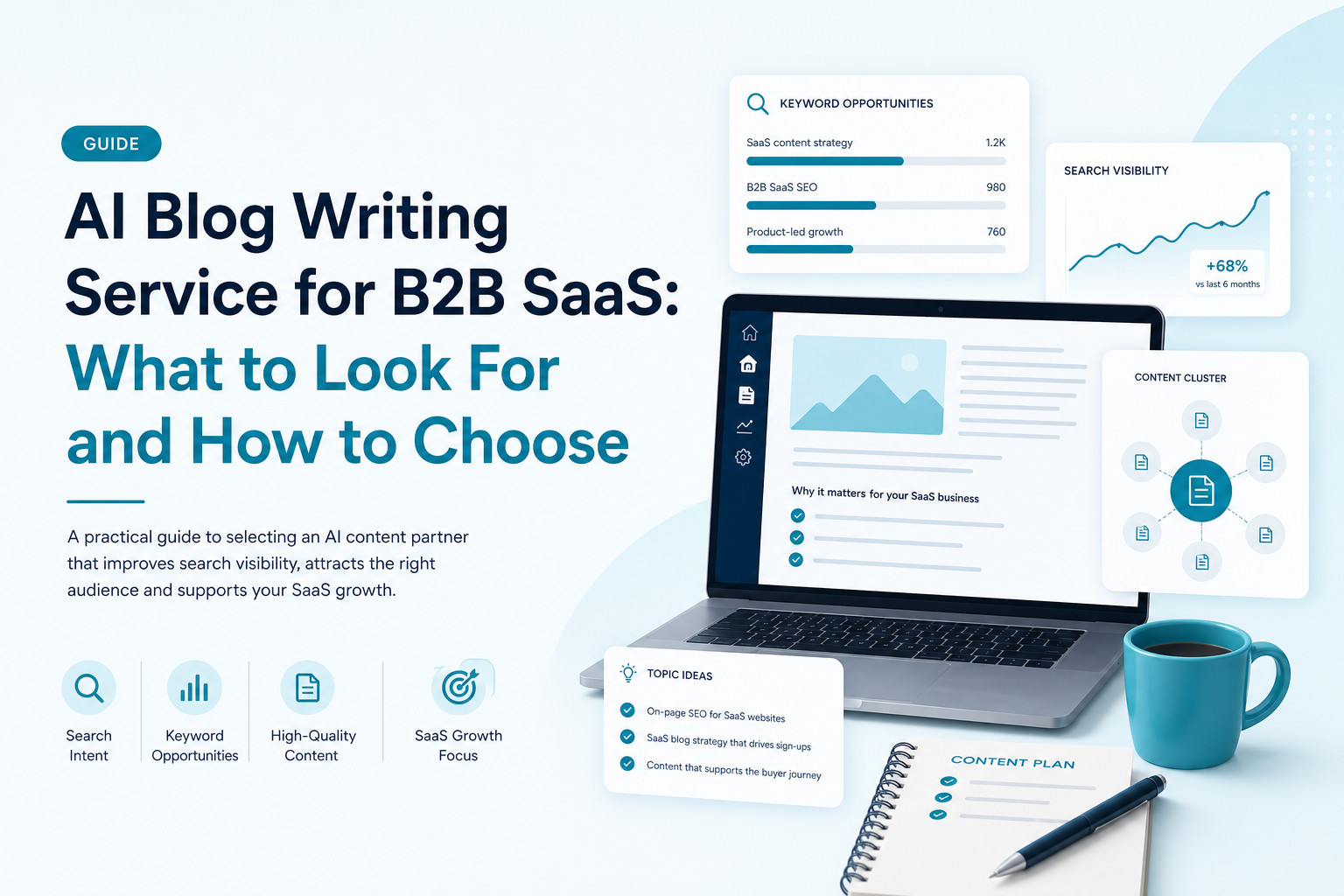
AI Blog Writing Service for B2B SaaS: What to Look For and How to Choose

AI Blog Writing Service for B2B SaaS: What to Look For and How to Choose

Choosing an AI blog writing service for B2B SaaS is not simply a matter of finding a tool that produces readable articles. Your content needs to support a clear search strategy, reflect your product accurately, match the intent behind relevant queries and give potential buyers useful reasons to trust your business.

For a small B2B SaaS company, the right service can reduce research time and create a more consistent publishing process. The wrong one may produce generic articles that sound polished but fail to attract qualified visitors or support your wider SEO goals. This guide explains what a suitable provider should include, how the process works, what affects pricing and how to compare AI SEO content platforms with other options.

What an AI blog writing service for B2B SaaS should include

A useful service combines content creation with research and strategic direction. It should not treat every topic as an isolated writing task. Instead, it should connect each article to your website, existing search visibility, competitors, customer questions and commercial priorities.

For B2B SaaS businesses, practical support often includes:

  • Keyword and search-intent research based on realistic opportunities.
  • Analysis of existing Google Search Console and Analytics data.
  • Competitor content-gap analysis.
  • Semantic keyword mapping and related-topic planning.
  • SEO briefs, content calendars and article production.
  • Review of brand positioning, product language and audience needs.
  • Local SEO content creation where the business serves defined locations.
  • Direct CMS publishing and SEO performance reporting where available.

The provider should also explain what human input is needed. AI can accelerate research, outlining and drafting, but product expertise, editorial judgement and fact checking remain important for credible B2B content.

Why generic AI writing tools are often not enough

General tools can produce a draft from a prompt, but they may not know which topics your website can realistically compete for. They can also miss the difference between an informational query, a comparison search and a buyer who is ready to request a demonstration.

A generic article may mention common industry terms without building a meaningful relationship between your product, audience and search intent. It may also repeat information already available across competing pages. This creates activity, but not necessarily a useful content asset.

A specialist AI SEO content platform takes a different approach. It uses evidence from your website and search performance to identify opportunities, then applies those insights to planning and writing. Ammpli combines Google Search Console and Analytics data with competitor research, search-intent analysis and semantic keyword mapping alongside our proprietary formula , helping small businesses turn existing visibility into a more focused content plan.

How the process works
How the process works

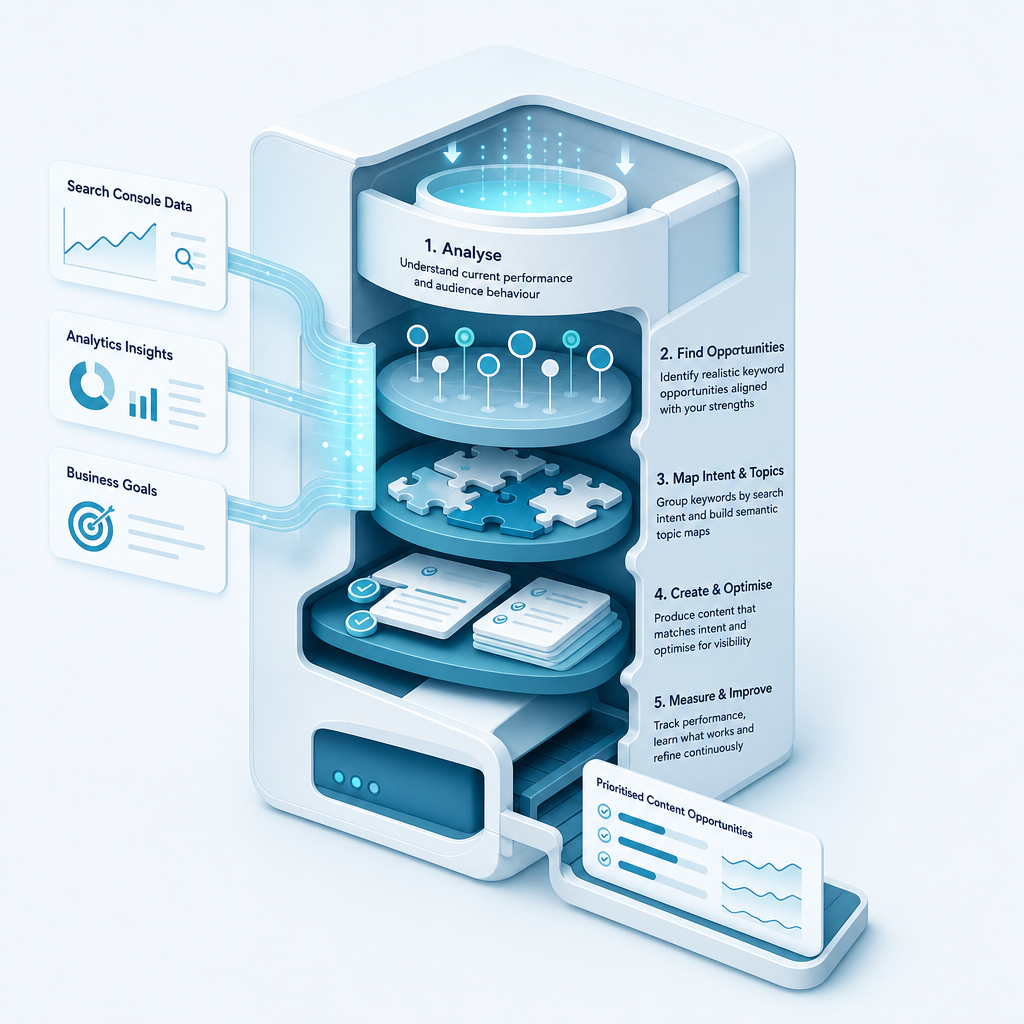
A reliable AI blog writing service should make its process clear before you commit. You should know how topics are selected, how drafts are reviewed and how performance is measured after publication.

1. Analyse your current search performance

The process begins with your website rather than a blank document. Google Search Console can show the queries that already generate impressions, the pages receiving visibility and opportunities where your site appears without attracting enough clicks.

Google Analytics data adds context about what visitors do after arriving. Together, these sources help identify subjects connected to your existing audience and commercial goals.

2. Find realistic keyword opportunities

Keyword research should go beyond search volume. A relevant query with moderate demand may be more valuable than a broad term dominated by large publishers. A keyword opportunity finder can help identify searches where your website has a credible basis for gaining visibility.

The best opportunities usually sit close to your expertise, product category or customer problems. They may include comparison topics, implementation questions, integration searches, workflow problems or industry-specific use cases.

3. Map search intent and semantic topics

Search intent explains what a person expects to find when they search. A page aimed at “how to rank higher on Google” will need a different structure from a page aimed at comparing SEO content software.

Semantic keyword mapping connects the main topic with related concepts, questions and terminology. This supports clearer coverage without forcing repeated phrases into the copy. It can also help build topical authority by planning a group of connected pages rather than publishing disconnected posts.

4. Review competitor content gaps

Competitor research should identify useful gaps, not encourage imitation. A content gap analysis tool can reveal questions competitors answer poorly, topics they have missed and areas where their pages lack practical detail.

For a B2B SaaS company, this may lead to content about implementation, security processes, workflows, team adoption, reporting or sector-specific applications. The final topic should still reflect your own experience and offer a clear reason for the reader to continue with your business.

5. Create, review and publish the article

The writing stage should produce an article with a clear purpose, useful structure and accurate product references. A suitable workflow includes editorial review, brand checks, internal linking and a final review of titles, headings, metadata and calls to action.

Some SEO content software can publish directly to a CMS. This can reduce manual work, although your team should retain approval over important product claims, regulated subjects and pages aimed at high-value prospects.

6. Measure performance and improve the plan

Publishing is not the end of the process. Search impressions, clicks, rankings, engagement and conversions can show which topics deserve further work.

Performance reporting should inform future content planning rather than focus on a single metric. A page may first build visibility for several related searches before generating qualified enquiries. Regular review helps your team decide whether to update, expand, link to or replace an article.

What outcomes can you reasonably expect?

An AI blog writing service for B2B SaaS should help you create a more consistent and evidence-led publishing system. The immediate outcome is usually a clearer list of topics, briefs and articles connected to your audience and website data.

Over time, useful content can support:

  • More relevant organic visibility.
  • Stronger coverage of customer questions.
  • Better internal linking between related pages.
  • More consistent communication of your product’s value.
  • A clearer route from informational content to commercial pages.
  • Less manual research for your marketing team.

No provider can responsibly promise a fixed ranking position or a set level of traffic. Results depend on competition, site quality, technical factors, content usefulness, authority and ongoing publishing. A trustworthy provider explains these variables instead of presenting guaranteed outcomes.

Pricing factors for B2B SaaS AI content services
Pricing factors for B2B SaaS AI content services

Pricing varies because providers offer different levels of research, editorial support and publishing assistance. A low-cost writing tool may produce drafts, while a specialist service may include opportunity analysis, content planning, semantic mapping, review and reporting.

Before comparing quotes, check what is included in the monthly or project fee. The table below highlights common differences between approaches.

What different B2B SaaS content options typically include
Option Typical focus Best suited to
Generic AI writing tool Prompt-based drafts with limited website context Teams with their own SEO strategy and editorial resources
Freelance SEO writer Human-led research and article production Businesses needing specialist writing for selected topics
Content marketing agency Strategy, production and account support Companies with a larger budget and wider marketing requirements
AI SEO content platform Data-led opportunity research, planning, writing and reporting Small teams seeking repeatable SEO content production

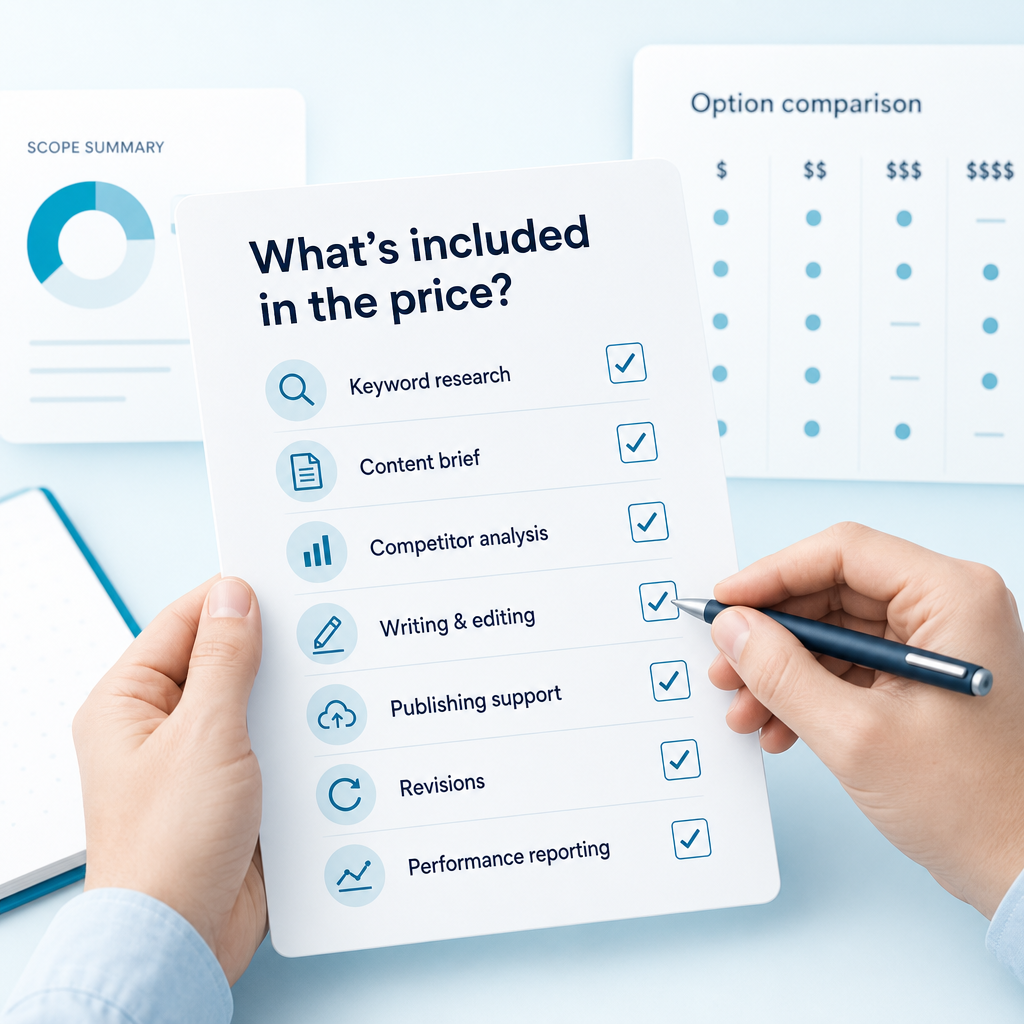
Ask whether the price includes keyword research, content briefs, competitor analysis, editing, publishing, revisions and performance reporting. Also check whether you can approve topics before articles are created. Clear scope reduces surprises and helps you compare providers fairly.

How to evaluate a provider before choosing

The strongest provider is not necessarily the one that produces the highest number of articles. It is the one that can show how each article relates to your audience, search data and business objectives.

Look for a provider that:

  • Explains its research and review process clearly.
  • Uses your actual website data rather than relying only on generic keyword lists.
  • Separates content creation from unsupported performance promises.
  • Allows you to review topics and product claims.
  • Creates content for people as well as search engines.
  • Can support content planning, internal linking and future updates.
  • Provides understandable reporting.
  • Has experience working with limited internal marketing resources.

Ask for examples that demonstrate quality and relevance, while checking whether the examples reflect your market. Reviews can help, but they should be read alongside the provider’s process, scope and communication standards.

Why Ammpli may suit a small B2B SaaS team

Why Ammpli may suit a small B2B SaaS team

Ammpli is an AI SEO content platform designed for small and growing businesses that need practical SEO support without the cost or complexity of a traditional SEO agency. It combines SEO opportunity analysis, Google Search Console data analysis, AI-powered SEO content creation and competitor content-gap analysis in one workflow.

The platform can help your team identify relevant searches where your website already has visibility but has not yet reached its strongest positions. It then supports search-intent research, semantic keyword mapping, topical authority planning and SEO content calendars, so your publishing decisions are based on evidence rather than guesswork.

Ammpli also supports local SEO content creation, blog and brand analysis, direct CMS publishing and SEO performance reporting. This makes it relevant to B2B SaaS teams in the United Kingdom and English-speaking international markets that want a repeatable approach without hiring a large external team.

When should you start?

It may be time to choose an AI blog writing service when your website receives impressions but your team does not have a clear plan for turning them into useful content. It may also be suitable when publishing has become irregular, articles are not connected to commercial goals or marketing staff spend too much time on manual research.

Start with a focused review of your existing website, search data and priority audiences. A good provider should help you identify a practical first set of opportunities rather than pushing an unnecessarily large content programme.

For many small teams, the best next step is to test the workflow on a limited set of topics. This lets you judge the quality of the research, writing, review process and reporting before making broader plans.

Frequently Asked Questions

What is an AI blog writing service for B2B SaaS?

It is a service or platform that uses AI to support research, planning and production of search-optimised blog content for business software companies. A strong service also considers website data, search intent, competitors, semantic topics and the product’s audience rather than producing generic drafts.

Can AI-written B2B SaaS content rank on Google?

AI-assisted content can perform well when it is accurate, useful, original and aligned with search intent. Rankings depend on many factors, including competition, site quality, technical performance, authority and the value the page provides. No responsible provider should guarantee a particular position.

How much does an AI SEO content platform cost?

Cost depends on the level of research, number of articles, editorial review, publishing support, reporting and other services included. Compare the full scope rather than the headline price, and check whether opportunity analysis and content planning are part of the package.

Is an AI SEO content platform suitable for a small B2B SaaS company?

It can be suitable when the company has an established website, some Google visibility and limited time or internal SEO expertise. The platform should make it easier to find realistic opportunities, plan connected content and publish consistently while keeping the team involved in approval and product accuracy.

What should I check before choosing a provider?

Review the provider’s research process, data sources, editorial controls, pricing scope, publishing options and reporting. Confirm that the service supports your audience and business model, explains limitations clearly and does not rely on unsupported ranking promises.

Can Ammpli help create a B2B SaaS SEO content plan?

Yes. Ammpli uses search-performance data, competitor research, search-intent analysis and semantic keyword mapping to identify content opportunities. It can then support SEO content planning, AI-powered article creation and performance reporting through a practical workflow for small and growing businesses.

Choose a more practical way to create SEO content

The right AI blog writing service for B2B SaaS should give you more than a collection of drafted articles. It should help you decide what to publish, why the topic matters, how it connects to your website and what to review after publication.

Ammpli brings those tasks together through an AI SEO content platform built around real search-performance data. If you are ready to turn your search data into better content, start your 14-day free trial. No credit card is required.
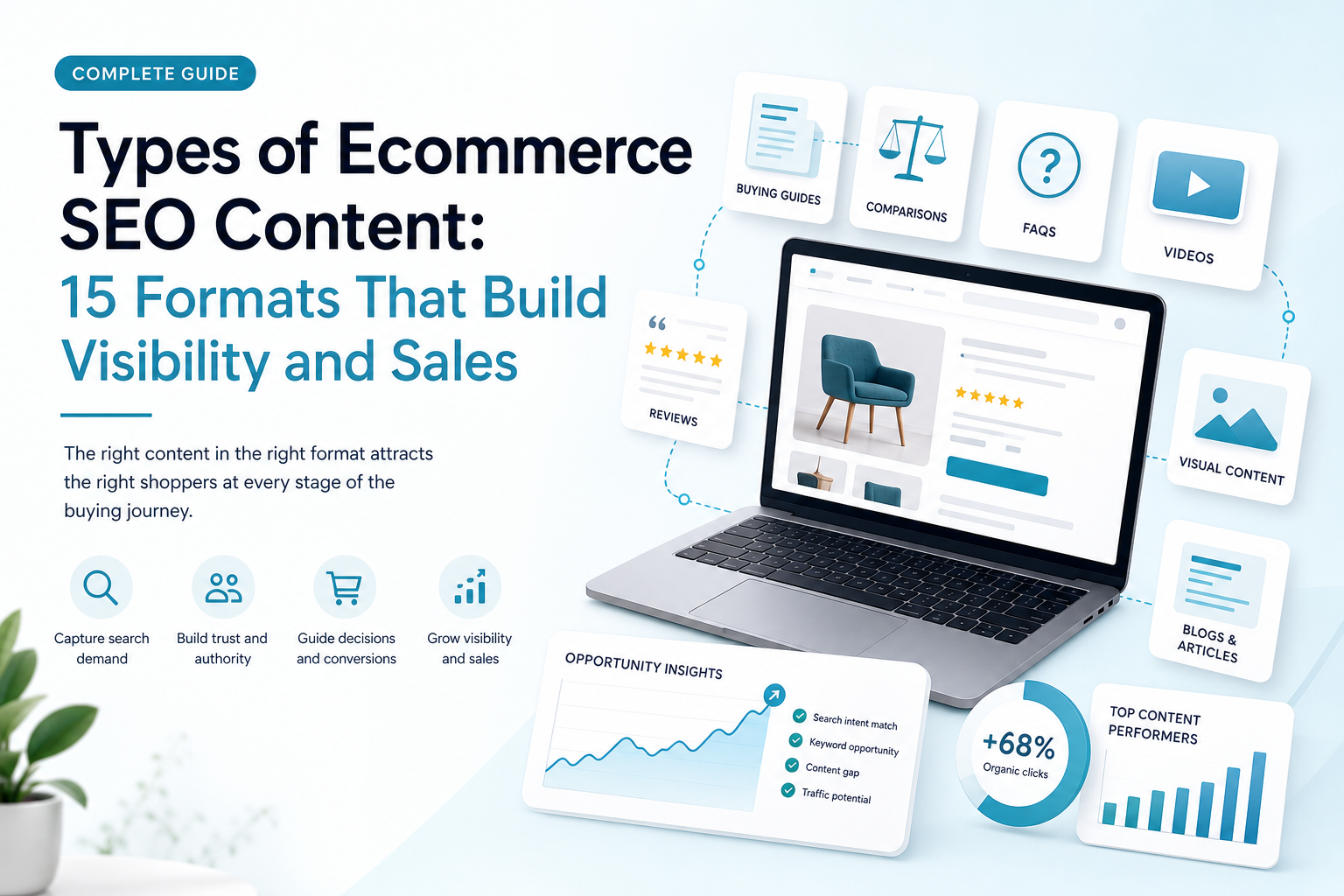
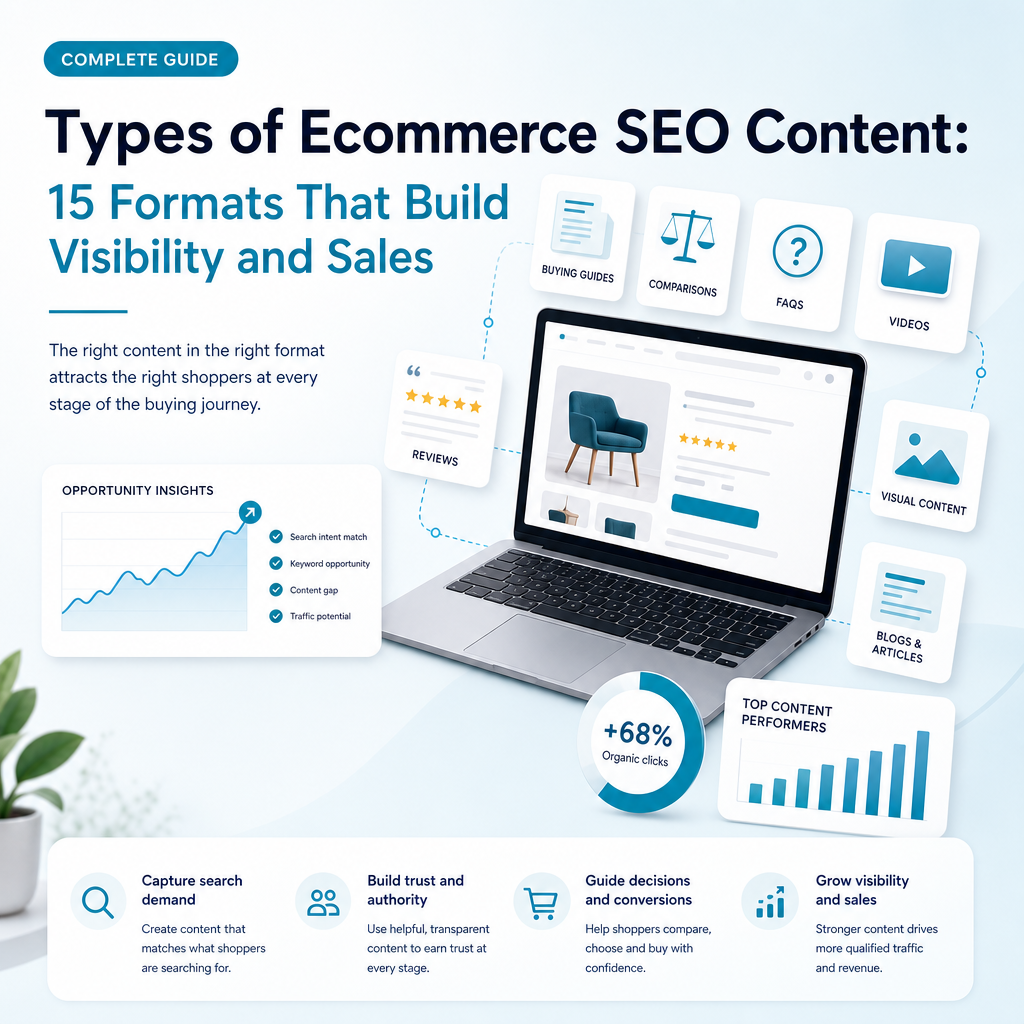
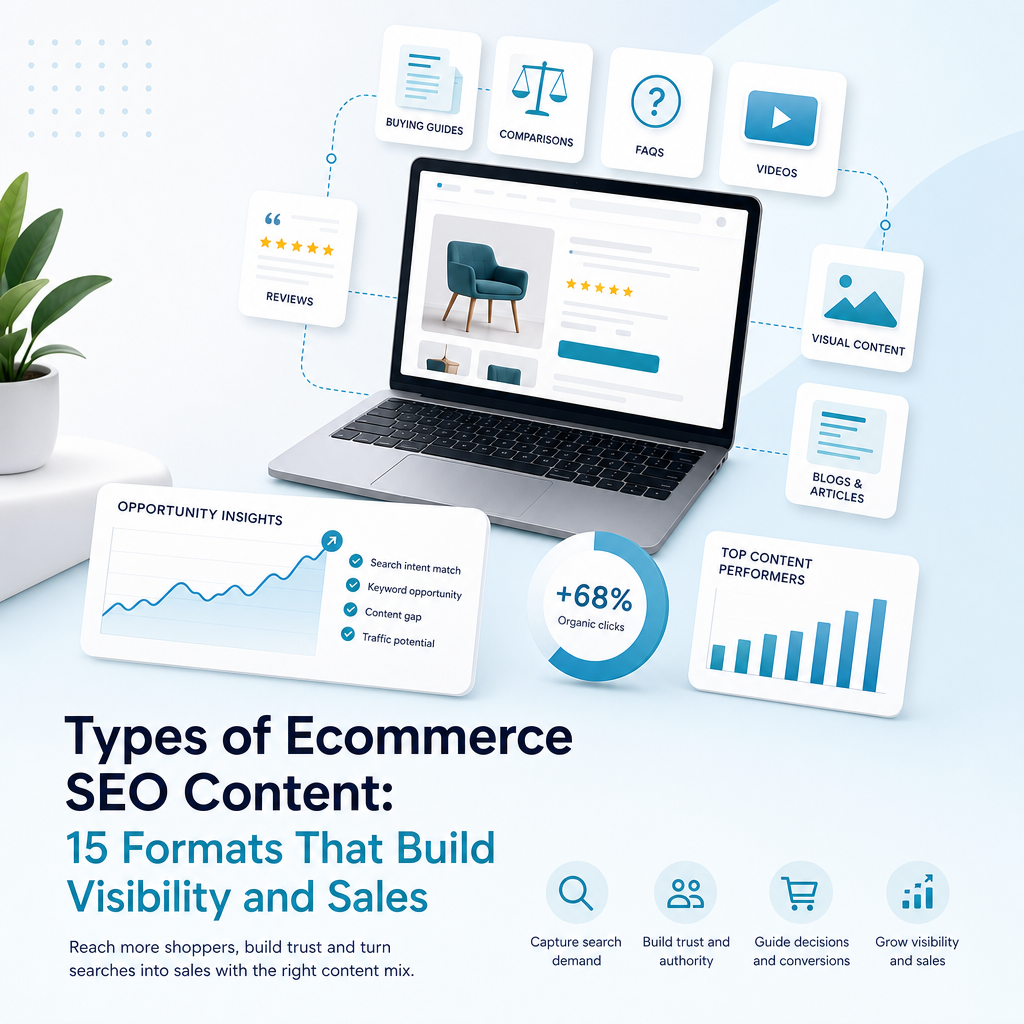
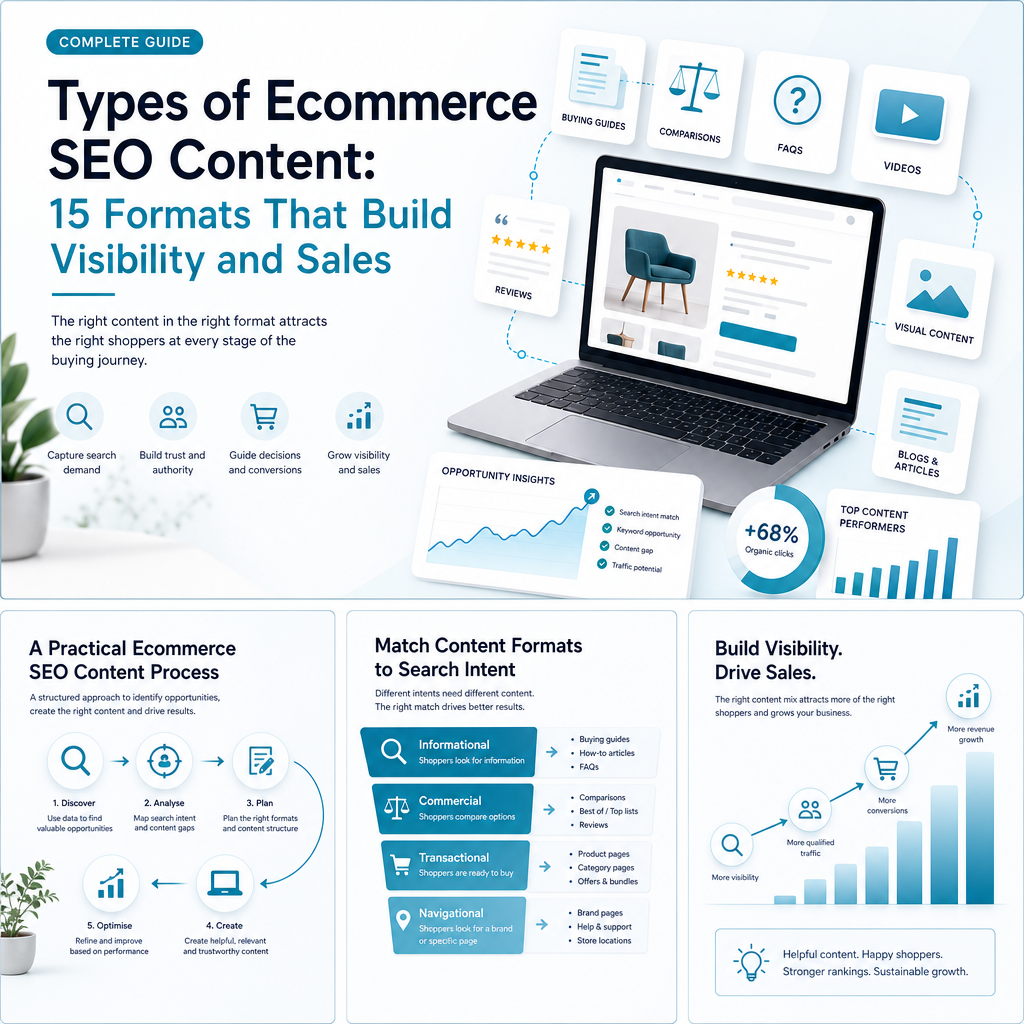
Types of Ecommerce SEO Content: 15 Formats That Build Visibility and Sales

Types of Ecommerce SEO Content: 15 Formats That Build Visibility and Sales

If your ecommerce website is receiving impressions but not enough clicks, enquiries or sales, the issue may not be your product range. It may be the type of content you are publishing, the pages you are prioritising and how closely each page matches what shoppers want to find.

The most effective ecommerce SEO content mix covers the entire buying journey. Product and category pages capture commercial searches, while buying guides, comparisons, FAQs and educational articles help shoppers make decisions. Supporting formats such as reviews, videos, visual assets and brand pages can build trust and strengthen the connections between important pages.

This guide explains the main types of ecommerce SEO content, what each format is designed to achieve, and how a small or growing ecommerce business can choose a practical mix without creating hundreds of low-value pages. It also explains how Ammpli uses Google Search Console data, competitor research, search-intent analysis and semantic keyword mapping to identify realistic opportunities before content is created.

What Is Ecommerce SEO Content?

What Is Ecommerce SEO Content?

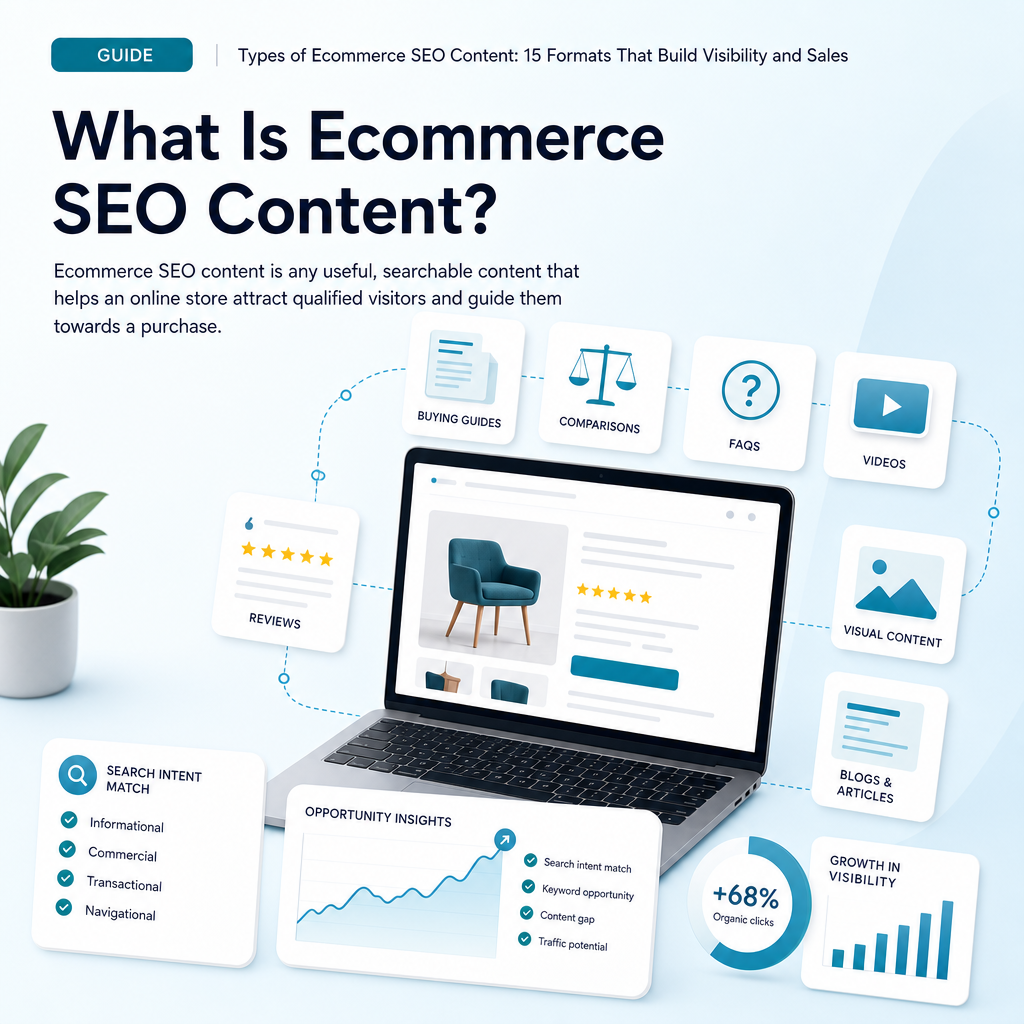
Ecommerce SEO content is any useful, searchable content that helps an online store attract qualified visitors and guide them towards a purchase. This includes visible page copy, metadata, product information, buying resources, customer reviews, videos, comparison pages and structured content such as FAQs.

Different formats serve different search intents. A page targeting “buy ergonomic office chair” needs a different structure from an article targeting “how to choose an ergonomic office chair”. Matching the page type to the search intent is one of the foundations of effective SEO for ecommerce.

Why Your Ecommerce Website Needs More Than Product Descriptions

Why Your Ecommerce Website Needs More Than Product Descriptions

Product pages matter, but they cannot answer every question a prospective customer has. Shoppers may want to compare options, understand materials, check compatibility, find a local supplier, learn how to use a product or confirm delivery and returns information before they buy.

A broader content strategy gives search engines more relevant pages to understand and gives shoppers more opportunities to discover your brand. It can also reduce reliance on paid advertising by building organic visibility around product, category and informational searches.

For small and growing ecommerce brands in the United Kingdom and English-speaking international markets, the practical challenge is deciding where to focus limited time and budget. Publishing every possible format at once usually creates inconsistency. A smaller set of well-planned formats is more useful than a large library of disconnected pages.

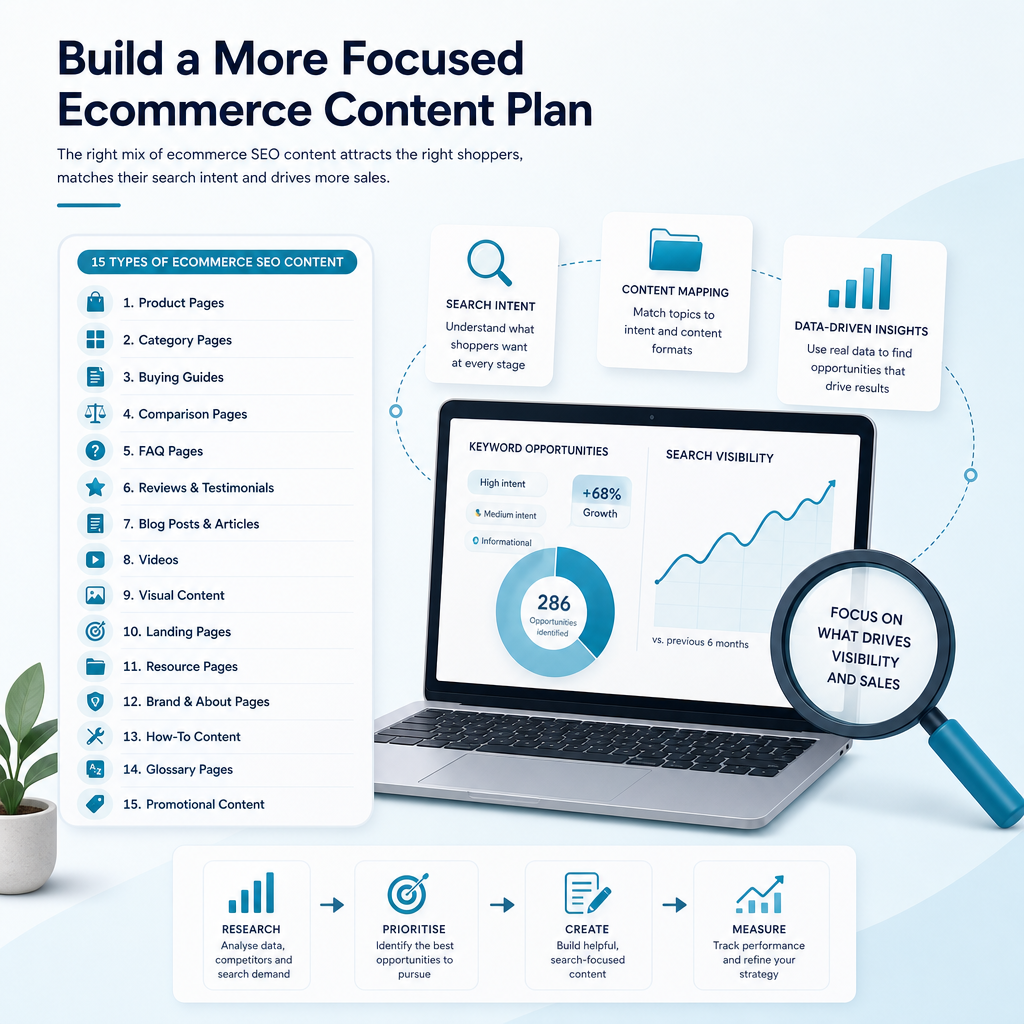
15 Types of Ecommerce SEO Content to Use

15 Types of Ecommerce SEO Content to Use

1. Product Pages

Product pages are usually the closest content asset to a transaction. They should target specific searches involving product names, models, materials, sizes, colours, features and use cases.

A strong product page includes an original title, clear description, benefits, specifications, images, descriptive alt text, pricing, stock status, delivery and returns information, reviews, related products and relevant structured data. Avoid copying manufacturer descriptions across your catalogue. Original content helps explain why the product is useful for your audience and gives each page a clearer purpose.

Product information should answer practical buying questions. Instead of only stating that a product is made from stainless steel, explain how that material affects durability, cleaning or suitability for a particular environment.

2. Ecommerce Category and Collection Pages

Category pages group related products and often target broader commercial searches than individual product pages. They can rank for terms such as “women’s waterproof jackets”, “office furniture online” or “industrial safety equipment”.

Optimised category pages need more than a product grid. Include a useful introduction, a clear H1, relevant metadata, subcategory links, filters that support shopping, descriptive images, internal links and helpful content below the products.

Each category should have unique copy that reflects the products and the customer’s needs. A short explanation can help shoppers understand what is included, while additional headings can cover product types, selection criteria, applications and common questions.

3. Brand Pages

Brand pages are valuable when customers search for a specific manufacturer alongside a product category. Searches such as a brand name combined with “running shoes”, “laptops” or “coffee equipment” often show clear commercial intent.

A useful brand page can explain the brand’s positioning, product range, key features, price level and relevant categories. Link from the brand page to products and categories that shoppers can browse next.

Do not create a page for every brand automatically without checking demand or adding useful information. A thin page containing only a logo and product grid is unlikely to provide a strong search experience.

4. Faceted and Filter-Based Pages

Filters help shoppers find products by colour, size, material, price, application or other attributes. Some filtered combinations also represent valuable long-tail searches, such as “waterproof hiking boots for women” or “oak dining tables under a specific budget”.

Not every filter combination should be indexed. Uncontrolled faceted navigation can create thousands of near-duplicate URLs, waste crawling resources and weaken the site’s structure. Only create dedicated, indexable pages where there is clear search demand and enough unique value to justify the page.

Use canonicalisation, noindex rules or other technical controls where appropriate. The correct implementation depends on the platform, URL structure and the value of each combination.

5. Buying Guides

Buying guides target shoppers who know they need a product but have not decided which option is right. They can capture commercial investigation searches such as “how to choose a coffee grinder” or “what office chair is best for back support”.

A useful guide explains the selection criteria, compares relevant features and links naturally to suitable categories and products. It should help the reader make a decision rather than simply repeat product specifications.

Buying guides also support internal linking. A guide about choosing hiking footwear can link to waterproof boots, trail shoes, size information and care instructions, creating a connected journey from research to purchase.

6. Product Comparison Pages

Comparison pages address searches where shoppers are evaluating two or more options. Examples include “manual versus electric coffee grinders”, “standing desk versus traditional desk” and “Product A versus Product B”.

Good comparisons use consistent criteria, explain which type of buyer each option suits and avoid unsupported claims. Include differences in features, materials, capacity, compatibility, price range, maintenance and intended use where those factors matter.

Comparison content works best when it leads to clear next steps. Link to the relevant products, category pages or buying guides without forcing the reader towards an option that does not match their needs.

7. Best-Of and Use-Case Pages

Best-of pages target searches such as “best office chair for a small room” or “best gifts for new homeowners”. They are commercial pages, but the reader often needs guidance before selecting a product.

These pages need genuine selection criteria. Explain why each item appears, who it suits and where it may not be suitable. A short list of relevant products with meaningful analysis is more useful than a long catalogue with shallow descriptions.

Use-case pages can also support seasonal or audience-specific demand, provided the page offers distinct value rather than simply changing a few words in a template.

8. How-To Guides

How-to content answers practical questions before and after purchase. Examples include how to clean a coffee machine, how to measure for a desk, how to install a product or how to care for a particular material.

Use clear headings, numbered steps, concise instructions and warnings about common mistakes. Include images or video where they genuinely improve understanding.

Link from each guide to products, accessories and related resources. This helps informational visitors discover relevant commercial pages without making the article feel like an advertisement.

9. FAQ Content

FAQs address specific questions that may prevent a purchase. Common subjects include sizing, compatibility, delivery, installation, warranties, returns, materials and maintenance.

FAQs can appear on product pages, category pages, service pages or as a dedicated resource. Keep each answer direct and make sure it matches the information shown elsewhere on the site.

Use structured data only when the questions and answers are visible to users and meet search-engine guidelines. Markup does not guarantee enhanced search results, but accurate structured data can help search engines interpret page content.

10. Reviews and Testimonials

Customer reviews provide original language from real users and can help future shoppers judge quality, suitability and performance. Product reviews may mention the exact features or concerns that new customers are searching for.

Display reviews clearly on product pages and consider creating broader customer story content where it adds value. Encourage specific feedback about the product, use case and experience rather than generic praise.

Review and rating structured data must accurately reflect visible information. Never add ratings or review details that users cannot verify on the page.

11. Video Content

Video can demonstrate products in a way that written copy cannot. Product demonstrations, installation instructions, comparisons, unboxing videos and care tutorials can all support ecommerce SEO and conversion decisions.

Embed relevant videos on the matching product, category or guide page. Include a written transcript or summary so the page remains useful to people who cannot watch the video and so the subject is clear in crawlable text.

Use descriptive titles, thumbnails and accessible captions. Video should support the buying journey rather than appear as an unrelated asset added for decoration.

12. Infographics and Visual Guides

Infographics can explain specifications, product differences, sizing systems, processes or industry data. They may earn shares and editorial references when they contain original, accurate information.

Do not publish an infographic as a standalone image and expect it to rank for a competitive query. Add supporting HTML text, a descriptive heading and useful alt text. Explain the key points in the visual and provide sources when presenting research or statistics.

13. Industry Reports and Original Research

Original research can support authority and attract links from publishers, suppliers and industry websites. Ecommerce businesses might publish research about customer preferences, product usage, sustainability, pricing patterns or sector trends.

Only publish findings that you can support with reliable data and a clear methodology. A smaller report with transparent evidence is more credible than a collection of unverified claims.

The report landing page should be written in HTML with a clear summary, key findings and relevant internal links. If a downloadable document is offered, treat the HTML page as the main search asset.

14. Seasonal and Promotional Content

Seasonal pages can capture demand around gifting, holidays, new academic terms, events or recurring purchasing periods. They should be planned early enough to be crawled, indexed and linked before interest peaks.

Keep useful seasonal pages when the subject returns each year, updating dates, products, availability and advice. Avoid producing near-identical pages for every year unless there is a clear reason to maintain separate URLs.

Promotional content should remain accurate and should not create confusion when products sell out or offers expire. Redirect, update or archive pages according to their ongoing value.

15. Pillar Pages and Content Clusters

A pillar page provides a broad overview of a topic and connects to more focused supporting content. For ecommerce, a pillar page might cover home coffee equipment, outdoor clothing, workplace furniture or sustainable packaging.

Supporting pages can cover product categories, comparisons, how-to advice, care instructions and common questions. Internal links should help users move between the overview and the detailed resources.

Pillar content works best when it reflects real search demand and the products or categories you actually offer. Long pages are not automatically better; depth should be guided by the questions a customer needs answered.

How to Choose the Right Ecommerce SEO Content Mix

You do not need to publish all 15 formats. Your priorities should reflect your catalogue, margins, search performance, resources and customers’ decision process.

Start by checking which pages already receive impressions and which queries show potential. Google Search Console can reveal pages that appear for relevant searches but receive few clicks, including queries where the site is visible but not yet in a strong position.

Then compare the search results for important terms. Note whether Google displays category pages, product pages, comparisons, guides, videos or other formats. The current result type is a useful signal about what searchers and the search engine expect.

Which ecommerce SEO content format should you prioritise?
Business need Recommended content Primary purpose
More visibility for products Product pages and category pages Capture commercial and transactional searches
Help shoppers choose Buying guides, comparisons and best-of pages Support commercial research
Answer customer questions FAQs and how-to guides Reduce uncertainty and attract long-tail searches
Build trust Reviews, testimonials, videos and case studies Provide evidence and product context
Grow topical authority Pillar pages and connected supporting articles Build depth around important categories
Scale a large catalogue Selective brand, category and filter pages Expand useful search coverage without uncontrolled page creation

A Practical Ecommerce SEO Content Process

A Practical Ecommerce SEO Content Process

A repeatable process helps a small team create content that supports business goals rather than publishing based on guesswork.

1. Analyse Existing Search Performance

Review impressions, clicks, click-through rate, average position, landing pages and query themes in Google Search Console. Look for relevant searches where pages already have visibility but need stronger alignment, clearer metadata, better internal links or more useful content.

2. Map Keywords to Search Intent

Group keywords into informational, navigational, commercial and transactional intent. Assign one primary purpose to each page so that product, category, comparison and blog content do not compete for the same search.

3. Identify Competitor Content Gaps

Review the topics and formats used by pages ranking for your target searches. Look for missing information, weak product guidance, poor category copy, unanswered questions and opportunities to provide a more helpful experience.

4. Build a Semantic Content Map

Map related concepts, attributes, questions, products and categories around each topic. Semantic keyword mapping helps a page cover the subject naturally without repeating the same phrase.

5. Create and Optimise the Page

Write for the shopper first, then refine the title, headings, internal links, images, metadata and structured data. AI can speed up research, outlining and drafting, but content should reflect the business, catalogue and customer needs.

6. Publish, Monitor and Refresh

Track how pages perform after publication. Refresh content when products, prices, regulations, availability or customer questions change. Pages that already earn impressions can be strong candidates for improvement.

Common Ecommerce SEO Content Mistakes

Many ecommerce websites have plenty of pages but not enough useful content. Avoiding a few recurring problems can improve clarity and reduce wasted effort.

  • Using copied manufacturer descriptions across multiple products.
  • Creating category pages with only a product grid and no useful context.
  • Indexing every filter combination without checking search demand.
  • Publishing articles that do not link to relevant products or categories.
  • Targeting the same keyword and intent on several competing pages.
  • Using vague metadata that does not explain the page’s value.
  • Ignoring mobile usability, image size and page performance.
  • Creating pages for products or brands with no unique information.
  • Leaving discontinued products without a plan for alternatives, redirects or retained information.
  • Publishing large volumes of automatically generated content without review.

How Ammpli Helps Plan Ecommerce SEO Content

Choosing the right types of ecommerce SEO content is easier when your plan is based on your own search data rather than general assumptions. Ammpli combines Google Search Console and Analytics data with competitor research, search-intent analysis and semantic keyword mapping.

For a small ecommerce team, this can help identify pages and searches where there is already evidence of demand. Ammpli can highlight relevant opportunities where your website receives impressions but has not yet reached its strongest position, then turn those insights into a practical content calendar.

The platform supports SEO opportunity analysis, keyword and search-intent research, competitor content-gap analysis, semantic mapping, topical authority planning, AI-powered SEO content creation, local SEO content creation, direct CMS publishing and SEO performance reporting. This gives founders and marketing managers a way to create data-driven SEO content without paying for the cost or complexity of a traditional SEO agency.

A generic AI writing tool can produce text, but it may not know which categories matter most to your business, which queries already bring visibility or how your pages compare with the current search results. Ammpli connects content creation to those decisions so your publishing effort has a clearer commercial purpose.

Frequently Asked Questions

What are the most important types of ecommerce SEO content?

Start with unique product pages, useful category pages and content that supports purchase decisions, such as buying guides, comparisons and FAQs. The right priority depends on your catalogue, customer journey, current rankings and the searches where your website already receives impressions.

Should ecommerce businesses prioritise product pages or category pages?

Both matter, but category pages often provide a stronger starting point because they target broader commercial searches and connect to multiple products. Product pages should then be improved for specific models, features, sizes, materials and use cases. Google Search Console data can help show which page type has the clearest opportunity.

How can I avoid thin content on ecommerce pages?

Add information that is genuinely specific to the page, such as product attributes, selection guidance, use cases, compatibility details, customer questions, reviews or category-level advice. Do not create large numbers of near-identical pages from templates unless each page has enough unique value and a clear search purpose.

Is AI-generated content suitable for ecommerce SEO?

AI can assist with research, outlines, drafting, semantic coverage and content production, but it should be guided by real business information and reviewed for accuracy. The strongest approach combines AI efficiency with original product knowledge, customer insight, useful examples and accurate stock, pricing and policy information.

How often should ecommerce SEO content be updated?

Review pages when products, stock, prices, delivery details, regulations or customer questions change. High-value pages can also be reviewed regularly using performance data. A page receiving relevant impressions but few clicks may need a stronger title, clearer intent alignment, better content or improved internal linking.

How do I know which ecommerce SEO content opportunity to pursue first?

Prioritise opportunities that combine search relevance, business value and realistic competition. Pages with existing impressions, clear commercial intent and a reasonable gap between current visibility and stronger positions are often practical candidates. Ammpli helps identify these opportunities using Search Console data, competitor analysis and intent mapping.

Build a More Focused Ecommerce Content Plan

Build a More Focused Ecommerce Content Plan

The best ecommerce SEO content strategy is not the one with the most formats. It is the one that connects the right page type to the right search intent, supports the customer journey and can be maintained by your team.

Begin with the pages closest to revenue, then add buying guidance, comparison content, FAQs and supporting resources where customers need more confidence. Review performance regularly and improve the pages that already show signs of search demand.

If you want to find your next ranking opportunity and turn your search data into better content, start your 14-day free trial with Ammpli. No credit card is required.
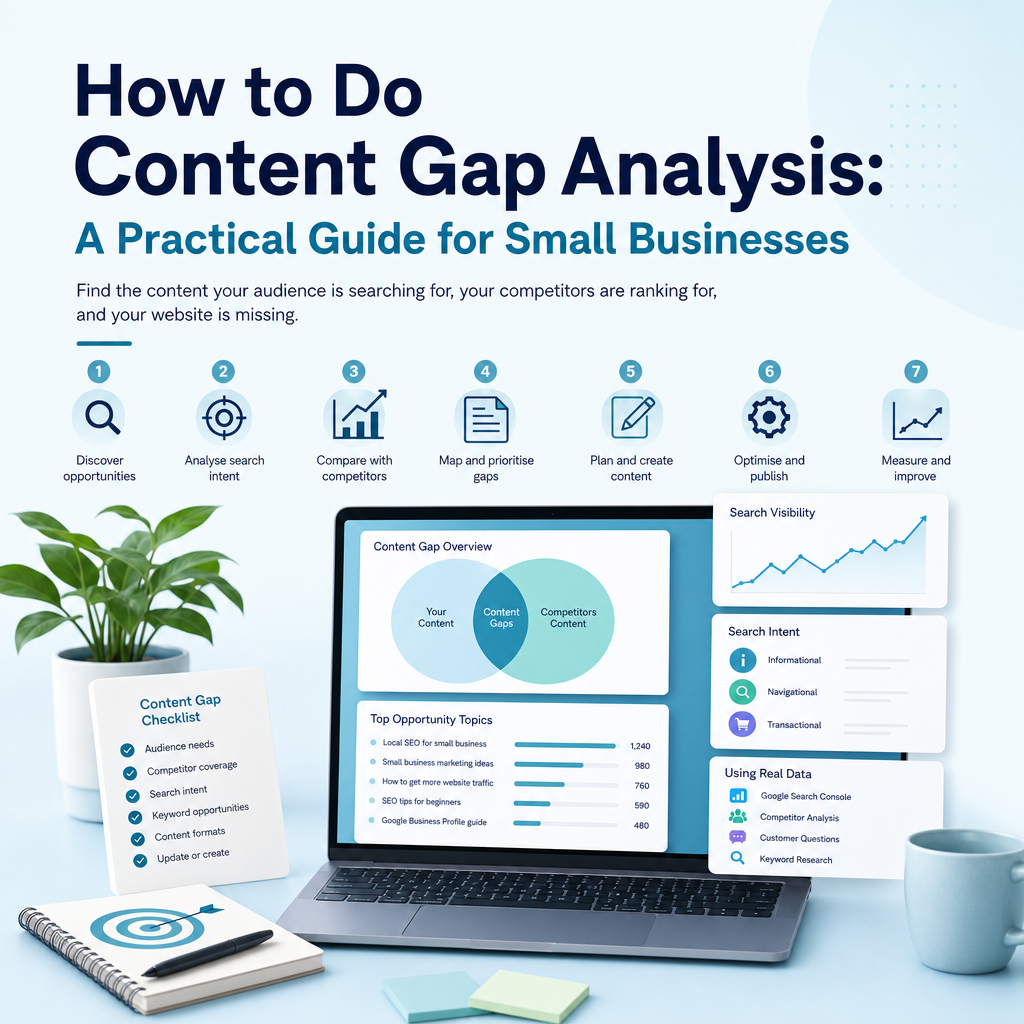
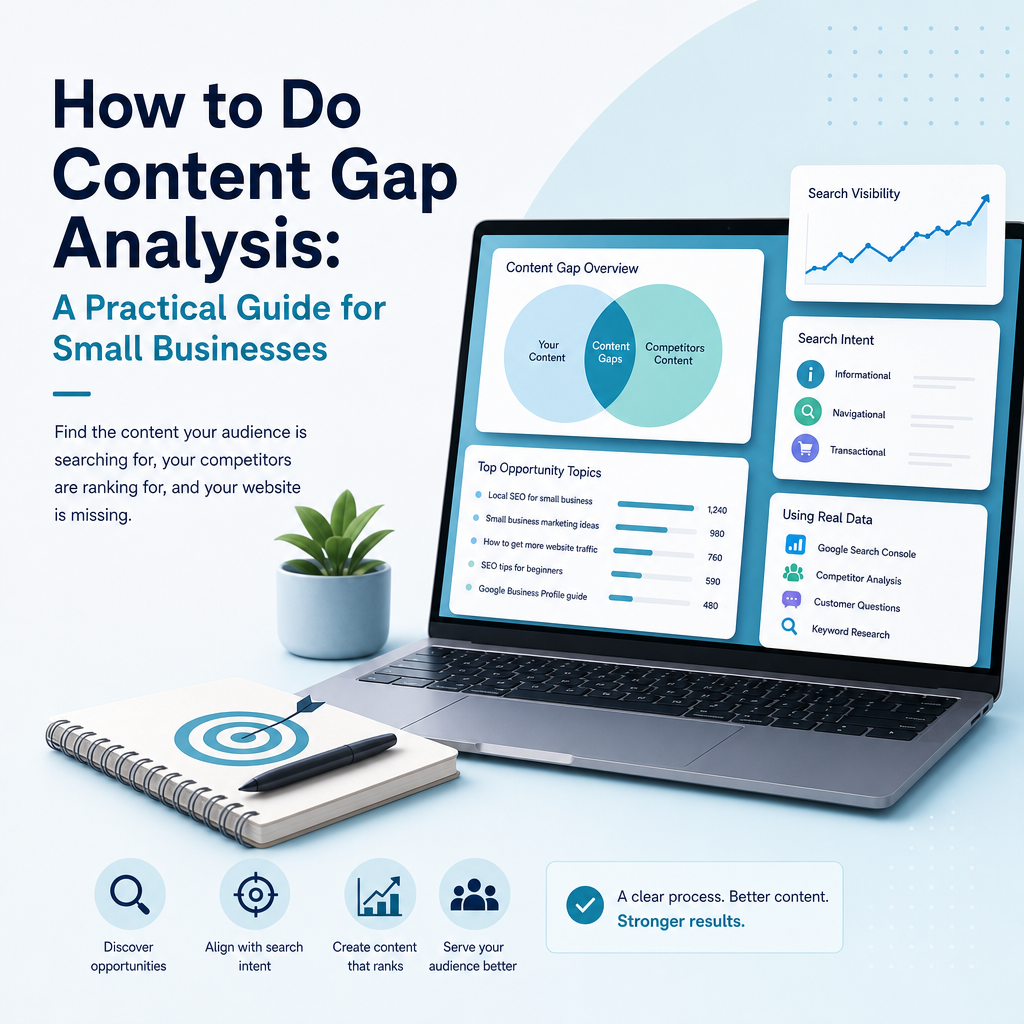
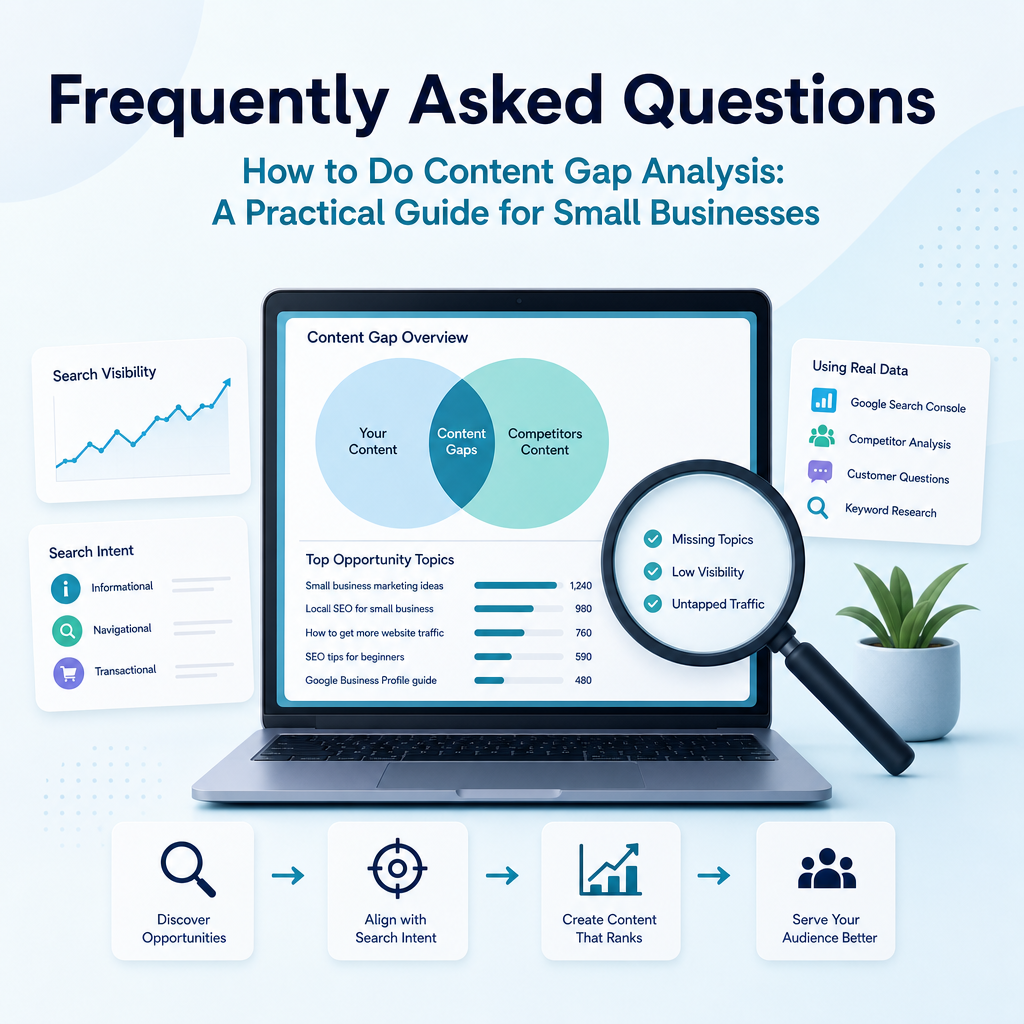
How to Do A Content Gap Analysis: A Practical Guide for Small Businesses

How to Do Content Gap Analysis: A Practical Guide for Small Businesses

You are publishing content, but the results are inconsistent. Some pages receive impressions without clicks, important services are difficult to find, and competitors appear for searches your business has never targeted. The problem may not be a lack of effort. It may be a gap between what your audience wants to know and what your website currently provides.

Learning how to do content gap analysis gives you a practical way to find those missed opportunities. Instead of choosing topics based on guesswork, you compare your existing content with real search behaviour, competitor coverage, customer questions and your business priorities.

This guide explains the process step by step, including how to use Google Search Console, competitor content-gap analysis, search intent, semantic keyword mapping and AI SEO tools. It is designed for small-business owners, founders and marketing managers in the United Kingdom and English-speaking international markets who want a focused, affordable approach to SEO content planning.

What Is A Content Gap Analysis?

What Is Content Gap Analysis?

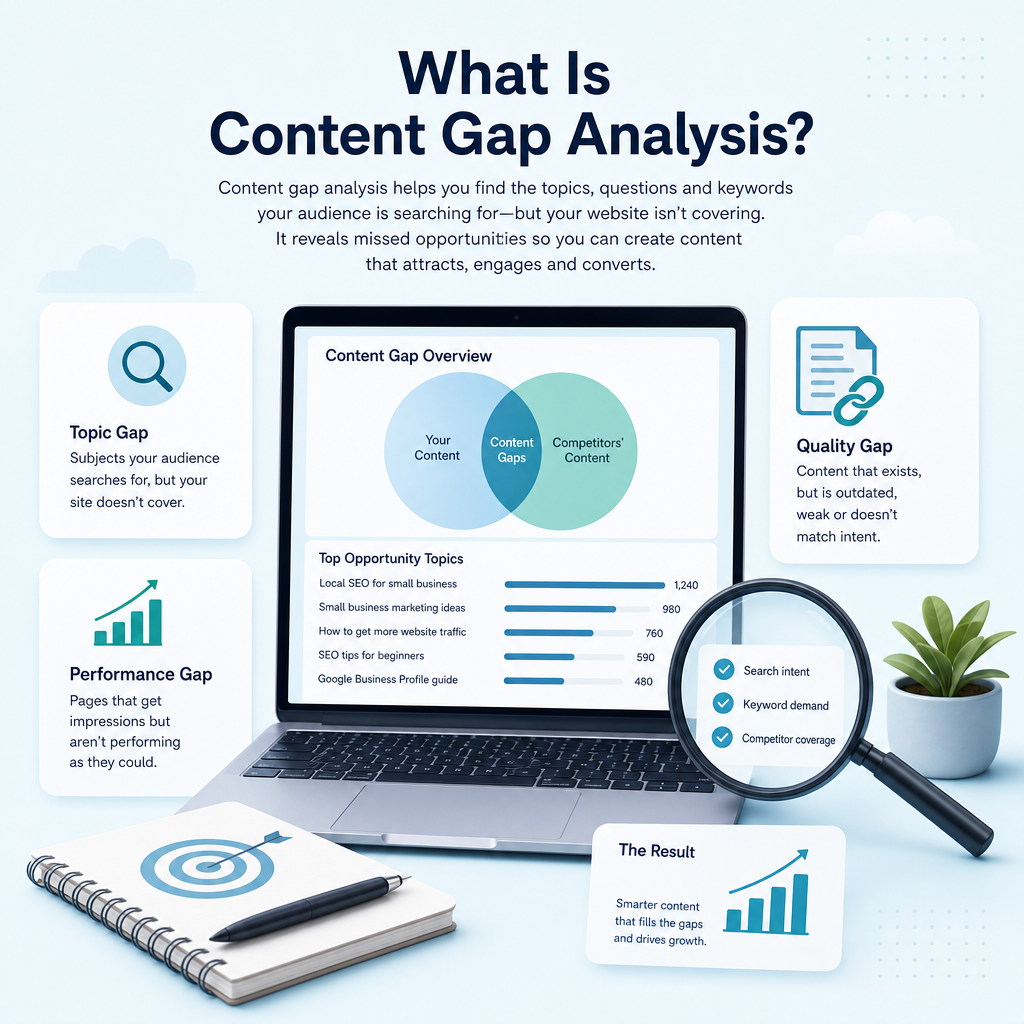
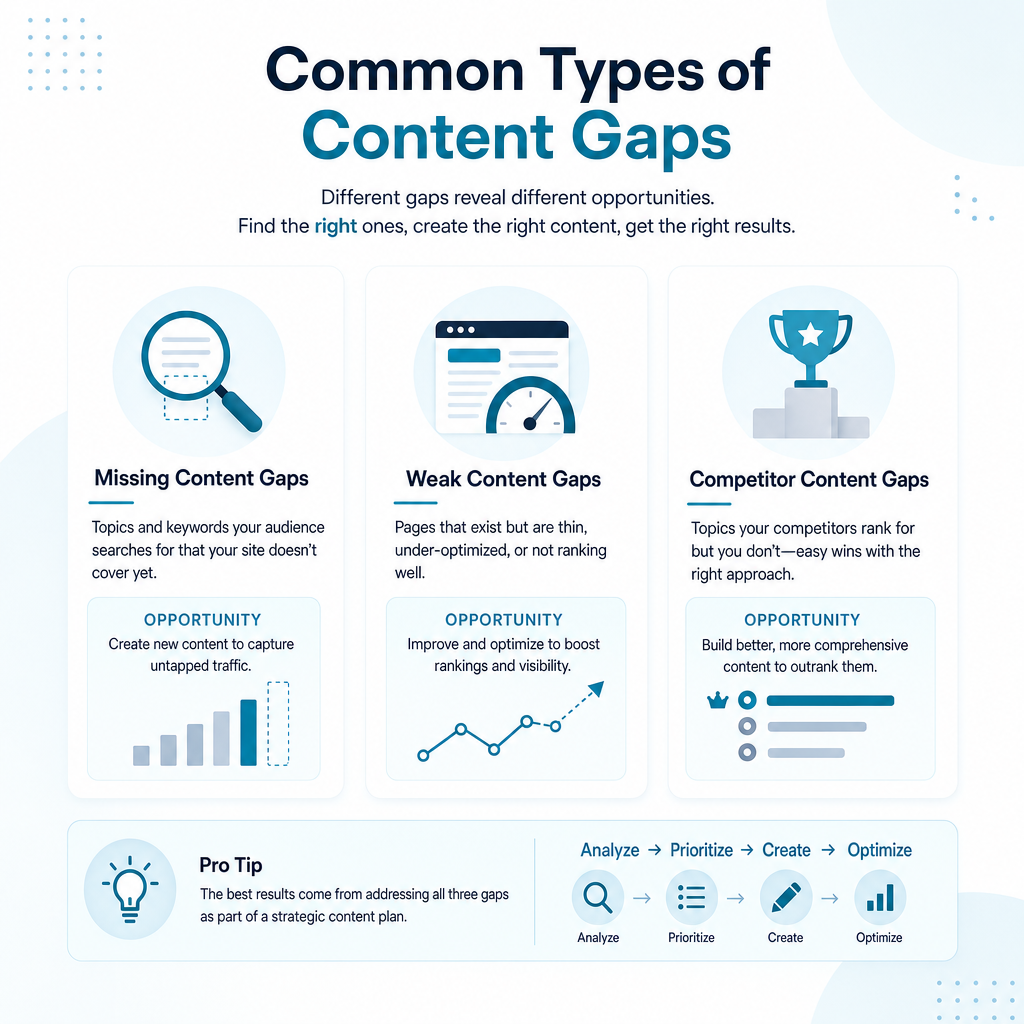
Content gap analysis is the process of finding topics, questions, keywords or content formats that your audience needs but your website does not cover well. A gap may be a completely missing page, an outdated article, a weak explanation, poor internal linking or content that does not match the searcher’s intent.

There are three useful ways to view a content gap:

  • Topic gap: Your audience searches for a subject that your website does not address.
  • Performance gap: You have a page, but it attracts impressions without enough clicks, engagement or enquiries.
  • Competitor gap: Other relevant websites rank for queries where your business has little or no visibility.

Content gap analysis is broader than keyword research. Keyword research identifies search terms, while content gap analysis asks whether your website provides the right answer, at the right stage of the customer journey, in a useful format.

Why Content Gap Analysis Matters for SEO

Why Content Gap Analysis Matters for SEO

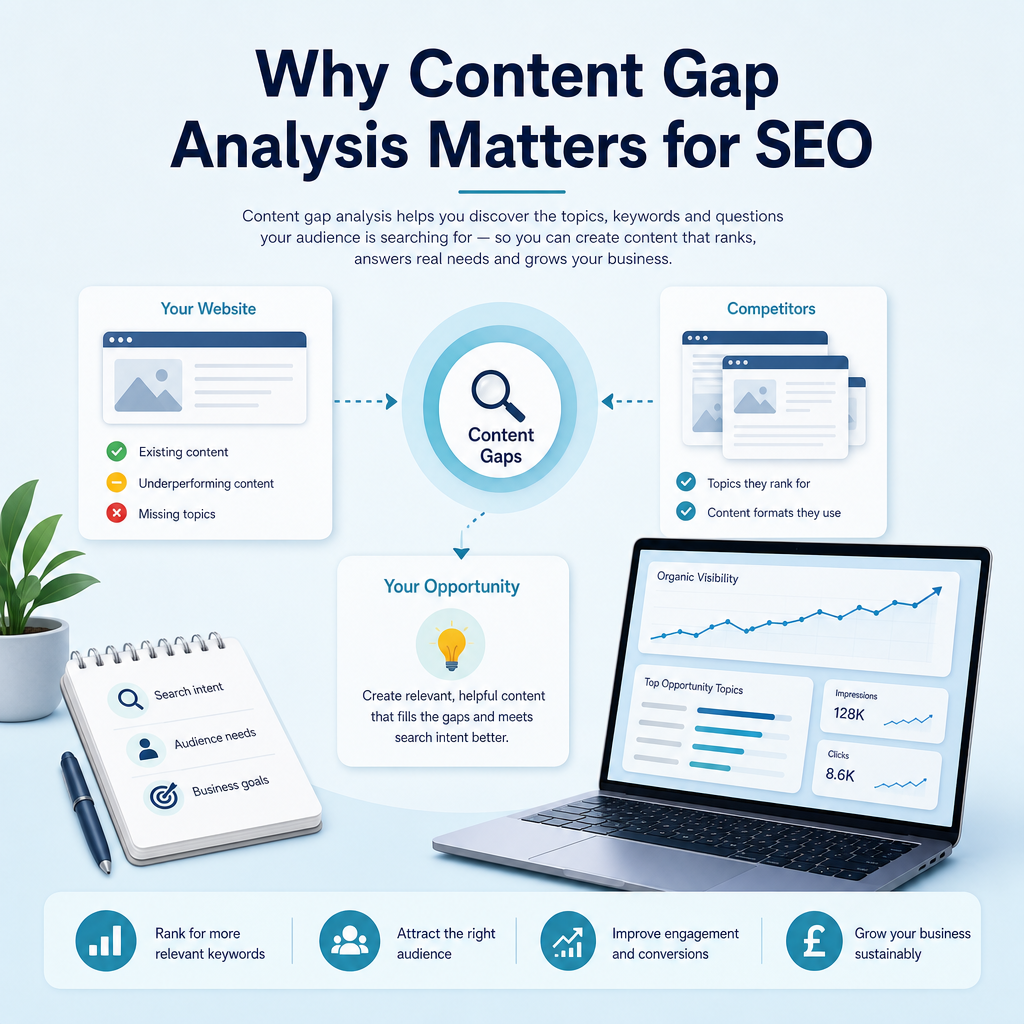
Small businesses cannot afford to spend limited time and budget creating articles that attract the wrong audience. A well-planned analysis helps you focus on realistic opportunities that relate to your services, customer needs and commercial goals.

It can help you:

  • Find searches where your website already has impressions but needs stronger coverage.
  • Identify topics competitors rank for that are relevant to your customers.
  • Improve the experience for visitors who cannot find clear answers.
  • Build topical authority through connected, useful content.
  • Prioritise content that supports enquiries, sales or other business outcomes.
  • Refresh pages that have become outdated or no longer match search intent.

The aim is not to publish more content for its own sake. The aim is to create the most useful next piece of content for a defined audience and business objective.

Content Gap Analysis vs Keyword Gap Analysis

Content Gap Analysis vs Keyword Gap Analysis

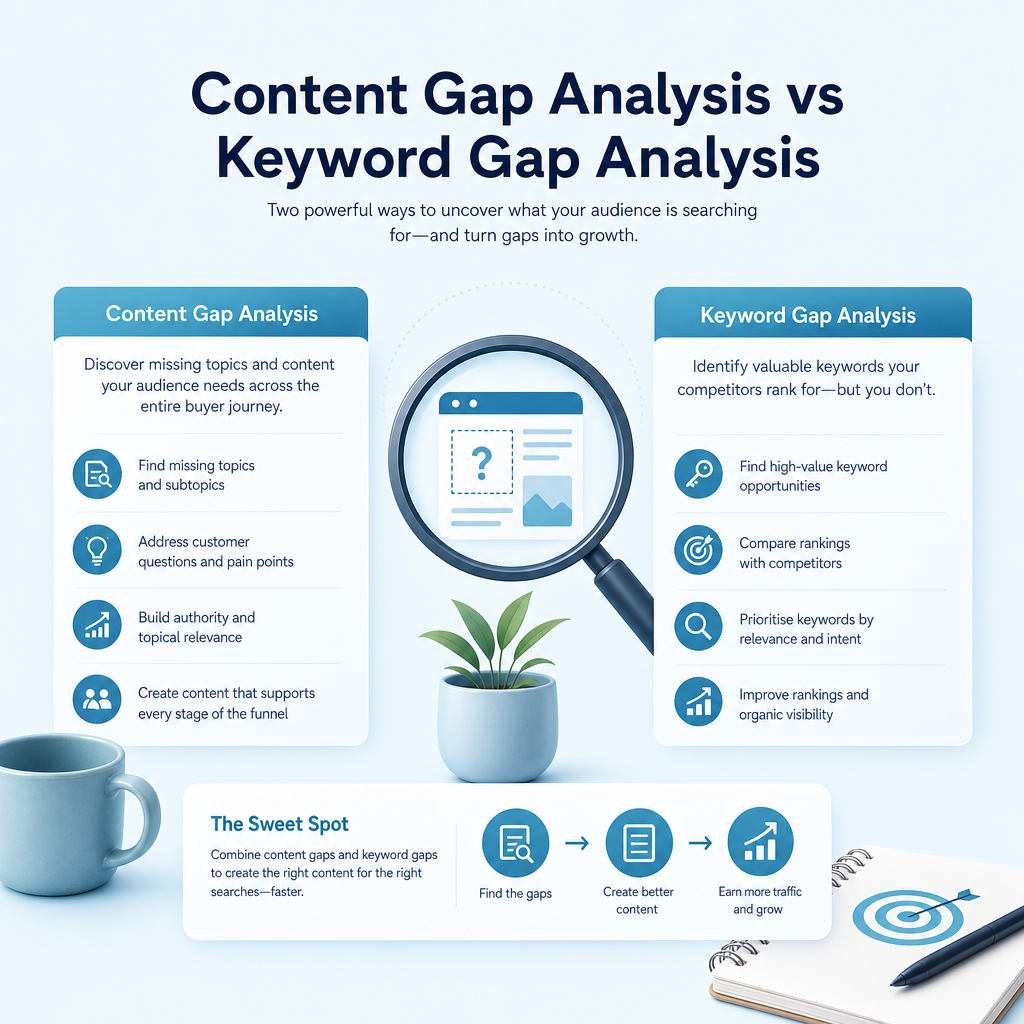
The terms are often used interchangeably, but they describe different levels of research. A keyword gap analysis usually compares the search terms your competitors rank for with the terms your website ranks for. It is useful for finding new SEO targets.

Content gap analysis looks at the wider customer experience. It asks what information is missing, unclear, outdated or difficult to access. The two methods work best together: competitor keyword data can reveal a possible opportunity, while search-intent and content review tell you what page should be created.

How content gap analysis compares with related research
Method Main question Useful output
Content audit What content do we already have? Pages to retain, improve, combine or remove
Keyword gap analysis Which relevant searches do competitors target that we do not? Potential keyword and topic opportunities
Content gap analysis What information is missing from the customer journey? Prioritised content plan
Search-intent analysis What does the searcher expect to find? Suitable page type, format and angle

Common Types of Content Gaps

Common Types of Content Gaps

Not every gap means you need a brand new article. Sometimes the topic exists already, but the page is too thin, too outdated, too hard to read, or aimed at the wrong intent. Looking at gaps this way helps avoid publishing duplicate or low-value content.

These are some of the most common types of gaps to look for:

Missing Topic Gaps

Your audience is searching for a subject, but you have no page covering it. This is common when a business has strong service pages but little educational content.

Keyword and Search-Intent Gaps

You may have a page on a topic, but it does not match what users want. For example, a service page might try to rank for an informational keyword when searchers actually want a guide, checklist, or explanation.

Depth and Quality Gaps

Competitor pages may be more detailed, easier to understand, or more useful. They may include examples, pricing context, FAQs, visuals, or clearer structure that your page lacks.

Freshness Gaps

Older pages may no longer reflect current pricing, tools, processes, or user expectations. This often causes rankings to stall or decline over time.

Format Gaps

Sometimes users want a comparison table, step-by-step process, case example, or local variation, but your page only offers a wall of text. The topic is not missing, but the format is.

Journey Gaps

You may have bottom-of-funnel service pages but little content for early-stage questions like “do I need SEO content creation?” or “how does competitor content-gap analysis work?” That gap weakens your ability to attract top-of-funnel search traffic.

How to Do Content Gap Analysis in Seven Steps

How to Do Content Gap Analysis in Seven Steps

A useful process combines your business knowledge with evidence from search and website data. You do not need to audit every page at once. Start with a service area, customer segment or topic that matters commercially.

1. Define Your Business and Content Goals

Begin by deciding what the analysis needs to achieve. A goal might be to increase visibility for a new service, support local SEO, improve leads from an existing service page or build authority around a specialist subject.

Write down the audience, service and desired action. For example, a UK software provider may want to attract growing companies searching for practical SEO content software. A healthcare practice may want to answer questions about a specific treatment area. A property business may need content that supports people comparing locations or services.

Clear goals help you reject attractive but irrelevant topics. A keyword with high search demand is not automatically a good opportunity if it does not connect with your offer.

2. Map the Customer Journey and Search Intent

Next, identify what your audience needs at different stages. Someone discovering a problem needs an accessible explanation. Someone comparing options may need a guide, comparison or pricing information. Someone ready to act needs clear service details, proof and a direct next step.

Search intent generally falls into four groups:

  • Informational: The searcher wants to learn or solve a problem.
  • Commercial investigation: The searcher is comparing providers, tools or approaches.
  • Transactional: The searcher is ready to purchase, enquire or sign up.
  • Navigational: The searcher is looking for a specific business, page or resource.

Review the current search results for important topics. If the results are mainly guides, a sales page may not match the intent. If the results show comparison and pricing pages, a general educational article may not satisfy the audience.

3. Audit Your Existing Content

Create a list of your relevant pages, including service pages, landing pages, blog posts, FAQs and resource pages. Record the page title, URL, topic, target query, publication date, links, conversions and recent performance.

Use Google Search Console to review queries, impressions, clicks, click-through rate and average position. Look for pages that appear for related searches but do not receive many clicks. These pages may need a stronger title, clearer structure, better intent alignment or additional supporting content.

Google Analytics can add information about engagement and conversions. Internal search data, customer support messages, sales conversations and enquiry forms can reveal questions that external keyword tools may not show.

Mark each page as one of the following:

  • Keep and monitor.
  • Refresh and expand.
  • Combine with another page.
  • Improve internal links.
  • Replace because the intent has changed.
  • Create as a new page because no suitable content exists.

4. Research Competitor and SERP Gaps

Choose a small group of relevant competitors and search competitors. Direct competitors offer similar services, while search competitors may be publishers, directories or software companies that rank for the same queries.

Compare the topics and keyword groups each competitor covers. A competitor content-gap analysis can reveal:

  • Relevant topics they cover that your website does not.
  • Questions their pages answer more clearly.
  • Service pages or use cases missing from your site.
  • Outdated information you can improve with a current, accurate explanation.
  • Content formats that better serve the audience, such as templates, checklists or comparison pages.

Do not copy competitor content. Use it to understand the expectations established in the results, then add value through clearer explanations, practical examples, stronger structure and accurate information about your own services.

5. Find Opportunities in Google Search Console

Google Search Console is particularly useful for small businesses because it shows how your website is already appearing in Google. Export queries and filter them by relevant service, topic or page.

Pay attention to:

  • Queries with impressions but few clicks.
  • Queries where the average position is close to the first page.
  • Related questions that your current page only mentions briefly.
  • Pages receiving visibility for several similar terms.
  • Declining impressions or clicks that may indicate outdated content or changing intent.

These signals can point to realistic ranking opportunities. A page that already receives visibility may need a focused update rather than a completely new article. Ammpli combines Google Search Console and Analytics data with search-intent analysis to help identify these opportunities without requiring a large manual spreadsheet exercise.

6. Group Keywords Using Semantic Mapping

A single page can often address a group of closely related searches. Semantic keyword mapping helps you organise these terms around one central topic, rather than creating several thin pages that compete with each other.

Start with a primary topic, then group related questions, entities, use cases and modifiers. For example, a page about an AI SEO content platform might include related concepts such as Google Search Console content strategy, content planning, competitor research, search intent and SEO performance reporting.

Map each keyword group to the most suitable page type. A broad topic may require a pillar guide, while a specific question could become a supporting article, FAQ section or service page. This structure helps your audience move naturally from learning to evaluating and taking action.

7. Prioritise and Create the Content

Not every gap deserves immediate attention. Score each opportunity against business relevance, audience need, search demand, current visibility, competition, effort and conversion potential.

Give priority to topics that are closely connected to your services and can be addressed with genuine expertise. A lower-volume query from a highly relevant buyer may be more valuable than a broad topic that attracts visitors unlikely to enquire.

Use the findings to create a practical SEO content calendar. Include the target topic, intent, audience stage, proposed format, primary and related terms, internal links, owner, deadline and refresh date.

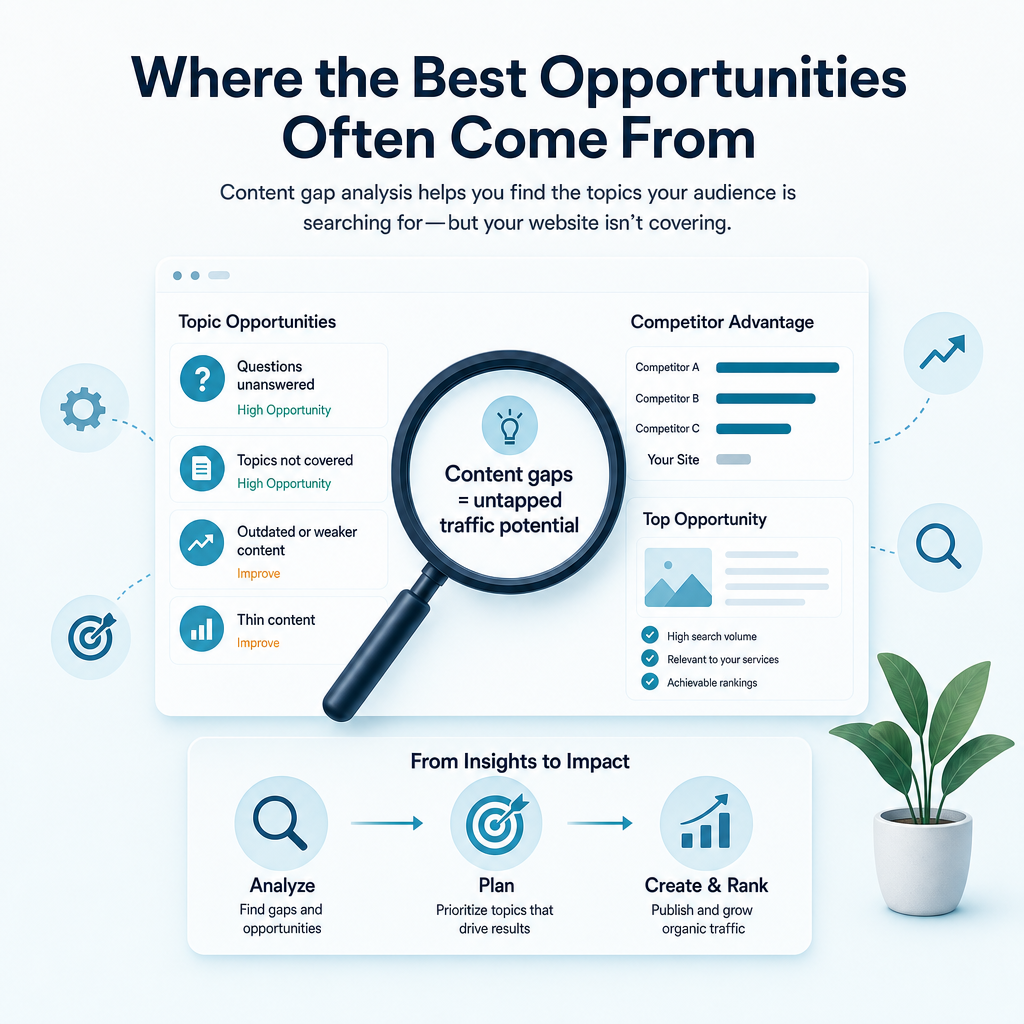
Where the Best Opportunities Often Come From

Where the Best Opportunities Often Come From

Many businesses assume the best SEO opportunities are high-volume keywords they have never touched. Sometimes that is true, but often the quickest gains come from pages that already exist. An underperforming page with some impressions can be easier to improve than a completely new page is to rank.

Useful opportunities often include:

  • Pages ranking on page two or the lower half of page one
  • Queries with impressions in Search Console but weak click-through rates
  • Topics competitors cover poorly
  • Local or niche variations of broader service topics
  • Older blog posts that need a better structure, fresher examples, and stronger intent match

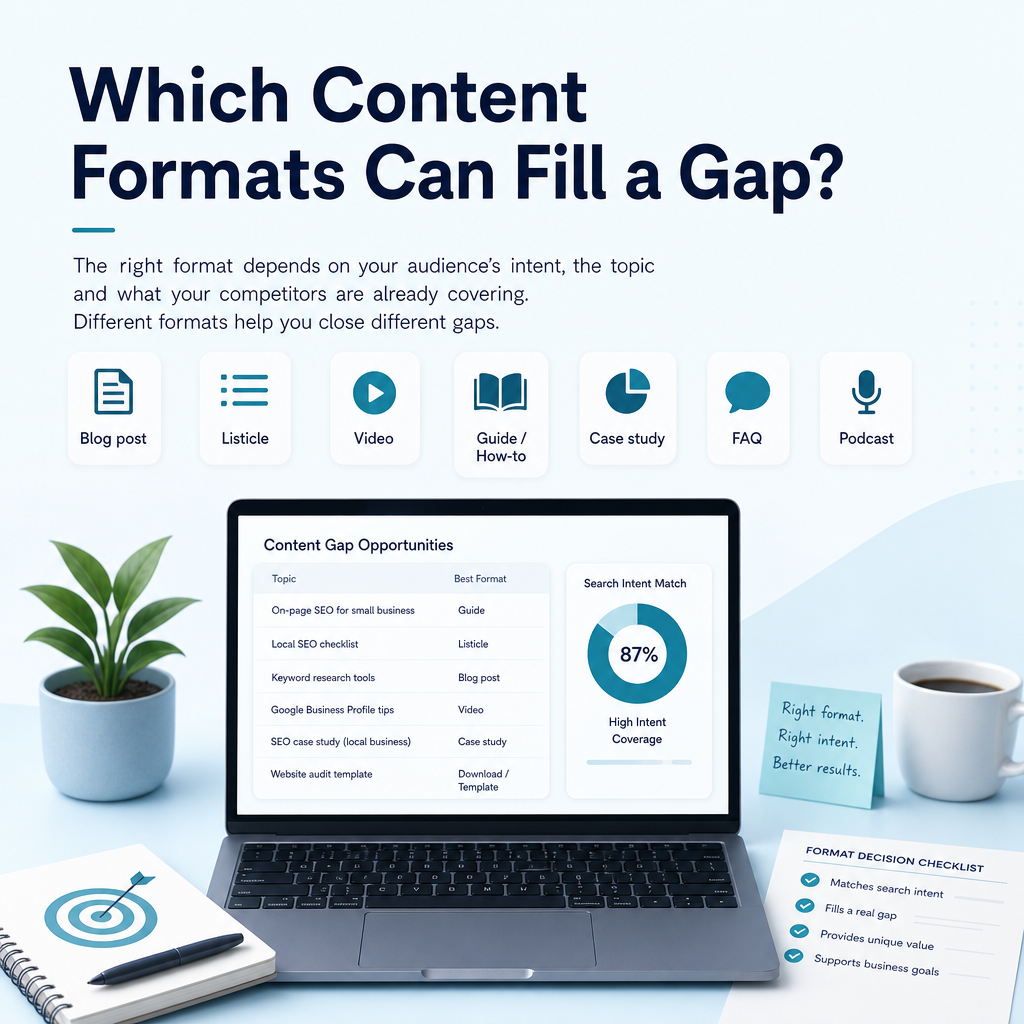
Which Content Formats Can Fill a Gap?

Which Content Formats Can Fill a Gap?

The right format depends on the question and the reader’s next action. A missing article is only one type of gap. Sometimes visitors need a clearer service page, a comparison, a checklist or a local landing page.

  • How-to guides: Useful for problem-solving and informational searches.
  • Service pages: Suitable for high-intent searches related to what you provide.
  • Comparison pages: Helpful when buyers are weighing providers, tools or approaches.
  • FAQs: Useful for recurring objections and specific questions.
  • Case studies: Helpful when prospects need evidence of your process and expertise.
  • Local SEO content: Relevant for businesses serving towns, regions or defined markets.
  • Templates and checklists: Practical formats that make complex tasks easier.

For Ammpli, a gap might lead to a new SEO guide, a content-planning resource, a service explanation or a page showing how search data supports content decisions. The format should reflect the audience’s intent rather than a fixed publishing habit.

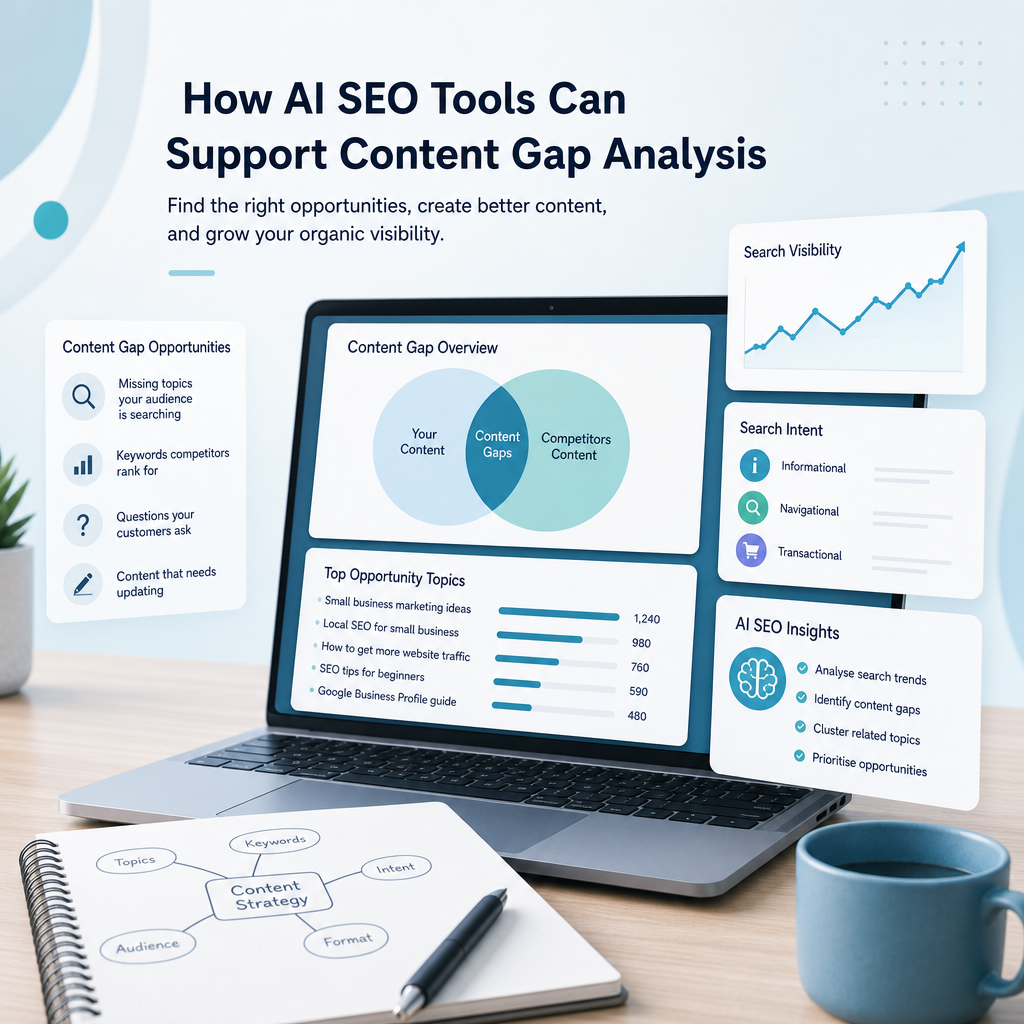
How AI SEO Tools Can Support Content Gap Analysis

How AI SEO Tools Can Support Content Gap Analysis

AI can speed up research, organise keyword groups and suggest questions you may have missed. It can also help turn a large export into themes for review. This makes AI SEO tools useful for small teams that lack the time for extensive manual analysis.

AI should support judgement, not replace it. Check every recommendation against your real services, customer needs, business priorities and available evidence. Generic AI writing tools may produce fluent text without understanding your existing search performance or the difference between a useful opportunity and an irrelevant topic.

Ammpli is built as an AI SEO content platform that connects opportunity analysis, competitor content-gap analysis, search-intent research, semantic keyword mapping, content planning and AI-powered SEO content creation. It can help small businesses turn data into a focused plan, with options including local SEO content creation, direct CMS publishing and SEO performance reporting.

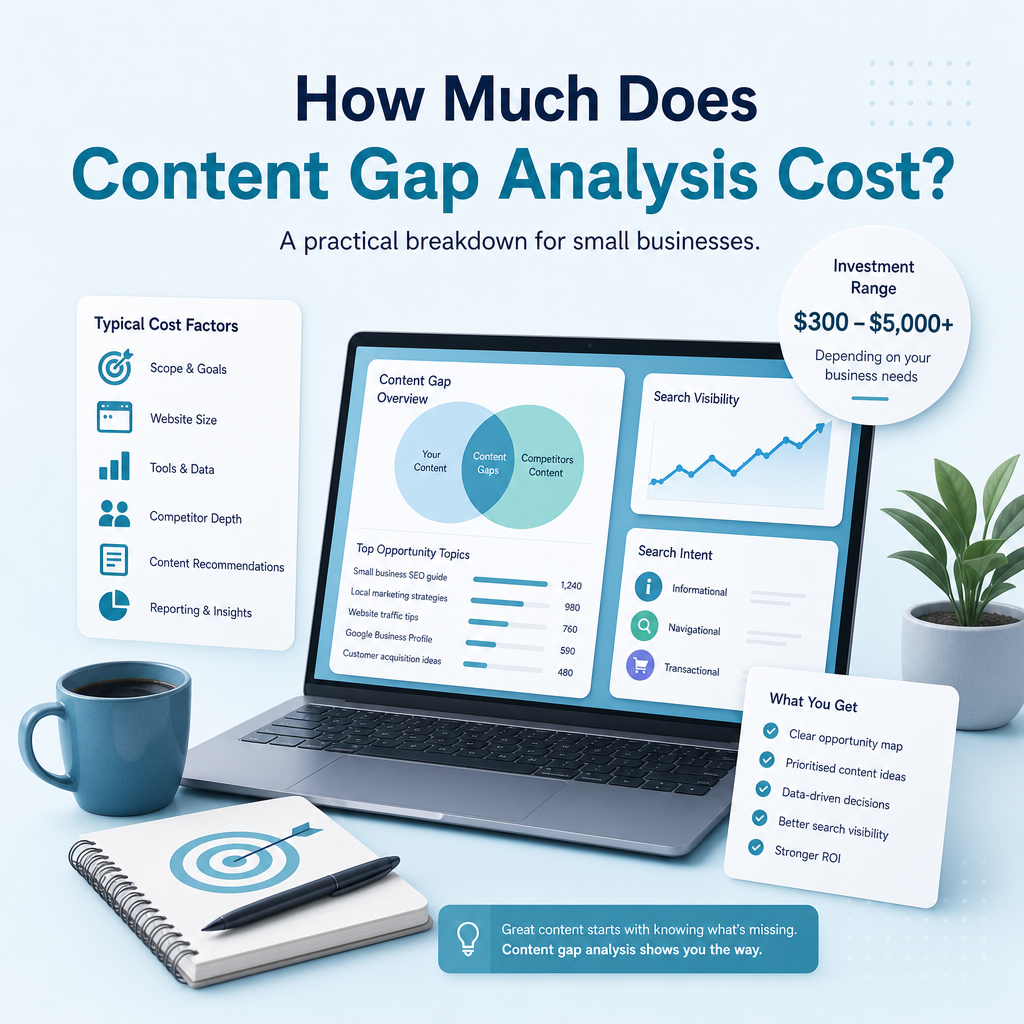
How Much Does Content Gap Analysis Cost?

How Much Does Content Gap Analysis Cost?

The cost depends on the size of the website, the number of competitors, the depth of the research and whether content creation is included. A small site may need a focused review of key service pages, while a larger business may require a sitewide audit, stakeholder input, topic mapping and an ongoing publishing plan.

There are three common approaches:

Content gap analysis approaches for small and growing businesses
Approach What is included Best suited to
DIY research Search Console exports, competitor review and a spreadsheet Teams with available time and SEO experience
Traditional specialist service Research, strategy, recommendations and sometimes content delivery Businesses seeking external expertise and hands-on support
AI SEO content platform Data analysis, opportunity identification, planning and content workflows Small teams seeking repeatable SEO automation with controlled costs

Ask any provider what data they use, what deliverables you receive, how recommendations are prioritised and how results will be reviewed. Be cautious of promises of guaranteed rankings or fixed traffic increases. A trustworthy provider explains the process, limitations and decisions clearly.

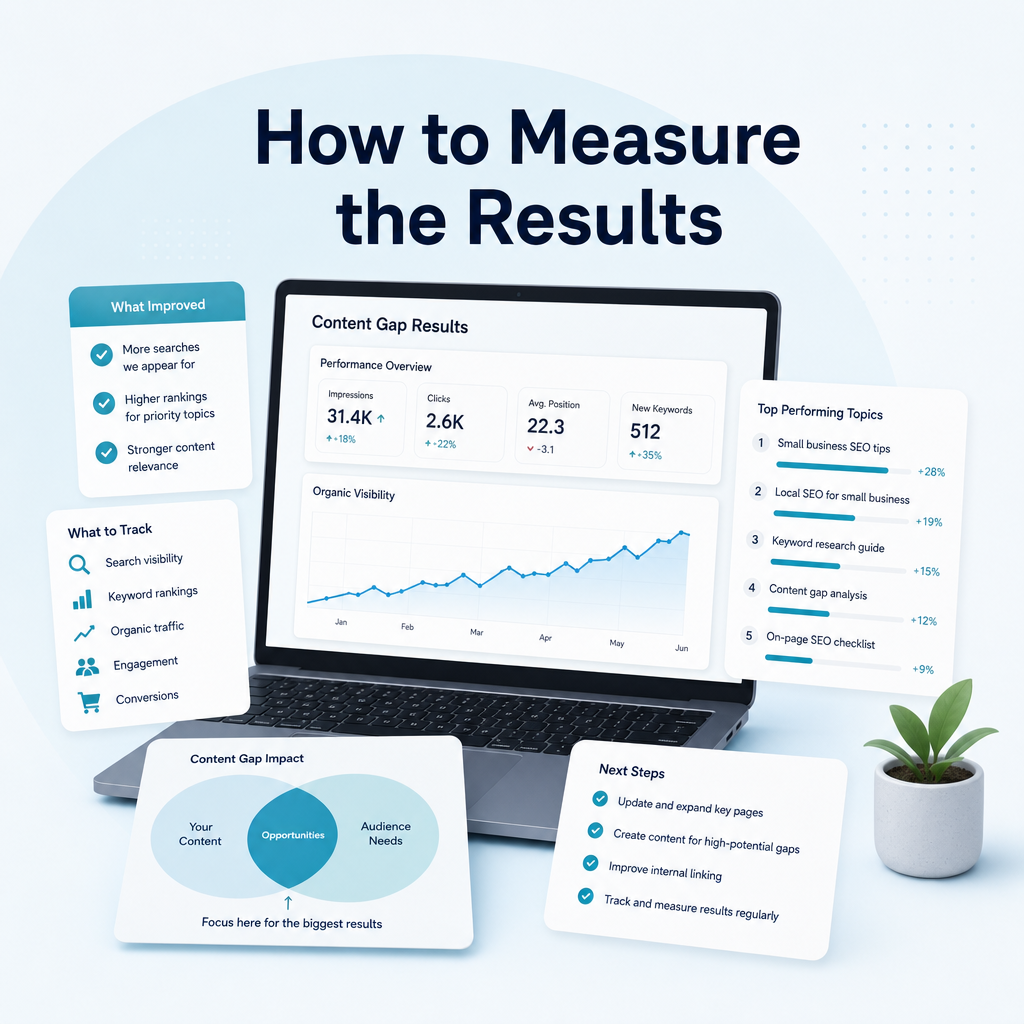
How to Measure the Results

How to Measure the Results

After publishing or improving content, measure whether it is reaching the intended audience and supporting the right business outcome. Allow enough time for meaningful patterns to develop, while checking early technical issues such as indexing, broken links and incorrect metadata.

Monitor:

  • Impressions and clicks for target query groups.
  • Click-through rate from search results.
  • Average positions and relevant search features.
  • Engagement with the page and related content.
  • Enquiries, sign-ups or other agreed conversions.
  • Internal searches and no-result searches.
  • Visibility across local and international markets where relevant.

Review performance on a regular schedule, such as quarterly or twice a year. Refresh content sooner when services change, regulations develop, customer questions shift or search data shows a clear decline.

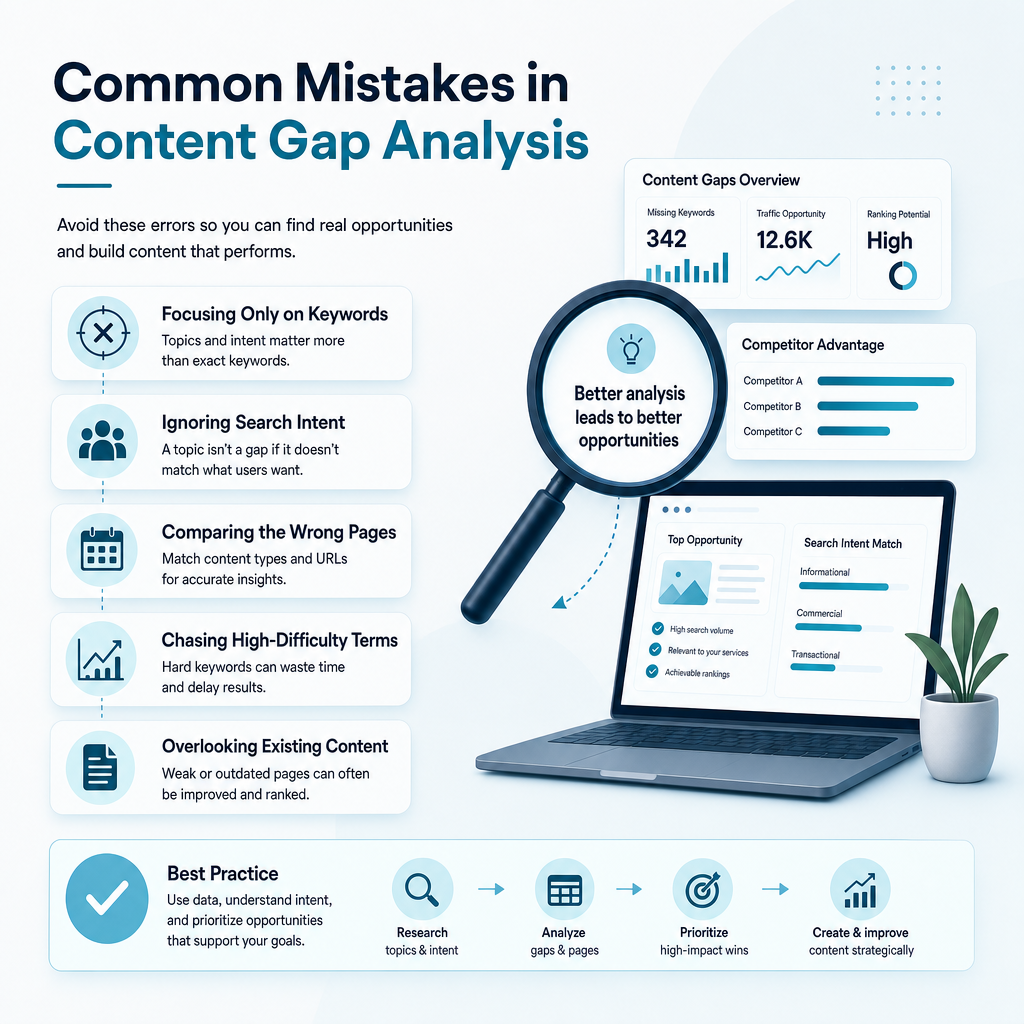
Common Mistakes in Content Gap Analysis

Common Mistakes in Content Gap Analysis

Content gap analysis sounds simple, but it is easy to do it badly. The biggest problem is focusing on volume without relevance. A site can publish a lot more and still not attract the right visitors.

Watch for these common mistakes:

  • Copying competitors too closely: the goal is to find opportunities, not to clone their content.
  • Ignoring search intent: ranking is harder when the page type does not match what users expect.
  • Only chasing big keywords: smaller, more targeted topics are often more realistic for growing businesses.
  • Skipping existing data: real Google Search Console data can reveal opportunities generic tools miss.
  • Publishing without a plan: random articles rarely build topical authority.
  • Using AI without strategy: AI-powered SEO content creation can speed up production, but it still needs real data, good briefs, and editorial review.

What Makes a Good Content Gap Analysis Provider?

What Makes a Good Content Gap Analysis Provider?

A strong provider does more than deliver a list of keywords. They connect search data with your services, audience, competitors and capacity to publish. Recommendations should be specific enough to act on and realistic for your current website authority and resources.

Look for a provider that:

  • Uses first-party performance data where available.
  • Explains search intent in plain language.
  • Separates relevant opportunities from attractive but unsuitable keywords.
  • Includes existing-content improvements, not only new articles.
  • Maps related topics into a coherent structure.
  • Shows how content will be reviewed and measured.
  • Offers a process that suits a small internal team.

Ammpli is designed for businesses that need practical SEO content planning without the cost or time commitment of a traditional SEO agency. It gives founders, marketing managers and small teams a way to turn Google Search Console and Analytics data into informed content decisions.

Frequently Asked Questions

Frequently Asked Questions

How often should I do a content gap analysis?

Review priority topics quarterly or twice a year, depending on how quickly your market, services and search behaviour change. Run a focused review sooner after launching a service, redesigning a website or seeing a sustained performance decline.

What is the difference between a content gap and a keyword gap?

A keyword gap identifies search terms competitors rank for that your site does not. A content gap is broader and includes missing topics, weak explanations, outdated pages, poor intent alignment and unsuitable formats.

Can Google Search Console identify content gaps?

Yes. Search Console can reveal queries where your pages receive impressions but few clicks, along with related searches and pages that are gaining or losing visibility. Combine this data with competitor research and a review of user needs for stronger decisions.

Can AI perform a content gap analysis on its own?

AI can organise data, suggest related questions and speed up research, but it should not be the only source of insight. Human review is needed to confirm relevance, accuracy, service availability, search intent and business value.

Should every content gap become a new page?

No. Some gaps are best addressed by updating an existing page, improving internal links, adding an FAQ or changing the format. Create a new page only when the topic has a distinct purpose and cannot be covered clearly elsewhere.

When should a small business take action?

Start when you have enough data to identify a relevant opportunity and the capacity to create or improve the page properly. A focused analysis of one service area is often more useful than waiting until you can audit the entire website.

How is content gap analysis different from a content audit?

A content audit reviews your existing content library for quality, performance, and usefulness. A content gap analysis goes further by identifying what is missing, underdeveloped, or not matching user demand. The two often work best together.

What tools are used for content gap analysis?

Businesses often use a mix of SEO tools, competitor research platforms, and Google Search Console. The best setup depends on whether you are comparing single pages, whole websites, or trying to build a broader SEO content strategy.

Is content gap analysis only for large websites?

No. In fact, smaller service-based businesses often benefit a lot because they need to focus limited time and budget on the best opportunities. A targeted analysis can help them avoid wasting effort on content that is unlikely to rank or convert.

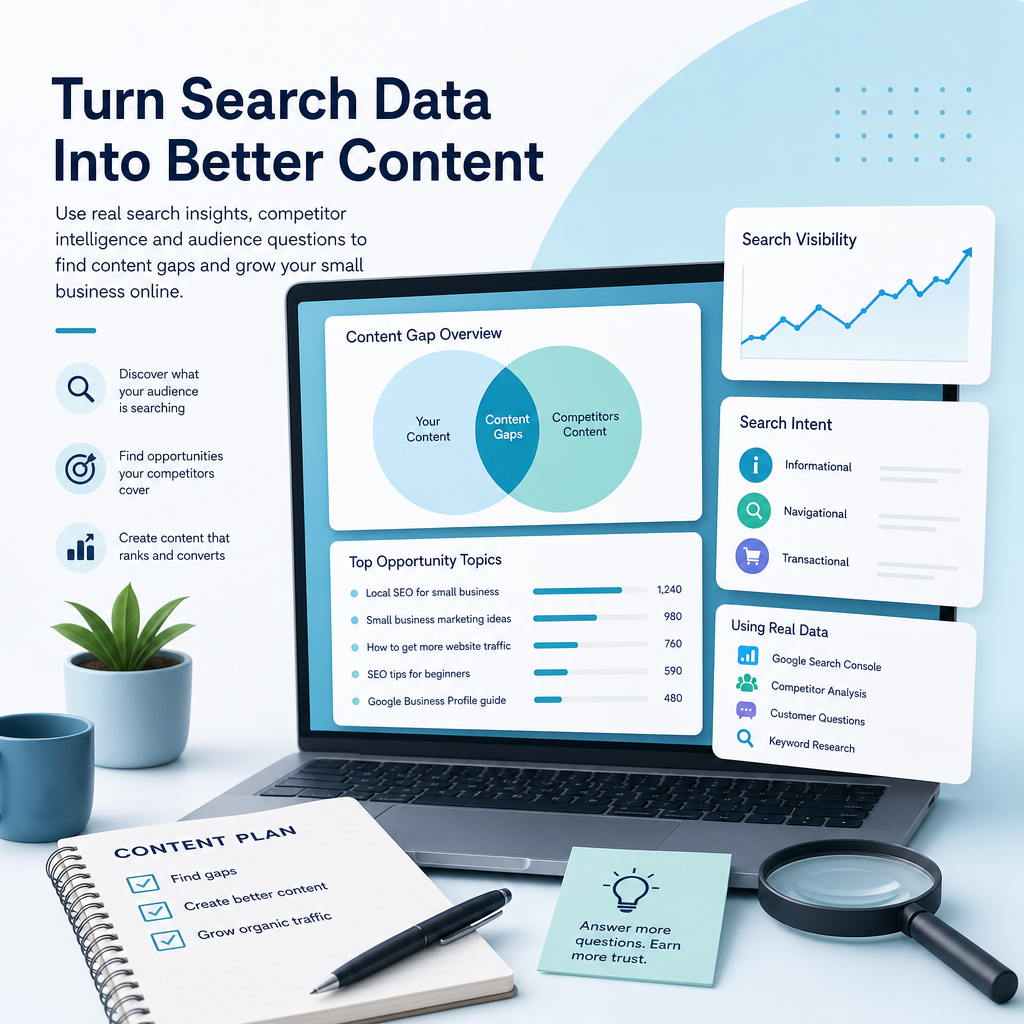
Turn Search Data Into Better Content

Turn Search Data Into Better Content

Knowing how to do content gap analysis helps you replace random publishing with a clear, evidence-led process. By combining your existing content audit with competitor research, Google Search Console, Analytics, search intent and semantic mapping, you can find opportunities that are relevant to both your audience and your business.

Ammpli brings these activities together in an AI SEO content platform for small and growing businesses. Use real search-performance data to find your next ranking opportunity, create your SEO content plan and publish useful content with less manual research.

Start your 14-day free trial with Ammpli and turn your search data into better content. No credit card required.
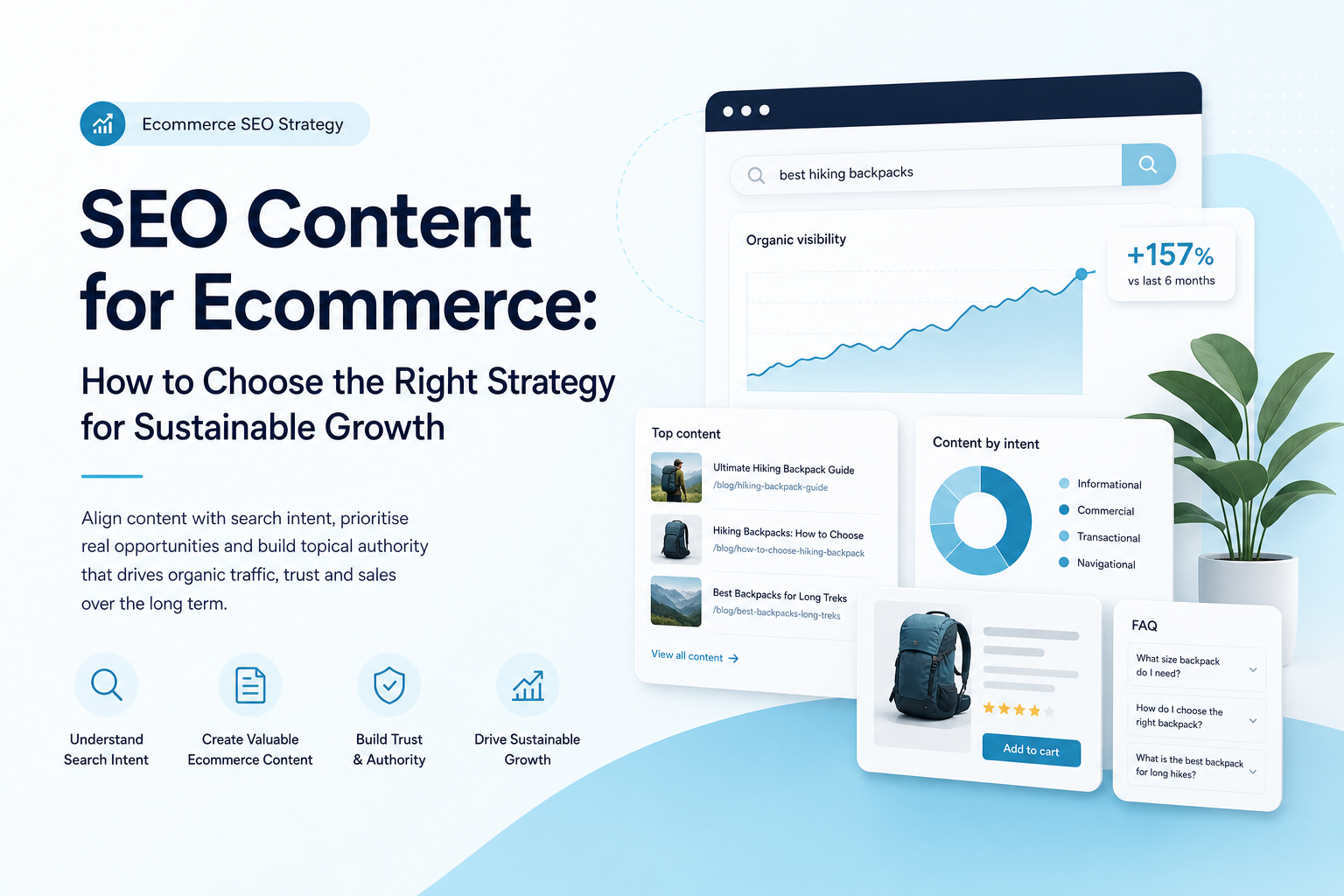
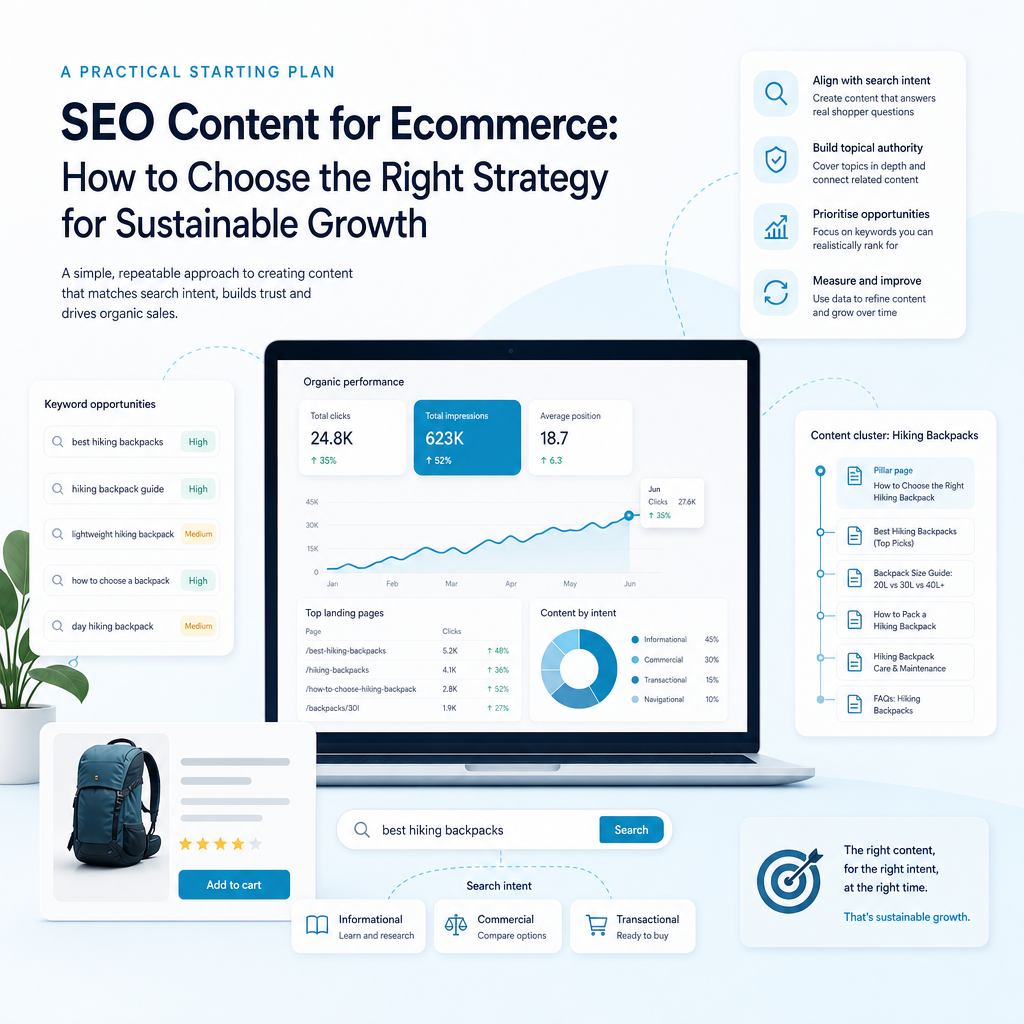
SEO Content for Ecommerce: How to Choose the Right Strategy for Sustainable Growth

SEO Content for Ecommerce: How to Choose the Right Strategy for Sustainable Growth

Your ecommerce store may have strong products, attractive photography and a reliable checkout, yet still struggle to attract customers from Google. The problem is often not a lack of content. It is a lack of direction: unclear search intent, product pages that repeat supplier descriptions, category pages with little useful information and blog posts aimed at keywords your business has little chance of ranking for.

SEO content for ecommerce should connect what shoppers search for with what your store genuinely offers. That means improving product and category pages, answering questions before purchase, building trust through useful information and prioritising realistic opportunities rather than publishing at random.

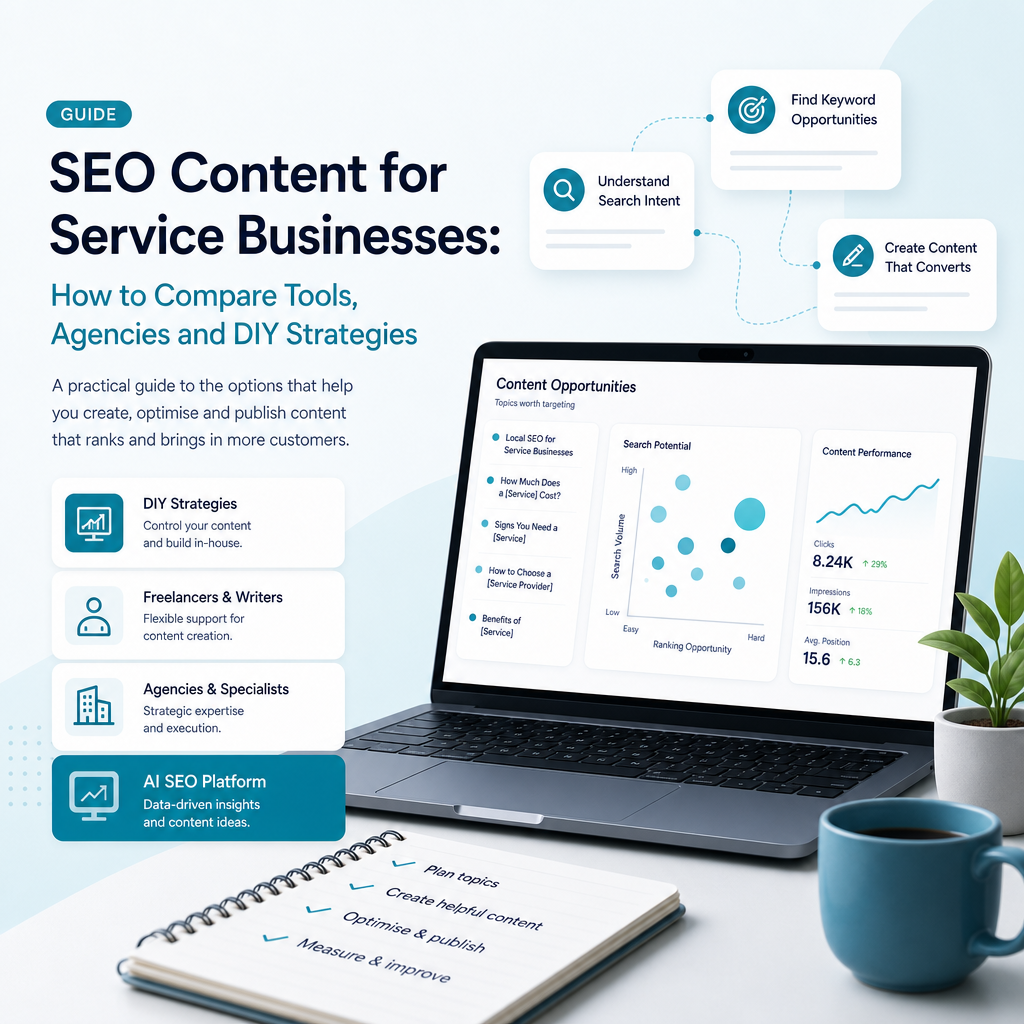
This guide explains how to compare the main approaches to ecommerce SEO content, what a practical process looks like and how a small or growing business can use search data to make better decisions. It also explains where an AI SEO content platform such as Ammpli fits alongside internal marketing, freelance writers, specialist providers and traditional agencies.

What is SEO content for ecommerce?

SEO content for ecommerce is content created and structured to help an online store appear for relevant searches and guide visitors towards a purchase. It includes more than blog articles. Product descriptions, category introductions, buying guides, comparison pages, FAQs, local landing pages and customer reviews can all contribute to organic visibility.

The strongest ecommerce content satisfies both the shopper and the search engine. It helps a customer choose the right product, understand specifications, compare alternatives or resolve an objection. At the same time, it gives Google clear information about the page, its subject, its relevance and its relationship with other pages on the site.

Why ecommerce content needs a different approach

Ecommerce websites have several page types, each with a different role. A product page usually targets a specific item or model, while a category page targets a broader product group. An article may answer an informational question, and a buying guide can support shoppers who are comparing options.

These pages should work together rather than compete with each other. For example, a store selling home office equipment could create a category page for ergonomic office chairs, product pages for individual chairs and a guide explaining how to choose a chair for long working days. Each page serves a different search need and links naturally to the others.

  • Product pages: Support specific product, brand, model and specification searches.
  • Category pages: Target broader commercial searches and organise the product catalogue.
  • Buying guides: Help shoppers compare features, use cases, sizes, materials and price points.
  • Blog content: Answer informational questions and introduce customers to relevant products.
  • Reviews and questions: Add first-hand language, trust and useful detail to product pages.

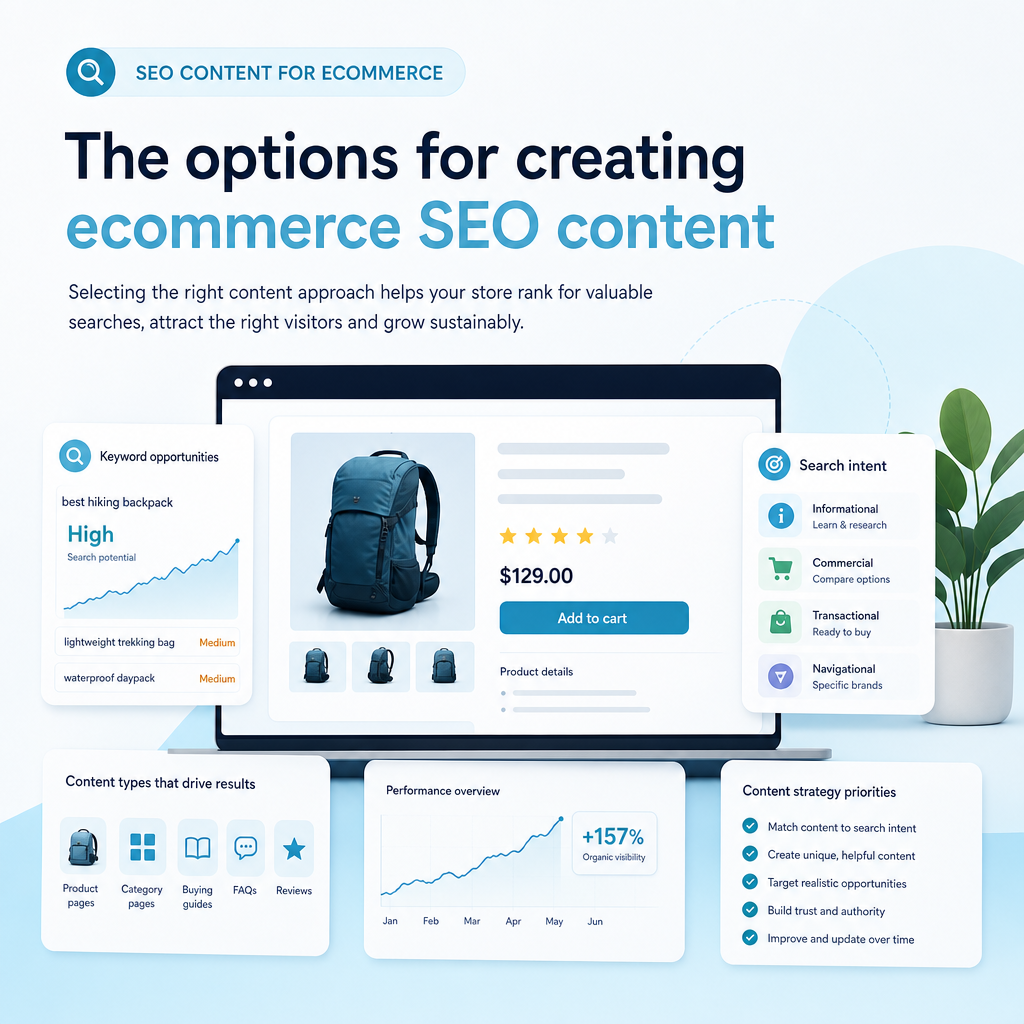
The options for creating ecommerce SEO content

The options for creating ecommerce SEO content

Small businesses normally choose between several content models. You can write content internally, hire freelancers, use generic AI writing tools, work with an agency or use an AI SEO content platform. None is suitable for every business, so the right choice depends on your catalogue size, internal expertise, budget, publishing goals and need for strategic guidance.

The main difference between these options is not simply writing speed. It is the quality of the research, the accuracy of the recommendations, the amount of human review and the connection between content production and business results.

Comparison of ecommerce SEO content options for small businesses
Option Best fit Strengths Limitations
Internal content creation Businesses with available marketing expertise Strong brand knowledge and direct product access Research and production can take substantial time
Freelance SEO writer Businesses needing specialist writing support Flexible capacity and human judgement Research quality and strategic consistency vary
Generic AI writing tool Early drafts, ideas and simple content tasks Fast and accessible May not understand search performance, competition or the catalogue
Content or SEO agency Businesses needing broad strategic support Access to specialists and established processes Higher ongoing cost and less direct control
AI SEO content platform Small teams wanting data-led planning and scalable production Connects opportunity research, planning and content creation Still requires business knowledge, review and quality control

DIY content creation

Writing content yourself can work well when you have a small catalogue, strong product knowledge and enough time to research each topic. Internal teams often understand customer objections, product differences and brand language better than an external provider.

The challenge is consistency. Keyword research, competitor analysis, content briefs, writing, editing, publishing and performance reporting can quickly become a large workload. DIY content can also become reactive, with the team publishing topics that sound useful without checking whether they match search demand or support a commercial goal.

Freelance writers and content specialists

A freelance writer can add valuable capacity without the commitment of a full agency relationship. This option is useful when you already have a content strategy and need someone to turn clear briefs into well-written pages.

The quality of the result depends heavily on the brief and the writer’s ecommerce experience. A writer may produce polished copy but still miss technical requirements, search intent, internal linking opportunities or gaps in the competitor landscape. You may also need to manage research, editing and publishing internally.

Generic AI writing tools

Generic AI writing tools such as ChatGPT can help with brainstorming, outlines, rewrites and first drafts. They can reduce the time needed to create basic copy, but they do not automatically know which searches your website is already appearing for, which competitors are strongest or which topics are realistic for your domain.

That distinction matters. Content can be grammatically correct and still be commercially weak. A generic tool may produce a broad article targeting a competitive term while overlooking a smaller search opportunity where your store already has impressions. AI-generated text also needs fact-checking, product review and brand editing before publication.

Traditional agencies and content marketing providers

An agency can provide strategic advice, technical SEO, content production, outreach and reporting under one relationship. This can be a good fit for larger catalogues, complex migrations or businesses that need broad marketing support.

For a small ecommerce brand, the cost and process may be more than necessary. Some agencies also work from standard packages that prioritise a fixed number of articles or keywords instead of the opportunities visible in your own search data. Ask how the provider chooses topics, how success is reported and who owns the content and strategy.

AI SEO content platforms

An AI SEO content platform is designed to bring research, planning and production into one workflow. Ammpli combines Google Search Console and Analytics data with competitor research, search-intent analysis and semantic keyword mapping to identify opportunities that are relevant to a specific website.

This approach is different from asking an AI tool to write an article from a single keyword. The aim is to understand where the site has existing visibility, what content competitors cover, which related terms belong together and what type of page best matches the search. Ammpli then turns those insights into a practical content plan and search-optimised articles.

How to build a practical ecommerce SEO content strategy

A useful strategy starts with the customer and the catalogue, not with a list of random keywords. Begin by identifying the products, categories, margins, seasonal priorities and questions that influence buying decisions. Then connect those business priorities with real search behaviour.

The process should be repeatable enough for a small team to manage, but flexible enough to respond to stock changes, new products and seasonal demand. A content calendar is useful, but only when each planned page has a clear purpose.

1. Map the buying journey

Shoppers use different searches at different stages. Someone looking for general advice may not be ready to buy, while someone searching for a specific product, size or feature may have strong purchase intent.

  • Informational: “How do I choose a standing desk?”
  • Commercial research: “Best standing desk for a small office”
  • Comparison: “Electric standing desk versus manual desk”
  • Transactional: “Buy white electric standing desk”
  • Local: “Office furniture shop in Manchester”

Match informational searches with guides and helpful articles, commercial searches with comparison content and category pages, and transactional searches with product and collection pages. A mismatch between the keyword and page type often leads to weak engagement, even if the page attracts impressions.

2. Use Google Search Console as a source of opportunity

Google Search Console shows the queries, pages, impressions, clicks, click-through rates and average positions associated with your website. This makes it especially useful for finding content opportunities that generic keyword tools may not reveal.

Look for relevant queries where your website receives impressions but has not yet achieved strong visibility. These searches can indicate that Google already associates your site with the topic. A new guide, improved category page or clearer product content may be more realistic than starting with an unrelated high-volume keyword.

Analytics data adds another layer. It can show which landing pages lead to engagement, product views, enquiries or sales. Together, Search Console and Analytics help you prioritise topics based on visibility and business relevance.

3. Analyse competitor content gaps

Competitor research should identify more than the keywords other stores rank for. Review the page types appearing in search results, the questions they answer, the product attributes they explain and the internal links they use.

A content gap may be a missing buying guide, an underdeveloped category page or a product comparison that customers need before making a decision. It may also reveal that competitors have created pages for searches your catalogue cannot satisfy. Do not copy their structure automatically. Use the research to identify a useful angle your business can support with accurate information.

4. Build semantic topic groups

Search engines understand relationships between words and concepts, not just exact keyword matches. Semantic keyword mapping groups related terms around a subject so that one page can address the topic naturally without repeating the same phrase.

For example, a page about waterproof hiking boots may need to cover grip, ankle support, walking conditions, materials, sizing, waterproof membranes and care. These related concepts help the page answer the underlying need behind the search.

Semantic mapping also reduces the risk of creating several thin pages that target nearly identical terms. Where one strong page can satisfy the intent, consolidate the information. Where the intent differs, create separate pages and link them clearly.

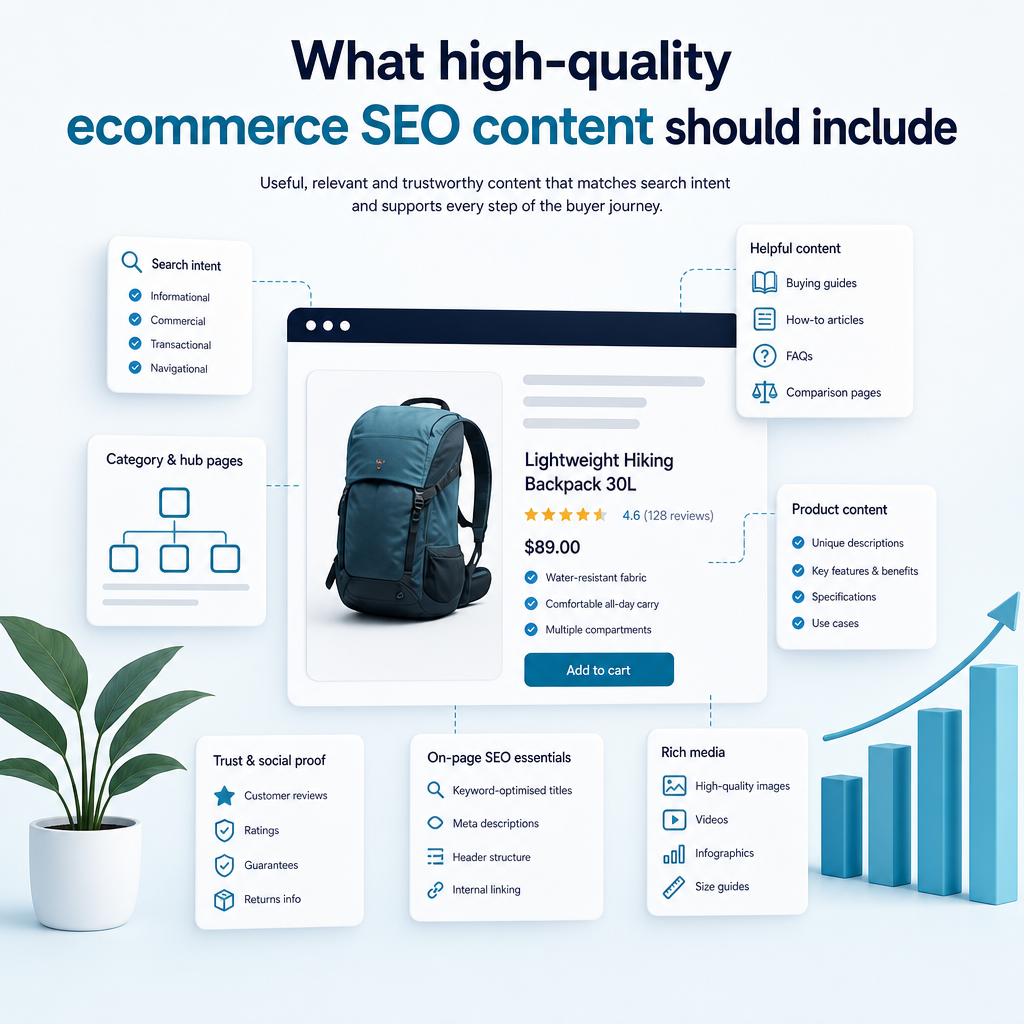
What high-quality ecommerce SEO content should include

What high-quality ecommerce SEO content should include

Good SEO content for ecommerce is useful before it is persuasive. The reader should be able to understand the product, compare options and decide what to do next without searching elsewhere for basic information.

Quality varies by page type, but the same principles apply: accuracy, originality, clarity, relevance and a visible connection to customer needs.

Product pages

Product pages should describe more than what the manufacturer supplied. Explain the benefits of important features, who the product suits, how it compares with alternatives and what the customer needs to know about size, compatibility, delivery, returns and care.

  • Use a clear, unique product title and H1.
  • Write original descriptions based on customer needs.
  • Include specifications in an easy-to-scan format.
  • Use descriptive image file names and relevant alt text.
  • Add genuine reviews and customer questions where available.
  • Link to related products, categories and buying guides.
  • Keep price, availability and delivery information accurate.

Category pages

Category pages are often the most valuable commercial pages on an ecommerce site. They should help shoppers understand the range, choose a suitable product and reach relevant product pages quickly.

A useful category page may include a concise introduction, buying advice, filters that reflect genuine product attributes, frequently asked questions and links to related categories. Avoid adding large blocks of generic copy simply to increase word count. The content should support the shopping task.

Buying guides and comparison content

Buying guides are valuable for middle-of-funnel shoppers who know the problem they want to solve but need help selecting a product. A strong guide explains the differences between options, identifies important features, sets realistic expectations and links to suitable products.

Comparison tables can make this information easier to use. Keep the claims accurate and explain which product is suitable for which use case rather than declaring one universal winner. This creates a better experience and gives the reader a clear route to purchase.

Reviews and user-generated content

Customer reviews add first-hand language that businesses may not think to include themselves. They can answer questions about fit, setup, durability, delivery and everyday use. Reviews also support trust, particularly when shoppers cannot see or test a product in person.

Request reviews after customers have had enough time to use the product. Encourage specific feedback, but do not attempt to control the sentiment. Authentic negative reviews can help shoppers make an informed decision and show that feedback is genuine.

Technical foundations that support content

Content cannot perform well if search engines cannot crawl, understand or index the pages. Ecommerce stores often have technical complications caused by filters, product variants, temporary stock changes, duplicate URLs and large image files.

A technical review should sit alongside content planning. You do not need to fix every issue at once, but you should know which problems affect priority pages and customer experience.

  • Site architecture: Keep the path from the homepage to important categories and products clear.
  • Internal links: Connect guides, categories and products with descriptive links.
  • Canonicalisation: Manage duplicate or near-duplicate URLs created by filters and sorting.
  • Indexing: Decide which pages provide enough value to appear in search.
  • XML sitemaps: Keep important product, category and editorial URLs discoverable.
  • Mobile experience: Check navigation, text, filters, images and checkout on smaller screens.
  • Performance: Monitor loading speed and Core Web Vitals across key templates.
  • Structured data: Use accurate product, offer, review, breadcrumb and article markup where appropriate.
  • Security: Use HTTPS and maintain a trustworthy shopping experience.

Google’s ecommerce guidance highlights product data, structured data, URL design, site structure and crawlable pagination as areas that store owners should manage carefully. Technical implementation does not replace useful content, but it helps search engines interpret and surface it.

How to measure the value of ecommerce SEO content

Traffic alone does not show whether your content is helping the business. A page can attract many visitors who have no interest in buying, while a smaller page may influence valuable purchases or repeat visits.

Choose measures that reflect the purpose of each page. Informational articles may be judged by relevant impressions, clicks, engagement and assisted product views. Product and category pages should be connected to organic revenue, add-to-cart activity and conversion behaviour where tracking is available.

  • Impressions and clicks in Google Search Console
  • Click-through rate for important queries
  • Average position by page and search intent
  • Organic sessions by product, category and article page
  • Product views and add-to-cart actions
  • Revenue or enquiries attributed to organic search
  • Conversion rate and average order value from organic visitors
  • Pages gaining or losing visibility over time
  • Queries that reveal new content opportunities

Review performance regularly, but avoid reacting to daily fluctuations. Use the data to improve titles, update outdated information, strengthen internal links, merge competing pages and create content where demand is clear.

Common mistakes when choosing an ecommerce content solution

Many small businesses choose a provider based on volume alone: how many articles are included, how quickly they can be produced or how low the monthly price appears. Those details matter, but they do not tell you whether the content will support your catalogue or attract the right shoppers.

Ask practical questions before committing to a solution. The answers will reveal whether the provider has a repeatable process or simply produces text.

  • Does the provider use your Google Search Console data?
  • How are search intent and page type determined?
  • Will competitor content gaps be reviewed?
  • How are semantic topics mapped?
  • Who checks product facts and brand accuracy?
  • How will internal links and content updates be managed?
  • Can the process support seasonal products and changing stock?
  • What reporting will show business relevance, not only publishing volume?
  • Can your team review, edit and approve content before publication?
  • Who owns the content, data and strategy if you change provider?

When should you use an AI SEO content platform?

An AI SEO content platform may suit your business if you already have an established website, receive Google impressions or rankings and need a more consistent way to identify and publish opportunities. It can be particularly useful when a small team cannot dedicate hours to manual research each week.

It is less suitable as a substitute for product expertise, editorial judgement or technical support. The best process combines automation for research and production with human review for accuracy, brand fit and customer usefulness.

How Ammpli supports SEO content for ecommerce

Ammpli is an AI-powered SEO content platform for small and growing businesses in the United Kingdom and English-speaking international markets. It is designed for teams that need practical SEO support without the cost, complexity or time commitment associated with a traditional agency relationship.

Ammpli combines Google Search Console and Analytics data with competitor research, search-intent analysis and semantic keyword mapping. This helps identify relevant opportunities, including searches where a website already receives visibility but has not yet reached its strongest positions.

From there, Ammpli supports SEO opportunity analysis, content gap analysis, topical authority planning, SEO content calendars and AI-powered SEO content creation. Businesses can also use features such as local SEO content creation, blog and brand analysis, direct CMS publishing and SEO performance reporting.

The result is a more connected workflow: find a realistic opportunity, understand the intent, map the topic, create the content, publish it and monitor what happens. This approach gives a small team more structure without removing the business knowledge needed to produce trustworthy ecommerce content.

A practical starting plan for a small ecommerce team

A practical starting plan for a small ecommerce team

You do not need to optimise every product and category page at once. A focused first phase can reveal which type of content is most likely to support your commercial priorities and where the biggest weaknesses sit.

Start with pages that combine business value and existing search potential. This may be a category with healthy margins, a product range with clear demand or a guide that answers a question customers regularly ask before buying.

  1. Connect and review Google Search Console and Analytics data.
  2. List priority products, categories, seasonal ranges and customer questions.
  3. Find relevant queries where the site already receives impressions.
  4. Review competing pages and identify missing or weak information.
  5. Map related terms and assign each topic to the correct page type.
  6. Improve one or two priority category or product pages.
  7. Create a buying guide that supports a clear commercial category.
  8. Strengthen internal links between guides, categories and products.
  9. Check technical basics, structured data, mobile usability and page speed.
  10. Report on visibility, engagement and commercial actions before expanding.

Frequently Asked Questions

What is the best type of SEO content for an ecommerce website?

The best type depends on the search intent and the role of the page. Product pages support specific purchase searches, category pages target broader commercial demand, and buying guides help shoppers compare options. A balanced strategy connects all three rather than relying only on blog articles.

Can AI create effective SEO content for ecommerce?

AI can support research, outlines, drafting and content production, but effective ecommerce content needs accurate product knowledge, search-intent analysis and human review. A platform connected to Search Console and Analytics can provide more relevant direction than a generic writing tool because it considers the website’s existing visibility and opportunities.

How do I choose between an agency, freelancer and AI SEO content platform?

Choose based on the support you need. A freelancer may suit a business with an existing strategy that needs writing capacity. An agency may suit a larger or technically complex project. An AI SEO content platform may suit a small team that needs data-led opportunity research, content planning and scalable production with internal review.

Should ecommerce businesses create separate pages for every keyword?

No. Creating a separate page for every close variation can lead to thin content and competing pages. Group related terms when they share the same intent, then create separate pages only when the search need, product group or audience is genuinely different.

How does Google Search Console help with ecommerce content planning?

Search Console shows the queries and pages already generating impressions and clicks. This can reveal realistic opportunities where your website has relevance but needs stronger content or a better page type. Combining this data with Analytics helps you prioritise topics that also support engagement, product discovery and commercial actions.

Is SEO content worth investing in for a small ecommerce business?

SEO content can be worthwhile when it targets relevant searches, improves the shopping experience and is measured against business goals. Small businesses should avoid publishing large volumes without a plan. A focused programme based on existing search data, product priorities and content gaps is usually a more practical starting point.

Take the next step with Ammpli

SEO content for ecommerce works best when every page has a clear purpose and every topic is connected to real customer demand. If your team is unsure what to write, which keywords are within reach or how to publish consistently, Ammpli can help turn your search data into a practical content plan.

Start your 14-day free trial with Ammpli and find your next ranking opportunity. No credit card required.

Free for 14 Days

Start Your 14-Day Free Trial

Discover ranking opportunities, uncover keyword gaps and build content strategies designed to help your business get found in modern search.

✓ No credit card required
✓ 14 days free access
✓ AI-powered keyword research
✓ Content opportunities in minutes


Start Your Free Trial →

SEO Content for Service Businesses: How to Compare Tools, Agencies and DIY Strategies

SEO Content for Service Businesses: How to Compare Tools, Agencies and DIY Strategies

You know your service business needs useful content, but deciding what to publish is rarely straightforward. You may have an established website, some Google impressions and occasional rankings, yet still lack a clear answer to three practical questions: which topics are worth targeting, which searches are realistic for your site, and how can you publish consistently without consuming your week?

This is the challenge behind effective SEO content for service businesses. A generic AI writing tool can produce a polished article, but it may not understand your existing search performance, your customers’ intent or the gaps in competing content. A traditional SEO agency can provide strategy and execution, but the cost and commitment may not suit a small or growing business.

This guide compares the main options available to small-business owners, founders and marketing managers: managing SEO internally, hiring a specialist or agency, using freelance writers, and adopting an AI SEO content platform. It also explains what quality SEO content involves, how Google Search Console can shape your plan, and when a data-driven platform such as Ammpli may be a suitable next step.

Why SEO Content Matters for Service Businesses

Service businesses depend on being found when a potential customer has a problem, question or buying need. Unlike an online shop with hundreds of product pages, a service company often has a smaller website and fewer obvious opportunities to target. The content must work harder to explain the service, answer concerns and connect the business with relevant searches.

Good SEO content supports visibility at several points in the decision process. A service page can attract someone ready to enquire, while an educational article can help a prospect compare options or understand what they need. Together, these pages build topical authority and give search engines clearer evidence that the business is relevant to its market.

What effective content can help you achieve

  • More relevant visibility: Content can help your website appear for searches connected to your services, expertise and locations.
  • Greater credibility: Clear answers and practical guidance help prospects feel more confident before they contact you.
  • Better-qualified enquiries: Content that matches search intent can attract people with a stronger connection to your offer.
  • More efficient marketing: Organic content can continue attracting visitors after publication, unlike advertising that stops when spending stops.
  • A stronger competitive position: A focused content library can cover questions and topics competitors have ignored.

SEO is not instant and it does not replace every other marketing channel. Paid search can provide immediate exposure, while SEO content creates a longer-term asset. The right balance depends on your budget, capacity, service area and commercial priorities.

What Does SEO Content for Service Businesses Include?

SEO content is more than adding a keyword to a blog post. It combines research, planning, writing, optimisation, publishing and performance review. Each part affects whether the final page is useful to readers and understandable to search engines.

For a service business, the content mix commonly includes service pages, location pages, comparison guides, frequently asked questions, problem-solving articles, case-study-style content and supporting blog posts. The exact mix should reflect what your audience searches for and what your business can credibly provide.

Core content types

  • Service pages: Explain what you provide, who it is for, the problems it solves and how customers can take the next step.
  • Location pages: Connect your services with the towns, regions or markets you genuinely serve. Each page should add useful local context rather than simply replacing a place name.
  • Informational articles: Answer questions related to your service, such as “How do I choose an SEO content platform?” or “What should a technical SEO audit include?”
  • Comparison content: Help buyers compare DIY work, software, freelancers, agencies and other alternatives.
  • FAQ content: Address objections about process, cost, suitability, timescales and expected outcomes.

Every page should have a clear purpose. Publishing several articles on similar subjects can create overlap, dilute effort and make it harder to identify which page should rank. A content plan should map each topic to a distinct search intent and business objective.

The Main Options for Creating SEO Content

Small businesses have more choices than ever when it comes to producing search-focused content. The best option depends on how much time you have, the level of expertise in your team and whether you need strategy as well as writing.

Price alone is not a useful comparison. A low-cost option may still require extensive research, editing and publishing work. A higher-cost option may include strategic planning, technical recommendations and reporting that reduce the workload on your team.

Comparison of common approaches to SEO content for service businesses
Option Best fit Strengths Limitations
DIY SEO content Owners or teams with available time and relevant expertise Low direct cost, strong internal knowledge and full control Research, writing, optimisation and reporting can become inconsistent
Freelance SEO writer Businesses that need writing support but can manage strategy Flexible capacity and specialist writing experience Quality varies, and the writer may not identify the best opportunities
SEO or content agency Businesses seeking managed strategy and execution Broader expertise, structured processes and ongoing support Higher cost and potential long-term contract commitments
Generic AI writing tool Teams that need drafting assistance Fast first drafts and useful support for ideation May lack business context, search data and opportunity prioritisation
AI SEO content platform Growing businesses that want data-led planning and scalable production Combines search analysis, content planning and AI-assisted creation Still requires review, business input and sensible editorial judgement

DIY SEO Content: When It Works and Where It Breaks Down

Managing SEO internally can be a sensible choice when the business owner or marketing team has a strong understanding of customers and enough time to work methodically. Internal teams often bring valuable first-hand knowledge that an external provider would need time to develop.

The difficulty is maintaining the full process. Keyword research, search-intent analysis, competitor review, semantic mapping, writing, editing, internal linking, publishing and performance tracking can quickly become a significant workload. Many businesses start with enthusiasm, publish a few articles and then stop when normal operational demands take priority.

DIY works well when you can:

  • Review Google Search Console data regularly.
  • Identify topics connected to your services and customer questions.
  • Write accurately and edit for clarity.
  • Maintain a realistic publishing schedule.
  • Track impressions, clicks, rankings and enquiries.

DIY becomes less suitable when your website already has a large amount of content but lacks a clear structure. In that situation, publishing more pages may not solve the underlying problem. You may need an audit, content-gap analysis and a prioritised plan before creating anything new.

Freelancers and Traditional SEO Agencies

Freelancers and Traditional SEO Agencies

Freelance SEO writers can provide useful writing capacity, especially when you already know which topics to target. They may be a good fit for a business with an internal marketing manager who can supply the brief, validate the subject matter and manage publication.

An agency usually offers a wider service. Depending on the provider, this may include technical audits, keyword research, competitor analysis, content creation, link acquisition, local SEO and reporting. The benefit is access to a broader process, but the cost can be difficult for a small team to justify if the work is not closely connected to commercial priorities.

Questions to ask any provider

Before agreeing to SEO services, ask how the provider decides what to publish and how progress will be measured. A credible provider should be able to explain the work in plain language and show how recommendations connect to your website and customers.

  • How will you use our existing Google Search Console and Analytics data?
  • How do you identify realistic keyword opportunities?
  • How will you separate informational topics from pages aimed at enquiries?
  • How do you analyse competitor content gaps?
  • What does the monthly process include?
  • Who reviews the content for accuracy and brand fit?
  • How will results be reported?
  • What happens if our priorities or service areas change?
  • Is there a minimum commitment?

Be cautious if a provider focuses only on rankings without discussing relevance, quality, conversions or business capacity. No legitimate SEO provider can promise a fixed position on Google. Search performance depends on competition, site quality, search behaviour and many factors outside a provider’s direct control.

Generic AI Writing Tools Versus AI SEO Content Platforms

Generic AI writing tools can be useful for brainstorming, outlining or producing an initial draft. They are often fast and accessible, but they typically need detailed direction. Without business information, source material and a clear brief, the result may sound plausible while missing the exact needs of your audience.

An AI SEO content platform is designed to connect content creation with search strategy. Instead of starting with a blank prompt, the platform can use data and analysis to identify opportunities, map related concepts and support a publishing plan. This does not remove the need for human judgement, but it can reduce repetitive research and planning work.

What to look for in AI SEO tools

  • Real search-performance data: The tool should help you see where your website already receives impressions or ranks close to stronger positions.
  • Search-intent analysis: It should distinguish between people seeking information, comparing providers and looking to buy.
  • Competitor content-gap analysis: It should show subjects competitors cover that your website does not address well.
  • Semantic keyword mapping: It should group related terms and concepts around a topic rather than encouraging repetitive wording.
  • Brand and business context: Content should reflect your services, audience, tone and location or market.
  • Editorial control: You should be able to review, revise and approve content before publication.
  • Performance reporting: The platform should help connect published content with search impressions, clicks and other useful indicators.

Ammpli is built around this approach. It combines Google Search Console and Analytics data with competitor research, search-intent analysis and semantic keyword mapping. This helps a small team move from “we need more content” to a more useful question: “Which content opportunity is most relevant and realistic for us to pursue next?”

How Google Search Console Improves Content Planning

Many businesses use Google Search Console only to check clicks. Its search queries and page data can reveal opportunities that are easy to miss through standard keyword research alone.

For example, a service page may receive impressions for a related search but appear lower in the results than the business would like. That may indicate an opportunity to improve the existing page, create a supporting article or build a clearer topic cluster around the service.

A practical Search Console workflow

  1. Review queries: Identify searches that are relevant to your services, customers and markets.
  2. Group related terms: Organise queries by service, problem, location and intent.
  3. Check the ranking page: Decide whether the existing page matches the query well.
  4. Find gaps: Look for questions or related topics that are not answered adequately.
  5. Prioritise opportunities: Focus on relevance, realistic competition and commercial value.
  6. Create or improve content: Update the best existing page or produce a new one where there is a clear need.
  7. Monitor change: Review impressions, clicks, position and engagement after publication.

This approach is more grounded than choosing topics solely because they have high search volume. A smaller, highly relevant search may be more valuable than a broad term dominated by large publishers. For small businesses, realistic opportunity selection often matters more than chasing the biggest keyword.

Local SEO Content for Service Businesses

Local SEO matters when customers search for providers in a defined area, such as a town, city, region or neighbourhood. It also matters for businesses serving the United Kingdom and international markets when location, language or regional expectations influence the buying decision.

A Google Business Profile should contain accurate information about the business, services, opening hours and contact details. Your website should support the same story through clear service pages, location information, consistent business details and useful local content.

Local SEO content principles

  • Create a dedicated page for a genuine service rather than combining unrelated services.
  • Build location-specific pages only where the business actually serves the area.
  • Add useful local detail, such as customer needs, service availability or regional context.
  • Keep your business name, address and phone information consistent across important listings.
  • Ask customers for honest reviews and respond professionally to feedback.
  • Use natural location terms rather than repeating the same place name throughout a page.
  • Make pages fast, mobile-friendly, accessible and easy to contact from.

Location pages should not be created by changing a city name in an identical template. Thin or duplicated pages can provide little value to readers. A strong location page should explain why the service is relevant in that area and give the visitor a clear next step.

Example of a location page: 

Local contractor SEO page

Common Mistakes When Choosing an SEO Content Solution

The wrong content process can create a lot of activity without improving your visibility. Small businesses often judge a provider by the number of articles delivered, but volume is not the same as progress.

A better decision focuses on the quality of the opportunity, the usefulness of the content and the clarity of the reporting. The solution should also fit your available budget and internal capacity.

Mistake 1: Choosing topics without checking existing performance

Starting with a blank keyword list can cause you to overlook terms where your website already has visibility. Existing impressions may reveal easier opportunities than completely new topics.

Mistake 2: Treating AI output as finished content

AI-generated drafts need fact-checking, editing and business review. Subject expertise, examples, claims and calls to action should be checked before publication.

Mistake 3: Publishing without a content architecture

Individual articles are less effective when they do not support key service pages. Use internal links and topic clusters to help readers and search engines understand how your content connects.

Mistake 4: Measuring only rankings

Rankings can move without producing useful visits or enquiries. Track impressions, clicks, engaged visits, contact actions and the quality of leads where possible.

Mistake 5: Expecting immediate results

SEO builds over time. Early progress may appear as better indexing, increased impressions or visibility for more relevant queries before it becomes a noticeable increase in enquiries.

Example of SEO building over time: 
Ammpli effect on SEO performance with a new website

When Is an AI SEO Content Platform the Right Choice?

An AI SEO content platform may suit your business when you have an established website and some Google search data, but not enough time or internal expertise to turn that data into a consistent plan. It can be particularly useful when you want more control than a fully managed agency relationship provides.

This approach may be suitable if you:

  • Want to find your next ranking opportunity.
  • Need a practical SEO content planning tool.
  • Want to publish regularly without conducting every research task manually.
  • Need content that reflects your brand and services.
  • Want to use Google Search Console content strategy rather than guesswork.
  • Serve customers across the United Kingdom or English-speaking international markets.
  • Need to balance SEO investment with other business costs.

Ammpli supports this workflow through SEO opportunity analysis, Google Search Console data analysis, AI-powered SEO content creation, keyword and search-intent research, competitor content-gap analysis, semantic keyword mapping, topical authority planning, SEO content calendars, local SEO content creation, blog and brand analysis, direct CMS publishing and SEO performance reporting.

It is not a replacement for your knowledge of your customers. The strongest results come when the platform’s data is combined with accurate service information, thoughtful review and a clear understanding of your commercial priorities.

How to Build a Practical SEO Content Process

How to Build a Practical SEO Content Process

A manageable process is more valuable than an ambitious plan that your team cannot maintain. Start with a small number of high-relevance opportunities and establish a repeatable cycle for research, creation, review and measurement.

A workable monthly cycle

  1. Review performance: Check Search Console and Analytics data for changes, emerging queries and underperforming pages.
  2. Select priorities: Choose topics that support important services and match realistic search opportunities.
  3. Study the search results: Review competing pages to understand content depth, format and intent.
  4. Map the topic: Identify related questions, entities and semantic terms to cover naturally.
  5. Create the draft: Use an internal writer, freelancer or AI SEO content platform.
  6. Review for quality: Check facts, tone, originality, accessibility, links and calls to action.
  7. Publish and connect: Add internal links to relevant service pages and supporting content.
  8. Report and improve: Measure performance and refine the next content priorities.

This process gives each article a job. Some content may support local discovery, while other pages may answer questions from prospects already comparing providers. Over time, the collection can strengthen visibility across the full customer journey.

Frequently Asked Questions

Choosing a content solution raises practical questions about cost, quality, process and suitability. The answers below cover the buying considerations most relevant to small and growing businesses.

There is no single best option for every business. The right choice depends on the complexity of your market, the quality of your existing data and how much work your team can manage.

Is SEO content for service businesses worth the investment?

SEO content can be a valuable investment when it targets relevant searches, supports important services and is reviewed over time. It is not an instant source of guaranteed enquiries, but it can build organic visibility and topical authority while reducing reliance on paid traffic.

How is an AI SEO content platform different from a generic AI writing tool?

A generic AI writing tool mainly helps produce text from a prompt. An AI SEO content platform connects content creation with search-performance data, keyword opportunities, search intent, competitor gaps and content planning, giving the writing a more strategic foundation.

Should a small business hire an agency or use SEO software?

Software may be more suitable when your team wants control and can review content internally, while an agency may be better when you need fully managed strategy and execution. Compare the level of support, reporting, commitment and total workload rather than looking only at the monthly price.

How does Google Search Console help with SEO content planning?

Google Search Console shows the searches and pages already generating impressions and clicks. This can reveal relevant opportunities where your website has visibility but needs stronger content, clearer targeting or better support from related pages.

How long does SEO content take to produce results?

The timeframe varies according to competition, website quality, search intent, authority and the consistency of the work. Early signs may include increased impressions or improved visibility for relevant queries, while meaningful commercial impact usually requires ongoing publishing, refinement and measurement.

Can AI-generated SEO content be high quality?

AI can support efficient research, outlining and drafting, but quality depends on the information provided and the review process. Content should be accurate, useful, original, aligned with the business and edited by someone able to check the subject matter.

Choose the Approach That Fits Your Business

SEO content for service businesses works best when strategy and execution are connected. DIY work can succeed with time and expertise, freelancers can add writing capacity, and agencies can provide managed support. AI SEO tools can help small teams reduce manual research and create a more consistent process without taking every decision away from them.

The key questions are simple: do you know which searches matter, can you identify realistic opportunities, and can you publish useful content consistently? If the answer is not yet clear, a data-led content planning process can give you a stronger starting point.

Ammpli helps small businesses turn search data into better content through opportunity analysis, competitor research, intent analysis and practical content planning. Start your 14-day free trial and find your next ranking opportunity. No credit card required.

Free for 14 Days

Start Your 14-Day Free Trial

Discover ranking opportunities, uncover keyword gaps and build content strategies designed to help your business get found in modern search.

✓ No credit card required
✓ 14 days free access
✓ AI-powered keyword research
✓ Content opportunities in minutes


Start Your Free Trial →